|
|
November 2026 TIME Newsletter
|
|
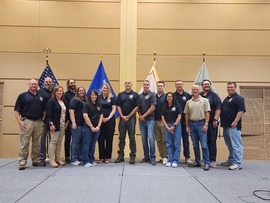 CIB Staff 2026 CIB Conference
|
|
In September we held our 24th CIB Conference in Green Bay, WI. I would like to thank all of you that were able to attend! We are already working on the 25th CIB conference to be held in September 2027, please share any feedback or suggestions you may have.
This issue of the TIME System newsletter has important information regarding the increase in Civil Bond amounts. TraCS will be updated with the new amounts in November.
As we start to wind down 2026 we would like to remind agencies of the upcoming annual purge of files in CIB and NCIC. Please see the article about what agencies need to do when you get the notification that purge information is ready.
This addition also has great information regarding TAC responsibilities, AI in a CJIS environment, Commitments / Warrant Categories, and which one you should select, and the newest DOT license plates for Heavy Fleet Vehicle.
CIB has our 2027 in-person training schedule posted on WILEnet and it is included in this newsletter. If you are finding that you cannot make those dates, please reach out to cibtrain@wisdoj.gov.
As TIME System users, CIB is always interested in your feedback and suggestions as to how we can improve our systems. Please feel free to reach out anytime!
|
|
|
The 2025 Wisconsin Act 179 requires an additional fee of $30.50 in associated civil violation costs, which applies to all civil bond amounts, with just a couple exceptions.
The change goes into effect November 1, 2026. Please note that the act does not change the following offense bond amounts:
- $10 Safety Belt Use
- $10 Failure to Carry Proof of Insurance
Until the software update occurs in Badger TraCS, officers can manually adjust their individual citation bond amount to include the additional fee of $30.50.
Agencies that use Traffic and Criminal Software (Badger TraCS) will have a software update made available that will adjust the civil bond amounts. What steps will your agency need to take?
- The release date for the software update will be made available on Sunday, November 1, 2026.
- The earliest TraCS unit can help with installs would be Monday, November 2, 2026.
- There are no special instructions to follow with this update.
- Your agency will need to request the update be released to your agency.
Any questions regarding the TraCS update may be routed to BadgerTraCS@dot.wi.gov.
|
|
|
Every agency accessing the TIME System is required to designate a TIME Agency Coordinator (TAC). The individual must be employed by the criminal justice agency. Any exceptions must be coordinated with and approved by the Crime Information Bureau (CIB). Does your agency have a TAC? Who is it? What are their responsibilities?
The TAC is the primary liaison (point of contact) with the CIB, regularly communicating via email, phone calls or by participating in virtual or in-person meetings. Often, this may be someone with authority at the agency (a chief for a small department, director of communications center, captains, lieutenants, etc.) However, in some cases an agency might delegate office personnel, law enforcement officers, dispatchers, etc. that they feel can handle the responsibilities of the role. The following are some (but not all) of the responsibilities a TAC may have:
- Provide feedback and recommendations for system improvement to CIB
- Ensure all physical, personnel, computer and communication safeguards and security are functioning properly and in compliance with applicable rules and regulations, including: the DOJ, CIB, National Crime Information Center (NCIC), International Justice and Public Safety Information Sharing Network (Nlets) and International Criminal Police Association (INTERPOL)
- Ensure the agency meets all applicable provisions of the Criminal Justice Information System (CJIS) Security Policy
- Update the Acadis roster in a timely manner
- Ensure employees are completing required training in the appropriate timeframes
- Complete CIB / NCIC audits
- Ensure monthly validations are completed on time
- Ensure appropriate agreements are signed and up-to-date (TIME Agency Agreement, inter-agency agreements, Management Control Agreement(s), etc.)
- Disseminate the CIB Newsletter
- After requesting a TIME System Username from CIB, the TAC is required to contact TSCC to obtain the temporary password. TACs should not be forwarding this email to users or having the end user call themselves. Note: TACs should ensure that users are logging into ealogin.justice.wisconsin.gov with the default password to set up their PIN and challenge question and then change their password. This is a necessary step for users to be able to successfully register for eTIME.
The above list is not all inclusive, and, as you can see, there are many responsibilities. Additional TACs are recommended to aid in communication with CIB, especially when a TAC is out for an extended period of time. Having an additional TAC on hand can make the transition much smoother when a TAC leaves the agency.
Although users are added to the roster through Acadis, and permissions can also be changed for those users through Acadis, CIB still needs to be informed if you are designating a new TAC or removing a TAC at your agency. Completion of the Acadis Webform “DJ_LE-326 Acadis Portal Administrative Rights” does not designate someone as a TAC. Only emailing cibtrain@wisdoj.gov a TAC assignment update makes it official.
|
|
|
Within the first week of January, CIB sends out notification letters to agencies that have records in the system that are being removed from both CIB and NCIC due to retention periods. A list of purged records is included with the letter. These are primarily property records, as most person records have indefinite retention periods; however, there are a few person file types that do expire. The purpose of this letter is to let agencies know that the records are being removed and allow them an opportunity to take action.
If an investigation is still being conducted regarding any of your records or your agency feels that there is law enforcement value, the record may be re-entered. Prior to re-entry, the data in the record or case file must be validated and the agency must confirm that the property is still stolen by contacting the complainant. Once re-entered, the property will be assigned a new System ID number and NIC number and the timeframe on the retention period starts over.
If the record is not re-entered, we recommend that a notation is made in the case file to reflect that the record was purged from the TIME System. If the entry was made by another agency on your behalf (e.g., dispatch), you must notify that agency of the records that have been purged or request that they re-enter the records so that their files are accurate.
As a reminder, retention periods for property are as follows:
- Stolen Vehicles entered with a VIN/OAN = 4 years plus the year of entry
- Stolen / Missing License Plates = 4 years plus the year of entry
- Stolen Boats with a Hull number / OAN = 4 years plus the year of entry
- Stolen Parts = 4 years plus the year of entry
- Stolen Articles = 1 year plus the year of entry (except for toxic chemicals, critical infrastructure items, and homeland security items that are indefinite)
- Stolen Securities = 4 years plus the year of entry (except for traveler’s checks and money orders, which are 2 years plus the year of entry)
- Recovered Guns = 2 years plus the year of entry
The purge will also affect license plate information in person entries (such as warrant, protection orders and missing person records). Keep in mind that this does not mean the actual wanted person or missing person record is being removed, but rather the license plate data that was included in that entry will be removed from the record after the license plate retention period is over.
In January 2027, your agency will likely see a lot of records that were entered either in 2022, 2024, or 2025 that are being purged. It will be up to your agency to determine if the record should be re-entered, either due to a current investigation involving that property or because there is investigative value in keeping the entry in the system.

|
|

Artificial intelligence (AI) is becoming increasingly prevalent in everyday life, and the use of AI has brought about many questions about its use in the multitudes of different computing scenarios. The question that is being asked within the technical realm for law enforcement and criminal justice agencies specifically is “can AI be used within CJIS environments?” As the FBI says many times when asked complex questions like this, “it depends.”
The CJIS Security Policy currently does not address in depth the use of AI within CJIS environments, however this is bound to change in the coming years as AI becomes much more prevalent within the systems architectures and products used. AI use in CJIS environments is governed by the CJIS Security Policy which prohibits the input of sensitive Criminal Justice Information (CJI) into consumer-level, public AI systems to prevent data leakage and the unauthorized use of data for AI model training. What does this mean for you as an officer on the street or agency admin personnel? Do not input any CJI obtained from the TIME System/NCIC into any AI application that the public can access (i.e., ChatGPT; Gemini; Claude; etc.).
Does this mean your agency cannot employ applications which do have AI agents or processes? No, it does not. Agencies can deploy applications with AI agents. However, agencies should do their due diligence to thoroughly investigate the use of such AI within the applications. Agencies should develop a moderate level of understanding on how their applications will leverage the AI within their product and how it will communicate or share any information with any other entity regardless of whether that entity is human or computer based.
Integration of AI into products and services for use within CJIS environments is already occurring. AI agents that are being deployed are required to be air-gapped or remain exclusively within the applications and shall not have the capabilities to extend outside of the specific application. The AI agents are also required to always have human oversight to ensure that no processes can perform unauthorized operations. There are no known artificial general intelligence (AGI) applications currently deployed within CJIS environments and all known AI that is deployed is narrow scope, but as AI advances closer to alignment, human oversight is key.
Should AI be used in CJIS environments? Much of the current AI in use is very narrow in scope and is still in its early stages. If your agency does decide to use AI within its CJIS environments, remember to keep in mind three main objectives:
- CJIS information (including CJI) should not be entered into publicly available AI applications.
- Applications or programs with AI agents/processes shall be air-gapped/isolated from the public internet.
- Human oversight of the AI agent/process is required.
If any agency has questions or concerns regarding AI use with CJIS environments, they may reach out to the TIME & Technical Unit in CIB via email at cibtrain@wisdoj.gov.
|
|
|
|
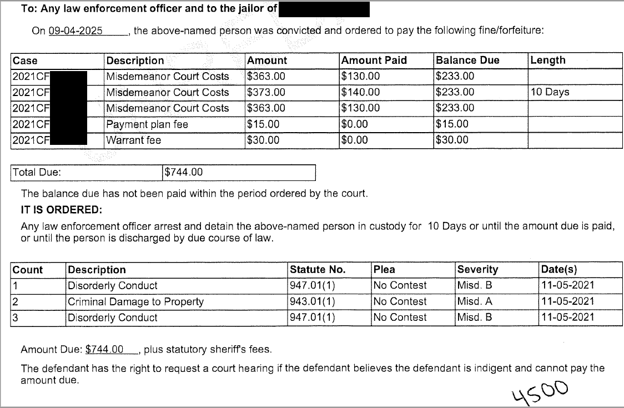
CIB training staff frequently receive questions from agencies about selecting the appropriate warrant category for the entry of commitment orders for non-payment of a fine or forfeiture. These non- payment commitments orders are to be entered using the same category as the offense for which the person was convicted. For example, a commitment stemming from a misdemeanor conviction would be entered as a misdemeanor in the TIME system.
Attached is an example of a commitment that should be entered as a “Non-Felony State Law Violation” warrant because the commitment stems from misdemeanor convictions for disorderly conduct and criminal damage to property.
|
|
|
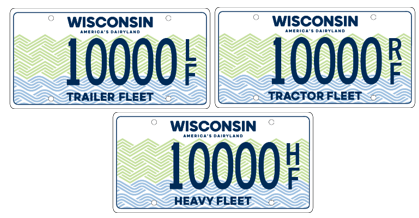
Three new plates are being issued by the Wisconsin DOT: Trailer Fleet (TLF), Tractor Fleet (TRF), and Heavy Fleet (HTF). Starting September 27, 2026, these three Heavy Fleet plates are a new option for fleet customers with heavy vehicles. DOT started issuing fleet plates in 2022 for eMV fleet customers with ten or more standard or light-truck vehicles. Like existing fleet plates, heavy fleet plates have a white background with green and blue details with blue numbers and letters. “Wisconsin” is printed at the top and “Trailer Fleet”, “Tractor Fleet”, or “Heavy Fleet” is printed at the bottom of the plates.
To query a fleet plate, use license plate type code “FL”. To enter a fleet plate as lost or stolen, use license plate type code “CO” (commercial).
|
|
|
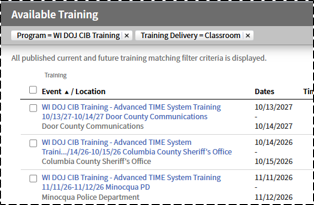
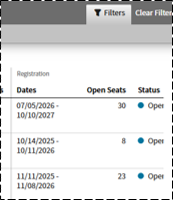
The 2027 In-Person Training Schedule for TIME System and related training has been created. TIME Agency Coordinators (TACs) will now see all 2027 In-Person TIME System classes when they look at the available training in Acadis – to just see the in-person classes, you can filter by “WI DOJ CIB Training” and “Classroom”. TACs can feel free to register themselves or others for those classes. As a reminder, if you scroll to the right, you can see the number of open seats available in each class. Registration will close two days before the class begins. We plan to post the training dates on WILENET in December. As always, please reach out to cibtrain@wisdoj.gov if you have any questions.
|
|
|
Habla Español? It has come to our attention that many agencies have limited access authorized users whose first language is not English. These users are required to read and sign the Security Awareness training, which may be difficult if English is not their first language. With Spanish being the most spoken language outside of English in Wisconsin, CIB made a Spanish version of the limited (physical) access Security Awareness training. This document is available on WILENET and can be printed out by the agency to distribute to necessary personnel. If you have any questions, please contact cibtrain@wisdoj.gov.
|
|
If you or someone you know would like to be added to the email distribution list to receive this newsletter, email . |
|
|
|
|