|
As your school revisits its cell phone policy, please make sure students still have access to SUSO (Speak Up, Speak Out) to report safety concerns.
If cell phone use is limited or restricted during the school day, consider providing an alternative way for students to reach SUSO. Many schools have found it helpful to bookmark the SUSO website on school-issued devices so students can easily and safely share concerns when they arise.
Thank you for helping ensure every student has access to speak up about safety concerns!
|
|
To ensure all statutory requirements are met, we recommend starting the submission process prior to the January 1, 2026, deadline. OSS is here to help. If you have questions regarding the submission process or any of the required documents, please contact Patrick Baldwin at patrick.baldwin@wisdoj.gov. For help accessing your SharePoint folders, please contact our Resource Center at schoolsafety@wisdoj.gov. |
|
|
The Wisconsin Coalition Against Sexual Assault (WCASA) and Children’s Wisconsin-Awareness to Action (A2A) are pleased to present a deep dive into two original resources for child sexual abuse prevention: the A2A Curriculum Review, and WCASA’s 10 Core Concepts for Child Sexual Abuse Prevention. This webinar will explore the content and background of these resources and provide guidance for implementing child sexual abuse prevention programming in the classroom and broader community. Join them for learning & discussion!
Learning Objectives:
1. Understand how social norms promote or undermine child safety
2. Recognize what qualifies as evidence-based programming
3. Discover how WCASA’s 10 Core Concepts for Child Sexual Abuse Prevention & A2A's Child Sexual Abuse Prevention Curriculum Review support selecting school-based child sexual abuse prevention curriculum
|
|
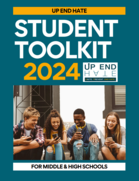
Empowering youth voice is essential in building a safe school culture. Upend Hate provides a free, downloadable toolkit for middle and high school students to learn about hate-based violence, take action to promote a safe and resilient school culture, and take a stance against hate in their school communities.
Learn more about Upend hate and download the resource at https://upendhate.org/join/#toolkit
|
|
|
|
There is still time to apply for the Office of Children's Mental Health (OCMH) mini-grant opportunity for Wisconsin high school programs/clubs to promote belonging and social connection in their schools. Mini-grants are $1,000 and can be used for activities and events that support youth belonging and social connectedness in the 2025-26 school year. Mini-grant recipients must implement their activities between award notification on November 24, 2025 and May 29, 2026.
See what prior grant recipients did with their mini-grants here. See our informational flyer for application rules, details, and important dates. Complete the application by November 17, 2025.
|
|
The Wisconsin Office of Children’s Mental Health (OCMH) produces a monthly newsletter that is packed with relevant and important information related to the well-being and mental health of Wisconsin’s youth. See their most recent newsletter here. If you’d like to stay current on children’s mental health in Wisconsin, sign up for their newsletter here. OCMH also has two other newsletters: Research News in Youth Mental Health spotlights recent articles and research impacting youth mental health, and the Wisconsin Lived Experience Newsletter shares resources and information related to lived experience sharing their voice. You can sign up for all at the same link.
|
|
|
The 2026 WSSCA Annual Conference is scheduled to take place March 5-6 at the Glacier Canyon Conference Center in Wisconsin Dells. Early bird registration is now open. See the conference flyer or visit the WSSCA website to learn more.
WSSCA is committed to providing affordable options to encourage members and potential members in furthering their knowledge and professional development. Applications for the WSSCA Annual Conference Scholarship Program will be accepted through December 1 and scholarships are awarded by December 15. For additional information on eligibility and scholarship details, see the WSSCA Annual Conference webpage.
|
|
|
Swatting calls and hoax threats have become a daily occurrence across the US, often targeting school campuses and faith communities. Swatting is the reporting of hoax threats to emergency services or schools of active shooter scenarios, bomb threats, or other acts of violence targeting specific locations. These swatting incidents can occur in clusters across the nation and can be AI-generated. Recently in Iowa, AI-generated bomb threats targeted school districts beginning with the letter A. Swatting hoaxes induce trauma and cause disruptions and confusion at the affected sites. Also, swatting diverts law enforcement resources from legitimate public safety functions.
Swatting hoaxes received by schools should initially be treated as credible. Schools should work with their law enforcement partners to determine the immediate safety response necessary to keep everyone safe. Using a multidisciplinary team approach, including the use of a school-based threat assessment team, can provide various perspectives, knowledge, and approaches when working to accurately understand the level of threat posed and the needed response.
Awareness of and responses to false threats have the potential to produce anxiety, stress, and trauma responses in staff and students. Consider debriefing with students in a structured, supportive setting to reaffirm their sense of physical and psychological safety. These discussions give opportunities to answer students’ questions, clear up misinformation, discuss how school leaders work to keep them safe, learn about what makes students feel protected and empower students to think about ways they can be involved in making safety decisions.
The following linked resources include guidance for schools affected by swatting or anonymous threats to help schools evaluate and respond to the posed threat.
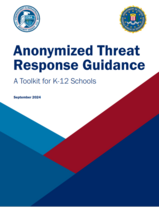
Anonymized Threat Response Guidance: A Toolkit for K-12 Schools: Cybersecurity and Infrastructure Security Agency (CISA) has put together a resource, to help schools and their law enforcement and community partners create tailored approaches to addressing anonymous threats of violence, including those received on social media.
Anonymized Threat Response Guidance: A Reference Guide for K-12 Schools: A CISA resource to accompany theschoolsafety@wisdoj.gov toolkit.
Talking to Children about Violence: Tips for Parents and Teachers. These resources from National Association of School Psychologists (NASP) guides caregivers (parents and school staff) as they reaffirm a sense of safety and wellbeing for youth.
Swatting Parent Letter Template. This resource is a template intended for use as you communicate with parents. Please feel free to edit the template to fit your school’s needs.
Swatting Emergency Management Procedures. This resource includes mitigation strategies and reporting procedures provided by the New Jersey State Police Cyber Crimes Unit, the Intelligence and Analysis Threat Unit at the Regional Operations Intelligence Center, the Office of Homeland Security and Preparedness, and the FBI.
We encourage you to report these threats to SUSO, so our staff can continue to monitor these threats and effectively support impacted schools and districts. In addition, OSS is here to support your response and recovery needs if you are impacted by a threat or other crisis event. Contact us at schoolsafety@wisdoj.gov or 1-800-MY-SUSO-1 (1-800-697-8761).
|
|
|
WSSCA Self-Assessment Training Workshop
This workshop is ideal for school staff and law enforcement representatives who are or will be involved in their school's or district's safety & security assessment process. Workshop participants will be provided with an assessment protocol instrument and report template. See flyer for more information.
This session will be presented by WSSCA's School Safety and Security Assessment Coordinator, Pat Finnemore.
November 19, 9:00 am – 4:00 PM, Oshkosh, WI
Click here to register.
|
Wisconsin Safe and Healthy Schools (WISH) Center Fall Training Opportunities
2025-2026 training dates are now available. Click here for the full list of upcoming events.
- November 11 & 12 and December 2 & 3, 2025 - Compassion Resilience: Training of Facilitators (TOF), Online - Zoom, 9:00am-12:00pm, Link to register
- November 14, 2025 - Youth Mental Health First Aid with CESA 6, Online, 9:00am-2:00pm, Link to register, Link to flyer
- December 10 & 11 - Building the Heart of Successful Schools, (Link to more information). Conference is Thursday Dec 11, pre-conference sessions Wednesday Dec 10 at Glacier Canyon Conference Center at the Wilderness Resort in Wisconsin Dells, WI.
- January 15, 2026 - Youth Mental Health First Aid with CESA 6, at CESA 6 in Oshkosh, 9:00am-2:00pm, Link to register, Link to flyer
- January 22, 2026 - Youth Mental Health First Aid, Online - Zoom, 8:30am-2:00pm, Link to register, Link to flyer
US Secret Service Offers Live Recurring Virtual Trainings on Targeted Violence Prevention
The U.S. Secret Service National Threat Assessment Center (NTAC) is offering live virtual presentations on preventing targeted violence. In these presentations, expert researchers will share findings and implications from decades of research on targeted violence and offer strategies for preventing acts of violence. This list of available virtual training events is regularly updated, and presentation topics change from month to month.
Click here to view upcoming events and register.
|
|
|
Please forward this email or share the link to subscribe with someone who would like to receive resources, training opportunities, and other updates from the Office of School Safety in a monthly newsletter.
Was this email forwarded to you?
If you received this newsletter from a friend or colleague and would like to receive it directly, use this link to subscribe today.
|
|
|
|
|




 1-800-MY-SUSO-1