Environmental Loans March 2026 Newsletter
The Wisconsin Department of Natural Resources (DNR)’s Environmental Loans programs provide affordable financial assistance to Wisconsin communities for water infrastructure projects that protect and improve public health and water quality for current and future generations.
Environmental Loans Is Now Using Docusign
The DNR’s Environmental Loans Section is using Docusign to execute financial assistance agreements as of Feb. 23, 2026.
Docusign eSignature is a web-based application that allows documents to be signed digitally by all parties and routed in a particular order. The State of Wisconsin has been using Docusign in other programs for a number of years and the process is proven effective and safe. There is no need for our customers to purchase or download anything. Docusign does not require signatories to have a Docusign account before signing.
Your DNR loan project manager will reach out to you to confirm the use of Docusign before your document is sent to you. Please confirm with your DNR loan project manager as to which email you would like your Docusign sent. If you are a signatory party to a particular document, you will receive an email from Docusign when your financial assistance agreement is ready. Your DNR loan project manager will also include a message with the email that includes your project number.
Please do not delete this email or send Docusign emails to your junk folders. If you have not seen an email from Docusign before your municipal meeting, check your spam folders and reach out to your DNR loan project manager.
To sign the document, you will click the link provided in the Docusign email and Docusign will take you to the pages that require your signature.
- Before signing, make sure to review the financial assistance agreement in full.
- We recommend waiting to sign until after your municipal meeting has been held.
Once completed, the document will automatically be routed to the next party for signature. Once all signatures have been completed, all parties will automatically receive a fully executed copy of the financial assistance agreement.
Resources
We hope that our customers find this to be an improvement in convenience and security. If you have any questions, concerns or would like to provide feedback, please contact your DNR loan project manager.
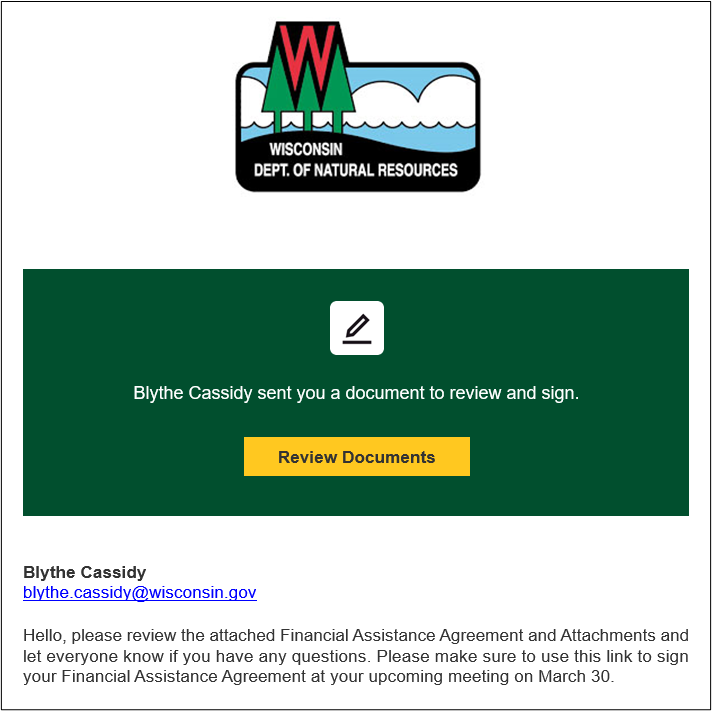 An example Docusign email from a DNR loan project manager.
Davis-Bacon Guidance Updated
The DNR Environmental Loans Section updated its Complying with Davis-Bacon Requirements (PUB-CF-074) guidance. The changes clarify the requirements and limitations of utilizing Wisconsin’s Youth Apprenticeship Program as it relates to the Clean Water Fund and Safe Drinking Water Loan programs.
Currently, the Wisconsin Youth Apprenticeship program is not a U.S. Department of Labor-approved apprenticeship program. Youths are only allowed to be paid less than the prevailing wage rates on projects covered by Davis-Bacon during the summer months when specific criteria are met. Davis-Bacon and Related Acts questions can be directed to the DNR construction management engineer serving your region.
DNR-Sponsored Free Online Training In Water Utility Management
The DNR is offering three free online training courses in water utility management comprised of four unique learning modules. The overarching theme of all four training modules is to aid governing bodies in developing and maintaining technical, managerial and financial capacity of a water utility. For more information and to register, visit Water Utility Management Training - Moraine Park Technical College.
Ten priority points will be granted to the state fiscal year 2027 Safe Drinking Water Loan Program applicants if at least 50% of the members of the water utility’s governing body have completed all four training modules prior to submitting a financial assistance application. Training must be completed and certified online by June 30, 2026, in conjunction with a Safe Drinking Water Loan Program application submittal.
The priority points must be requested through the priority evaluation and ranking formula (PERF) reevaluation request process if they were not initially requested in the notice of intent to apply/PERF that was submitted by the deadline of Oct. 31, 2025.
Direct priority/PERF point and application questions to Noah Balgooyen, Safe Drinking Water Loan Program coordinator, at Noah.Balgooyen@wisconsin.gov.
Related resources:
Upcoming Deadlines And Events
The deadlines for the notice of intent to apply submittal, financial assistance application submittal and loan closing are set in the corresponding program's annual intended use plan that is available on the DNR's Project Lists and Intended Use Plans webpage.
-
Late winter/spring 2026: The DNR intends to publish the state fiscal year 2027 Clean Water Fund Program project priority list.
-
Spring 2026: The DNR intends to publish the state fiscal year 2027 Safe Drinking Water Loan Program project priority list and the fiscal year 2027 Lead Service Line Replacement Program intent to apply list.
-
March 31: The last recommended date for submitting facilities plans to the DNR for review and approval for the state fiscal year 2027 Clean Water Fund Program funding cycle. Information on submitting these facilities plans is available on the DNR's Municipal Wastewater Facility Planning webpage and/or Storm Water Technical Standards, Models and Best Management Practices webpage.
-
April 2026: The DNR intends to publish the state fiscal year 2027 Safe Drinking Water Loan Program draft intended use plan for public comment. The DNR intends to host a webinar during the public comment period to discuss changes in the draft intended use plan and respond to questions from attendees.
-
April 30: The last recommended date for opening bids for the state fiscal year 2026 Clean Water Fund Program principal forgiveness projects and for all state fiscal year 2026 Safe Drinking Water Loan Program projects.
-
May 14: Requests for disbursements are due to the DNR at noon on Thursday, May 14, to be paid on the disbursement date of Wednesday, May 27 (schedule adjusted for Memorial Day).
-
May 31: It is strongly recommended that executed construction contracts be submitted to the DNR loan project manager for the state fiscal year 2026 Safe Drinking Water Loan Program projects by this date (earlier submittal is encouraged).
-
June 2026: The DNR intends to publish the state fiscal year 2027 Clean Water Fund Program draft intended use plan for public comment. The DNR intends to host a webinar during the public comment period to discuss changes in the draft intended use plan and respond to questions from attendees.
-
June 15: Public Service Commission-approved water rate case orders due to the DNR loan project manager for the state fiscal year 2026 Safe Drinking Water Loan Program projects.
-
June 30: Application deadline if competing for principal forgiveness for the state fiscal year 2027 Safe Drinking Water Loan Program funding cycle. The DNR recommends that all applicants (even those not competing for principal forgiveness) submit an application by the June 30 deadline due to potential limitations with loan capacity. Information on the application process is available on the DNR's Online Systems webpage.
-
June 30: Readiness-to-proceed deadline for the state fiscal year 2026 Clean Water Fund Program principal forgiveness projects. All required bid documentation, including executed construction contracts, is due for wastewater and stormwater projects. Failure to meet this deadline will result in principal forgiveness funds being forfeited.
Newsletter Sign Up
For timely delivery of future newsletters and bulletins, please send an email request with your contact information to Kay Christensen, DNR Environmental Loans Section outreach coordinator, at Kay.Christensen@wisconsin.gov. She will add you to the email list. If you want, she can also remove you from this list.
The DNR Environmental Loans Section tries to publish a newsletter every 1-2 months. Previous newsletters and bulletins are available on our News webpage.
Note: You can also sign up to receive updates from the Wisconsin DNR on diverse topics.
|