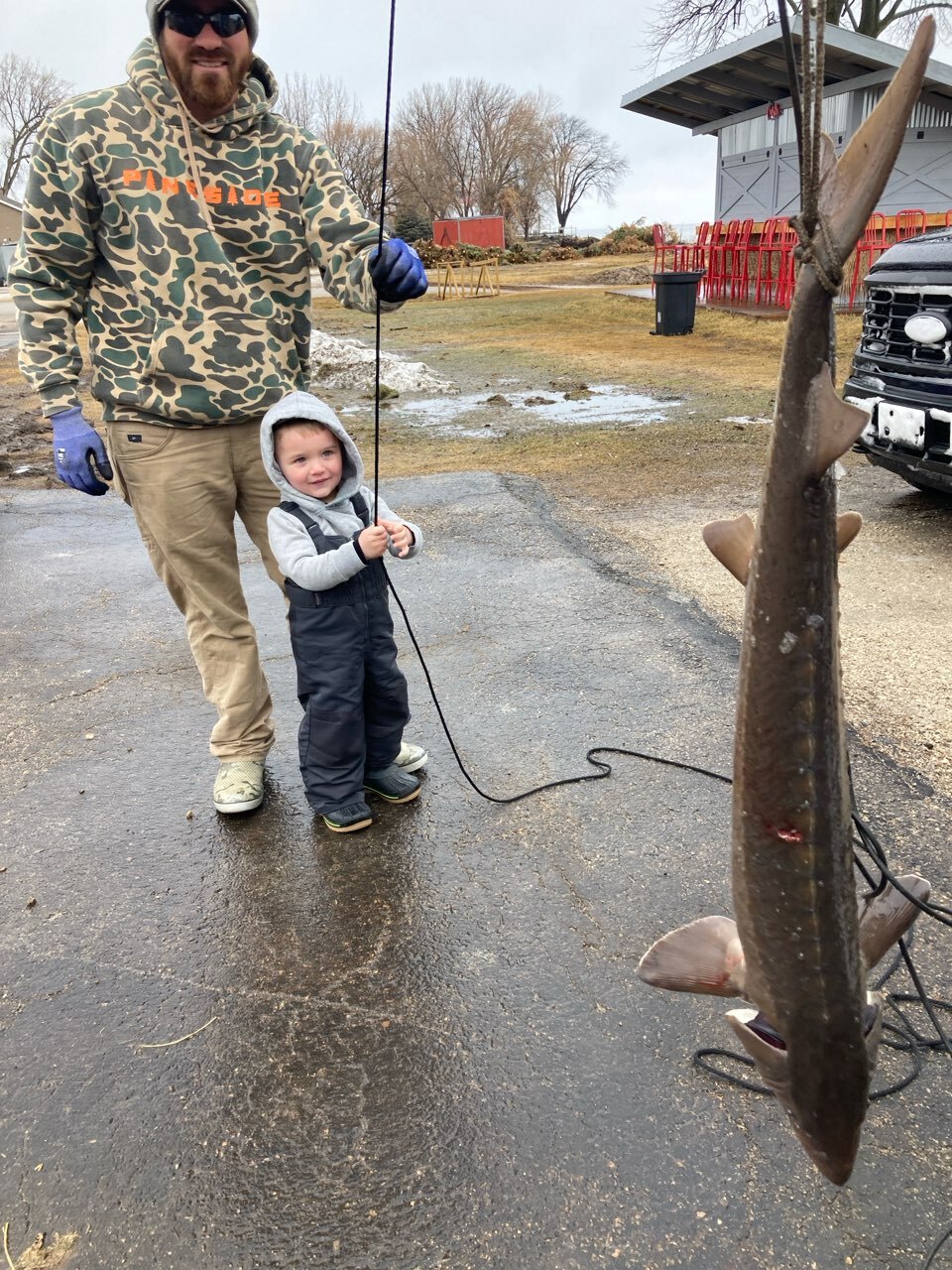
 What is better than spearing your first lake sturgeon? Sharing the experience with your son. Hopefully, we will see Cody and his son Holden again at a registration in the future.
Feb. 20, 2026 Harvest Update
If warm and rainy wasn't enough, today, spearers had to contend with wet and windy, which also isn't a great weather combination. Particularly after the warm days we have had. This is reflected in the daily harvest total of 19 lake sturgeon (4 juvenile females, 6 adult females and 9 males). This is the lowest harvest so far this season.
Lake sturgeon over 100 pounds continue to be relatively elusive this year, but two were harvested today. The largest, a 71-inch, 104.4-pound, F1 female, was speared by Lucas Muche. Just narrowly beating out Al Schumacher's 104.2-pound female. Congrats to both on the great fish!
With today's harvests, there have now been 1,435 lake sturgeon (196 juvenile females, 628 adult females and 630 males) harvested across the entire Winnebago System. We are not much closer to reaching the harvest cap than we were yesterday, so spearers will likely be able to spear for most of the weekend. Please continue to monitor the harvest numbers and emails for any season closure notices.
View the full Day 7 Harvest Report online.
While there are still likely a few more days of sturgeon spearing to go, there might be a few out there who haven't gotten their fill of lake sturgeon excitement for the year.
The good news is that lake sturgeon surveys conducted by the DNR around the state show stable or growing sturgeon populations in many waterbodies where lake sturgeon exist outside of the Winnebago System. Surveys have also shown populations expanding in waterbodies that previously had low or remnant lake sturgeon abundance.
Because of all this hard work by managers across the state, this year the DNR is happy to announce an increase in catch-and-release opportunities for lake sturgeon across Wisconsin. While these new opportunities do not include the Winnebago System, they do include some nearby waters.
This new catch-and-release season will start on June 6, 2026, and run through March 7, 2027, on 18 waterbodies throughout the state where lake sturgeon populations can support catch-and-release fishing. This information will be included in the 2026-2027 fishing regulations once they are published. No special license is needed beyond a general fishing license.
As mentioned, this opportunity does not include the Winnebago System. The Winnebago System currently has one of the most unique opportunities in the United States to harvest sturgeon. Because of this, the DNR will continue to prioritize the spearing season when evaluating whether or not to open up new opportunities in the fishery.
For now, it is good to know other opportunities are opening up close to Winnebago for anglers to also join in on some Wisconsin lake sturgeon fun.
To all the spearers planning to head out this weekend, please be safe and good luck.
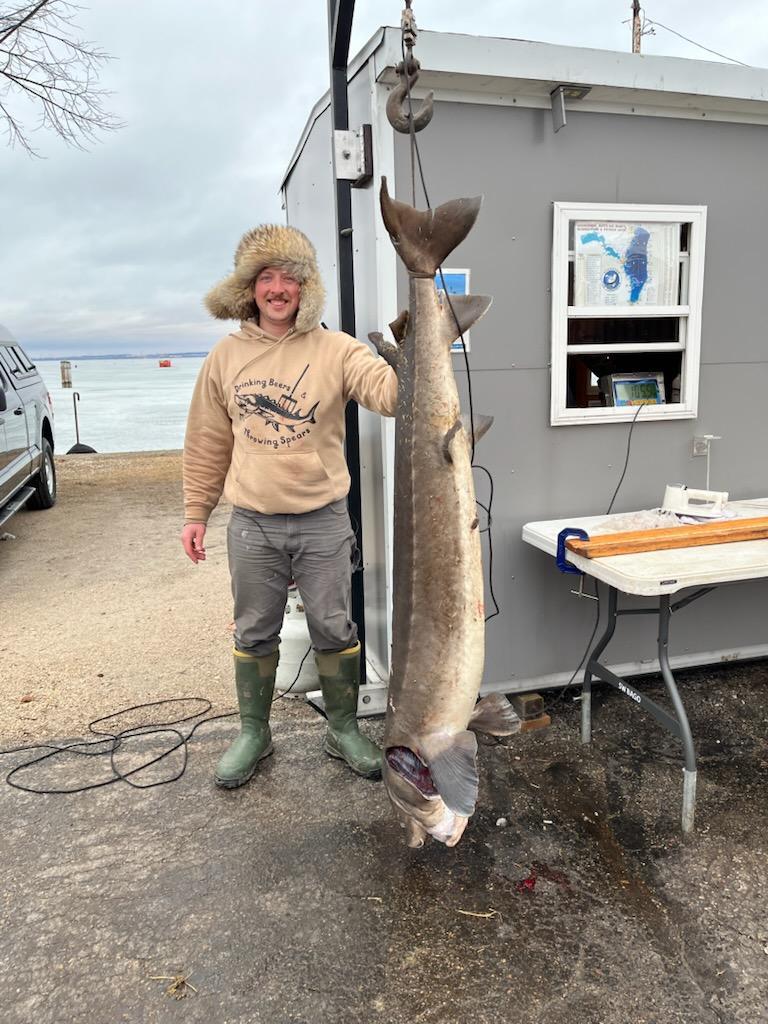 Lucas Muche was one of only two lucky spearers to harvest a fish over 100 pounds today with this 71-inch, 104.4-pound, F1 female.
Patterns That Protect, Part II: Spearing
As lake sturgeon make their spawning migrations across the Lake Winnebago System, individuals will move readily between spawning sites and tributaries. In many species and systems, such as walleye in the Great Lakes, fish are likely to return to the same spawning site each year. This trait, known as site fidelity, creates the potential for distinct spawning stocks within the larger system. However, lake sturgeon within the Winnebago System are known to move between spawning sites and tributaries. So, unlike distinct sites that create spawning stocks, within the Winnebago System, spawning stocks might be defined at the tributary level. If that is the case, that would mean that each river system within the Winnebago System has the potential to contribute differently (or disproportionately) to the spearing harvest.
Spawning stocks may experience varying levels of vulnerability to harvest for several reasons, including behavioral or environmental cues that influence how these fish disperse across the Winnebago System during the winter and spearing seasons. Understanding how these groups contribute to spearing harvest is important for preventing unintentional overharvest of one spawning group over another, which could harm the sturgeon population.
To determine if harvest rates are different amongst spawning groups of sturgeon, Sam Embersits, from the Wisconsin Cooperative Fishery Research Unit at UW-Stevens Point, has been categorizing the tagging and recapture histories of harvested lake sturgeon. If harvest is similar amongst spawning groups, the proportion of tagged fish harvested from each spawning group should align with the proportion of fish tagged within each spawning group. A mismatch in proportions could indicate that the harvest is overexploiting one spawning group relative to another.
To better explain what we mean, here is a hypothetical: if 5% of lake sturgeon were tagged in the Embarrass River over the years but 30% of all harvested sturgeon were from that same tributary, the Embarrass River is overcontributing to the harvest. This is a hypothetical example to show the logic and not reality. So when we run the actual numbers, we hoped to see that the proportions of fish tagged within a system mirror the proportion of fish harvested from that same system (following the hypothetical example above, we mean that we would hope to see 5% of lake sturgeon tagged in the Embarrass River and 5% of all harvested lake sturgeon were from the Embarrass River).
In general, lake sturgeon in the Winnebago System with multiple recaptures during spawning surveys showed little movement between spawning tributaries, which supports the idea that spawning groups (or stocks) exist at the tributary level. Unfortunately, there are a few fish that have been observed to utilize different tributaries to spawn from year to year. Thus, quantifying their contribution to each river system is not easy. So, for some fish, we had to consider them to belong to multiple tributaries/spawning groups. We did this by giving each of these fish a weight for each of the tributaries in which they were encountered. This weight was determined by the number of times the fish were encountered within that river system. For example, a lake sturgeon only ever captured in the Wolf River would have a weight of 1.0 for the Wolf River. But if a lake sturgeon was captured in multiple locations, they were weighted according to the proportion they were found in that tributary (see Table 1 for an example of fish 0A1309106B that was first captured in the Wolf River and only recaptured once in the Embarrass River, causing each tributary for this fish to be assigned a weight of 0.5). While not perfect at assigning tributaries, it allowed us to estimate more accurately how lake sturgeon utilized the different tributaries of the Wolf River System over the years.
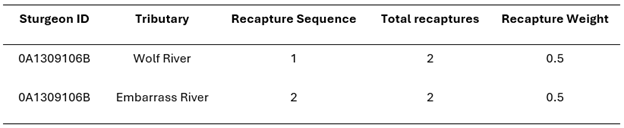 Table 1. To best capture the movement of individual fish, each recapture event was assigned one fraction of all recaptures for that individual.
Since 2000, 3,099 of the lake sturgeon harvested during the spearing season had been handled at least once by the DNR during a prior spawning season and received a tag. Most of the harvested fish were originally tagged in the Wolf River proper (86.5%), Embarrass River (5.8%), hatcheries (4.4%), or the Fox River (2.9%), while less than 0.15% of sturgeon were tagged in the Little Wolf, Montello, and Upper Fox rivers (Figure 1). Over 30% of these fish were recaptured at least once after tagging (n = 984), meaning that 2,246 fish could only be assigned to the tributary they were originally tagged. Analysis indeed showed that the proportion of fish tagged within each tributary mirrored the proportion of fish harvested. Of the harvested fish, 86.9% were from the Wolf River proper spawning group, 5.7% from the Embarrass River, and less than 0.15% from the Little Wolf and Upper Fox rivers (Figure 1). Harvest percentages for spawning groups from the Fox and Montello rivers included stocked fish tagged at hatcheries, released, and later recaptured in tributaries during spawning site surveys.
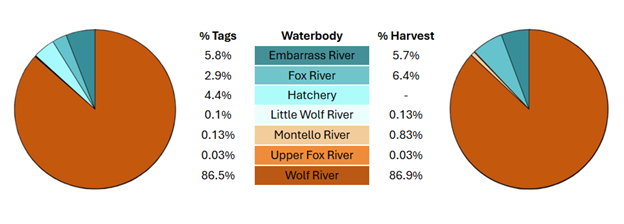 Figure 1. The proportion of fish tagged in each river (pie chart at left) verse the proportion of harvested fish and where they were originally tagged (pie chart at right).
These results suggest that contribution to harvest is equal across tributary spawning groups in the Winnebago System. This is a comforting result, as it indicates that the harvest management system is working as intended. We do not appear to be overharvesting particular spawning groups. Also, our monitoring and tagging efforts during the spawning season can still be used to give us a reliable picture of harvest in the system. When coupled with information collected on spawning site use, these results may help the DNR guide future selection of habitat reconstruction projects to either increase natural recruitment within the system or provide more spawning options on tributaries where spawning or larval habitat may be lacking.
No Ice Is 100% Safe
Before heading out on a frozen waterbody, it's crucial to prepare and plan. Here are a few safety tips to remember:
- Have a plan in case you do go through the ice.
- Roll your window down when traveling on the ice and make sure you can easily open your door – drive slow and turn the radio down so that you can use your eyes and ears to watch and listen for potential hazards.
- Recovery for a UTV or another vehicle is the responsibility of the owner/operator. After 30 days, the owner can be fined each day after 30 days.
- Never consume alcohol or drugs before or during your ride.
- Carry a cell phone, and let people know where you are going and when you’ll return home.
- Watch for pressure ridges or ice buckling. These can be dangerous due to thin ice and open water.
Remember, the DNR does not monitor ice conditions. Local fishing clubs, outfitters and bait shops are the best sources for local current ice conditions.
Check out the DNR's Ice Safety webpage for more information on staying safe on the ice, including tips for creating ice claws and what to do if you fall through ice.
Additional information on the Winnebago system sturgeon spearing season can be found on the DNR website.
|