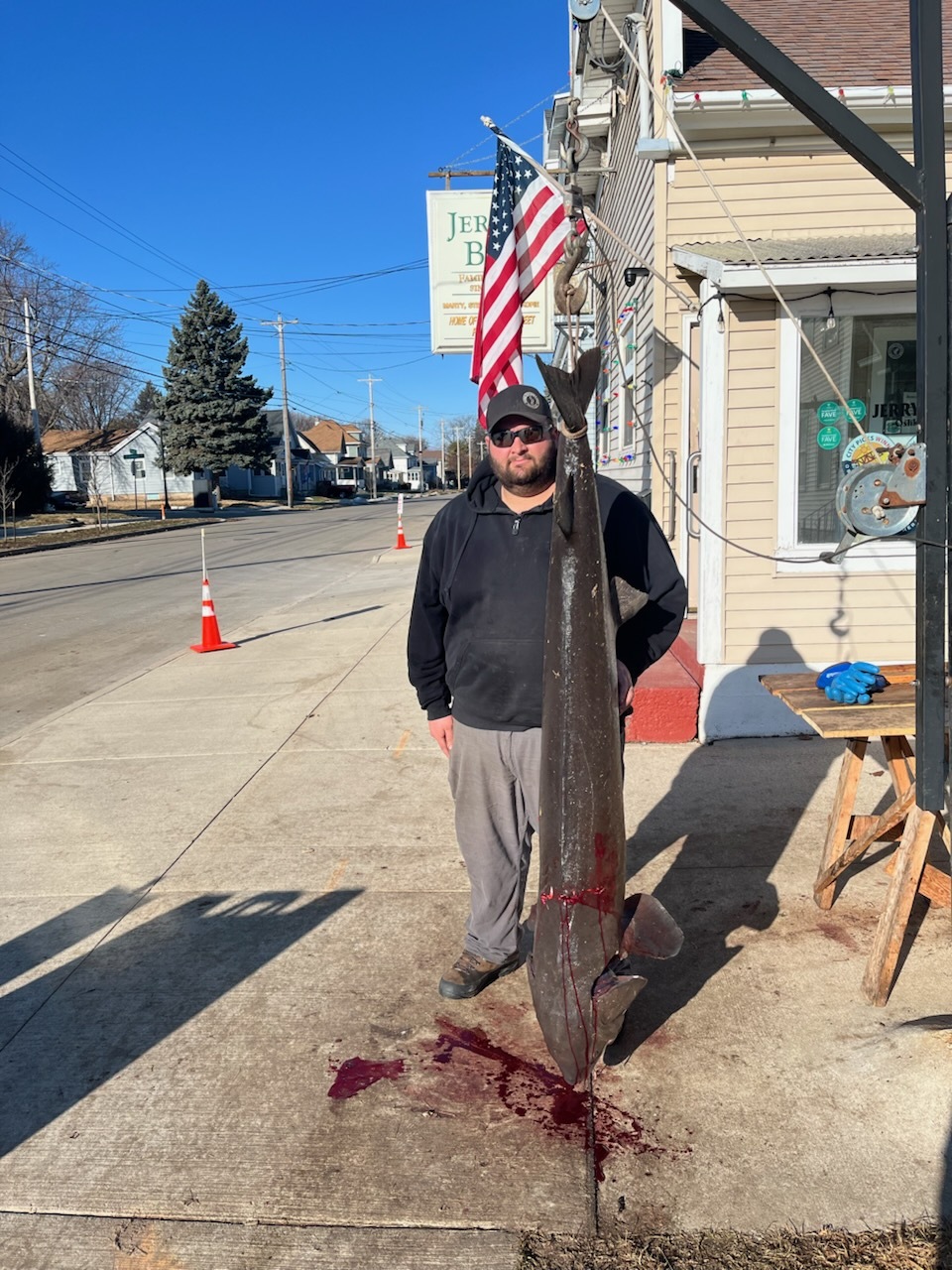
 Even on a slow day, spearers were still having some luck early in the morning. Maxwell Naparalla registered the first fish of the day in downtown Oshkosh around 9 a.m. this morning.
Feb. 19, 2026 Harvest Update
Warm weather was once again the story of today, but as always, the dedicated spearers of the Winnebago System found a way with a total of 30 lake sturgeon harvested today (2 juvenile females, 12 adult females and 16 males).
There was only one fish harvested over 100 pounds today and that was on the east side of the lake at Quinney. Jordan Schmitz harvested a nice 102.6-pound, 68.6-inch female – and it was his first ever lake sturgeon. Not a bad way to start!
The current totals for the entire Winnebago system are 193 juvenile females, 622 adult females and 620 males for a total of 1,435 lake sturgeon.
We continue to inch closer to the 90% trigger for the adult female harvest cap with 85% of the adult female harvest cap for the entire Winnebago system total harvested after today.
We expect harvest to pick up over the weekend with more spearers taking back to the ice. Spearers, please monitor the numbers and your email for any season closures.
View the full Day 6 Harvest Report online.
This is great time to remind spearers that there are technically three different seasons that the DNR monitors throughout the spearing season. Most people just think of the Upriver Lakes and Lake Winnebago, but these two seasons each have a portion of the harvest cap, which is why we also monitor the entire Winnebago system harvest caps as well.
As you look at the harvest table, there are three sections: Winnebago, Upriver Lakes, and Winnebago + Upriver Lakes. You'll notice that there are fewer fish remaining in the adult female harvest cap in the Winnebago + Upriver Lakes section.
Each individual level of protection ensures the annual harvest does not exceed safe levels, which keeps our sturgeon population healthy and thriving.
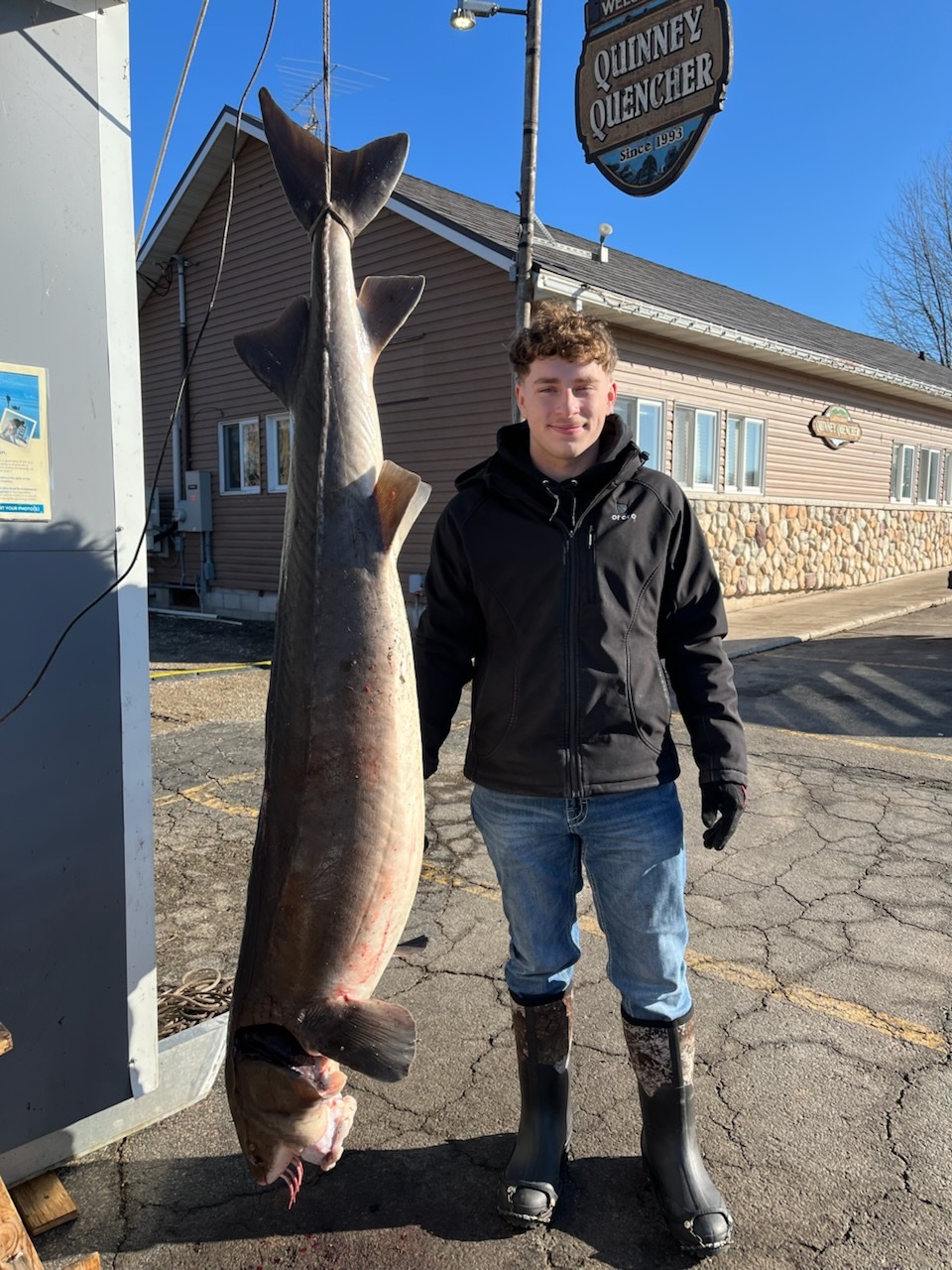 Jordan Schmitz came away with the largest lake sturgeon harvested today with a nice 102.6-pound, 68.6-inch lake sturgeon.
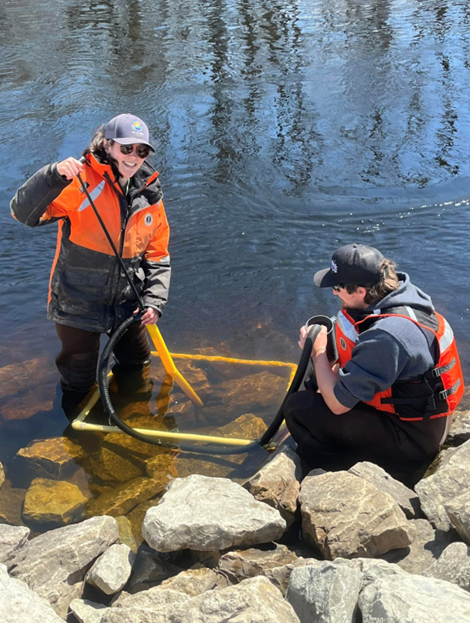
If you made it out to see the sturgeon spawn in the last couple of years, you may have seen Sam and her crew counting fish or collecting eggs!
Patterns That Protect, Part I: Spawning
As spring begins, warming temperatures and vibrant colors return to the landscape, setting the scene for the season’s main event in the Winnebago System. Lake sturgeon will soon make their way through the Fox and Wolf River drainages to spawn at over 70 possible sites. These fish can move quickly and capture the public eye as they gather by the hundreds along the riverbank at sites such as Bamboo Bend in Shiocton, Sturgeon Trail in New London, and Sturgeon Park in Shawano. The proximity of these fish provides an opportunity for the Wisconsin Department of Natural Resources (DNR) to tag adult lake sturgeon as part of the mark-recapture population estimate used to set harvest caps for the spear fishery.
To maximize tagging efforts, the DNR often prioritizes spawning sites that host large groups of lake sturgeon. However, this prioritization limits the information on lake sturgeon throughout the remainder of the system not regularly sampled. With this in mind, the DNR worked with UW-Stevens Point to develop a research project examining the timing and extent of spawning-site use by lake sturgeon throughout the Wolf River drainage. Information from this study will be used to align DNR sampling schedules with patterns in spawning site use to help maximize lake sturgeon tagging numbers while ensuring a good distribution of tags at spawning sites throughout the system. This study will also inform the DNR about the success of reconstructed habitat sites, helping make decisions about future site selections.
To implement this research project, the DNR has been funding a graduate research project through the Wisconsin Cooperative Fishery Research Unit at UW-Stevens Point. Graduate student Sam Embersits has spent the last two years tracking lake sturgeon spawning site use across natural and reconstructed sites in the Wolf River Drainage. Sam tracked lake sturgeon spawning at 15 private and publicly owned sites across the Wolf River system. This included the larger sites regularly sampled, as well as smaller sites not often frequented by the DNR due to time constraints. To analyze spawning site use and success, she counted spawning fish, collected eggs and sorted them based on quality (live or dead), and collected larvae.
Sam found that there were no specific patterns in the timing of site use during peak spawning temperatures during this study period. She also found that the proportion of live eggs to total eggs (percent live) varied across spawning sites, but with no correlation to the number of sturgeon using the site, nor to total egg abundance at the site. From these results, we can say that if spawning site patterns are occurring, we may need to look across more years to see whether these patterns occur under specific environmental conditions or differ under different environmental conditions. In addition, we can say that during these study years, the habitat locations examined seem to be able to adequately support the number of sturgeon using them to spawn. Sam also identified at least one site not routinely sampled by the DNR was found to have high use by lake sturgeon. This site is a good candidate for the DNR to try and sample regularly as well as maintain the habitat in the future.
Sam’s research also included finding unique ways to help gather information during the short spawning duration. To continue support for the DNR beyond her research project, Sam trained a small group of volunteers, with the help of Sturgeon Guard, to track spawning-site use in the coming years. This group will help maximize the impact of the DNR's spring sampling efforts by providing data on spawning activity throughout the system. This will provide the DNR crews with real-time information on where there are spawning lake sturgeon and reduce the amount of time crews will have to spend looking for spawning activity. This will also provide additional information on spawning-site use by lake sturgeon when sampling crews are unable to respond while sturgeon are present. Both will help the DNR sample more efficiently and create a more complete record of lake sturgeon use throughout the entire Wolf River drainage.
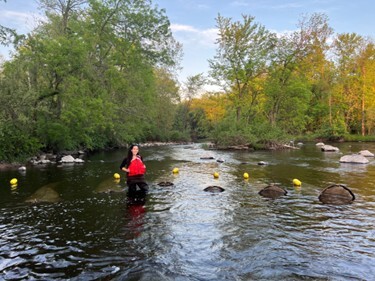 |
Sunset larval sampling with d-frame drift nets below Pella Dam, Pella.
No Ice Is 100% Safe
Before heading out on a frozen waterbody, it's crucial to prepare and plan. Here are a few safety tips to remember:
- Have a plan in case you do go through the ice.
- Roll your window down when traveling on the ice and make sure you can easily open your door – drive slow and turn the radio down so that you can use your eyes and ears to watch and listen for potential hazards.
- Recovery for a UTV or another vehicle is the responsibility of the owner/operator. After 30 days, the owner can be fined each day after 30 days.
- Never consume alcohol or drugs before or during your ride.
- Carry a cell phone, and let people know where you are going and when you’ll return home.
- Watch for pressure ridges or ice buckling. These can be dangerous due to thin ice and open water.
Remember, the DNR does not monitor ice conditions. Local fishing clubs, outfitters and bait shops are the best sources for local current ice conditions.
Check out the DNR's Ice Safety webpage for more information on staying safe on the ice, including tips for creating ice claws and what to do if you fall through ice.
Additional information on the Winnebago system sturgeon spearing season can be found on the DNR website.
|