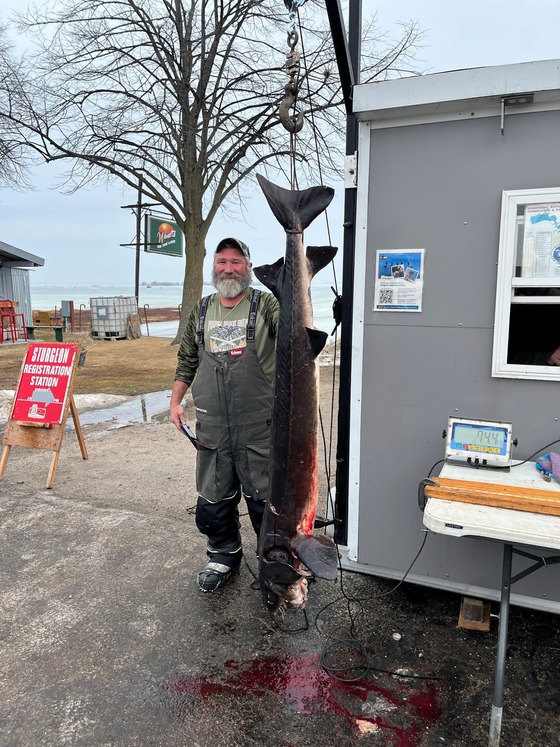
 Shawn Wendt filled his tag today with a 74.2-pound, 67-inch, M1 male. He registered his lake sturgeon at the Southwest Winnebago registration station before heading back out to help others remove their sturgeon shacks. Congratulations, Shawn.
Feb. 17, 2026 Harvest Update
On Lake Winnebago, another 111 lake sturgeon were harvested (26 juvenile females, 43 adult females and 42 males). The northeast stations are still registering the most with 16 at North Winnebago, 23 at Stockbridge and 26 at Quinney.
The Upriver season is CLOSED.
The current totals for entire Winnebago System are 187 juvenile females, 597 adult females and 587 males for a total of 1,371 lake sturgeon.
There were 43 adult females harvested today, meaning there are only 62 adult female lake sturgeon needed to hit the 90% trigger for the entire Winnebago System. However, we expect effort to drop off considerably due to the forecasted rainfall this evening. Please check with your local fishing clubs for updates on ice conditions and bridge closures. While effort is expected to drop, we ask spearers to continue to monitor the numbers and any season closures.
View the full Day 4 Harvest Report online.
Another four fish over 100 pounds were harvested on Lake Winnebago. The largest was a 135.3-pound, 78.5-inch, F4 female speared by Zachary Boehnlein and registered at the Downtown Oshkosh registration station.
As many spearers decide whether to remove their shacks due to the weather, others are removing their shacks following success. One success story comes from Shawn Wendt, who speared his sturgeon with a harpoon rather than a sturgeon spear.
Sturgeons Of The World
The first sturgeons appeared at least 200 million years ago at the dawn of the Jurassic period. Dinosaurs dominated the landscape while sturgeon occupied massive rivers and deltas of the supercontinent Pangea, which included what we now know as Europe, Asia and North America. The sturgeons of the world today remain limited to the Northern Hemisphere just as their ancestors were back in the Jurassic. However, modern sturgeons are more widely distributed across continents and waterbodies. They are not confined to rivers; they also occur in lakes, estuaries and oceans. If you live in Wisconsin, the sturgeon you are probably most familiar with is the lake sturgeon. They are locally regarded as large, long-lived, bottom feeders that spawn in the rivers in spring and inhabit lakes the rest of the year. So, how does this fish compare to other sturgeon species of the world? There are 25 sturgeon species alive today, with some studies recognizing 27. Here, we highlight some of these species, with an emphasis on their diversity, behaviors and distribution.
Behemoths In The Black Sea
If you’ve ever seen the outstretched mouth of a lake sturgeon, it’s easy to understand why they are bottom feeders. Most sturgeon have similar mouths located under the snout and oriented downwards (subterminal). This is ideal for vacuuming up bottom-dwelling invertebrates like larval insects, polychaete worms, crustaceans and more. Like most things in life however, there are exceptions. In the seas and rivers of Eastern Europe and Western Asia lives a big exception…a very big one.
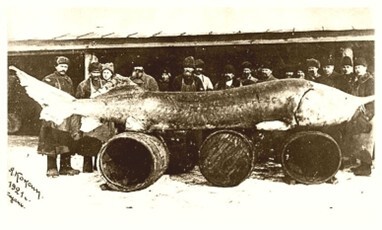
The beluga sturgeon is the largest freshwater fish on the planet, reaching lengths over 20 feet and weighing over 2000 pounds. Beluga sturgeon are wildly distributed across the Black, Azov and Caspian sea basins. This region has the highest diversity of endangered sturgeon species in the world due to overfishing, dam construction and habitat loss. As a result, beluga sturgeon rarely grow to the colossal size they once did over a century ago. However, they are unique in ways other than their immense size.
Figure 1: A belga sturgeon weighing 2,116.4 pounds caught in the Volga River in 1921. / Photo Credit: National Museum of the Republic of Tatarstan.
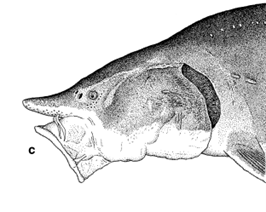
Figure 2: Illustration of beluga sturgeon showing forward facing mouth. / Illustration Credit: Vecsei et al 2002.
Adult beluga sturgeon are one of only two sturgeon with a forward facing mouth. This is because adult beluga sturgeon are pelagic predators, not bottom feeders. While they occasionally feed on mollusks and other benthic prey, most of their time is spent hunting large fish, aquatic birds and even young seals far above the seafloor.
Their mouth is adapted to feeding in the upper water column of the sea and for swallowing large prey whole. This feeding strategy is particularly important for beluga sturgeon in the Black Sea, which is permanently stratified between a freshwater upper layer and a salty bottom layer. In fact, the bottom of the Black Sea is so salty that most of it has no oxygen available for life, making bottom feeding almost impossible. Therefore, other bottom feeding species like Russian and stellate sturgeons are mostly limited to oxygen-rich coastal habitats that can support benthic prey. Because the beluga sturgeon feeds primarily on fish, bottom substrates do not influence their home range, allowing them to capitalize on prey throughout the sea.
Figure 2: Illustration of beluga sturgeon showing forward facing mouth. / Illustration Credit: Vecsei et al 2002.
No Ice Is 100% Safe
Before heading out on a frozen waterbody, it's crucial to prepare and plan. Here are a few safety tips to remember:
- Have a plan in case you do go through the ice.
- Roll your window down when traveling on the ice and make sure you can easily open your door – drive slow and turn the radio down so that you can use your eyes and ears to watch and listen for potential hazards.
- Recovery for a UTV or another vehicle is the responsibility of the owner/operator. After 30 days, the owner can be fined each day after 30 days.
- Never consume alcohol or drugs before or during your ride.
- Carry a cell phone, and let people know where you are going and when you’ll return home.
- Watch for pressure ridges or ice buckling. These can be dangerous due to thin ice and open water.
Remember, the DNR does not monitor ice conditions. Local fishing clubs, outfitters and bait shops are the best sources for local current ice conditions.
Check out the DNR's Ice Safety webpage for more information on staying safe on the ice, including tips for creating ice claws and what to do if you fall through ice.
Additional information on the Winnebago system sturgeon spearing season can be found on the DNR website.
|