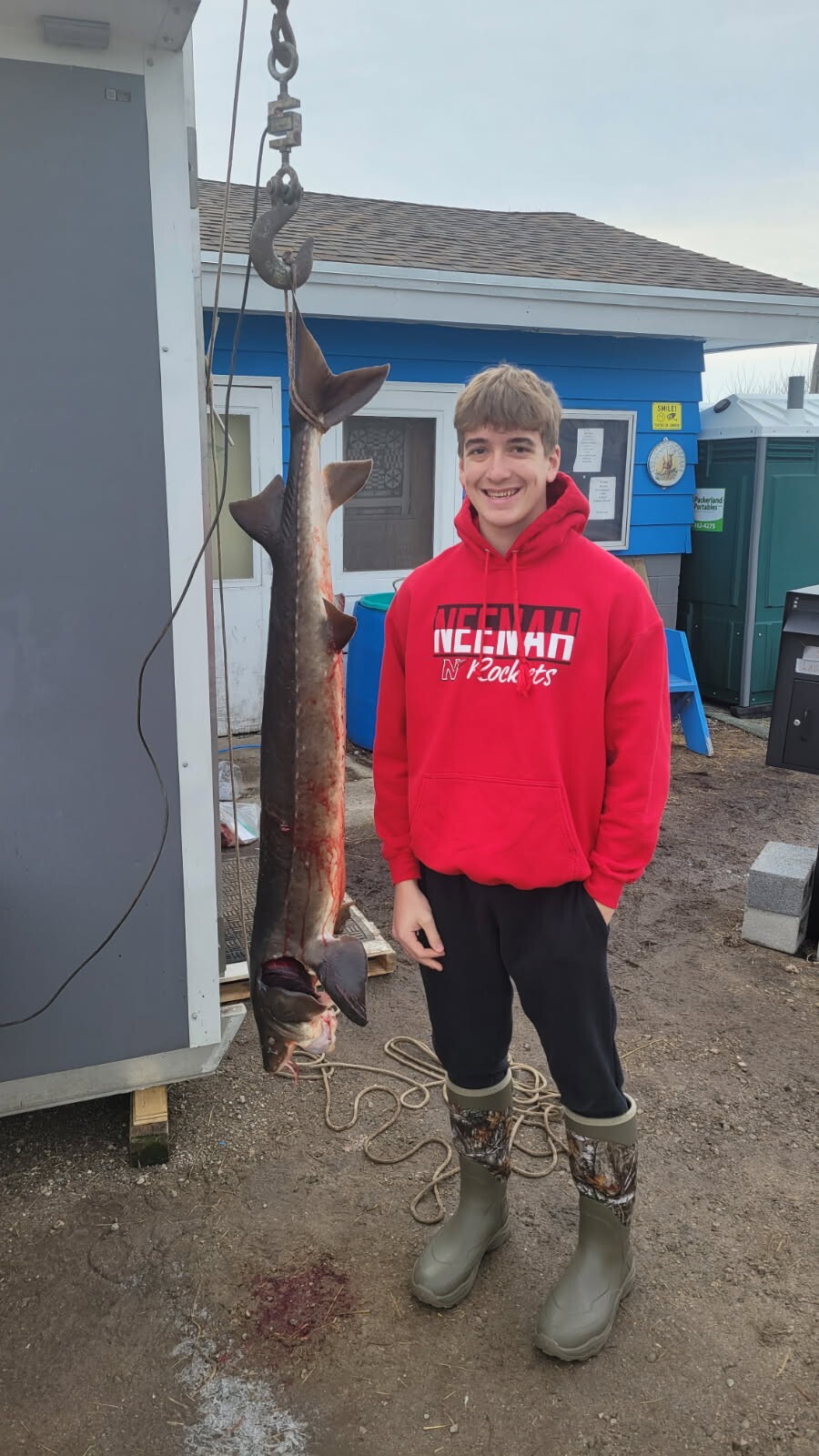
 Kole Gilman was able to fill his Upriver tag on the very last day of the season after his grandfather transferred the Upriver tag to him. We hope that this brought both of them a smile.
Feb. 16, 2026 Harvest Update
Today was the last day for spearers who had an Upriver Lakes tag. Now the Upriver season is closed.
It was a three-day season this year. The last time we had a three-day season or shorter was in 2014, when the season was also three days. There were a total of 279 lake sturgeon speared on the Upriver lakes this year (39 juvenile females, 76 adult females and 164 males).
With the end of the season Upriver, likely 50% of the 500 spearers that drew an Upriver tag successfully speared a sturgeon this year.
On Lake Winnebago, another 202 lake sturgeon were harvested (26 juvenile females, 107 adult females and 69 males). The northeast stations are still registering the most with 31 at North Winnebago, 73 at Stockbridge and 31 at Quinney.
The current totals for entire Winnebago system are 161 juvenile females, 554 adult females and 545 males for a total of 1,260 lake sturgeon.
Please note that 105 adult female lake sturgeon remain until we hit the 90% trigger for the entire Winnebago system. While we expect effort to drop off a little, there were 107 adult females harvested today. Spearers, please monitor the numbers and any season closures.
View the full details in today’s harvest report.
Another 10 fish over 100 pounds were harvested throughout the system. The largest was a 130.1-pound, 76.0-inch, F4 female speared by Cole Woelfel and registered at the Downtown Oshkosh registration station.
Many people ended up taking a day off to finish up the Upriver season and enjoy the Lake Winnebago season while there is still good clarity. This includes Kole Gilman, whose grandfather was selected for an Upriver tag this year but was unable to use it, allowing Kole his chance to fill the tag on the very last day of the Upriver Season. We hope that there is great story you can share with your grandfather!
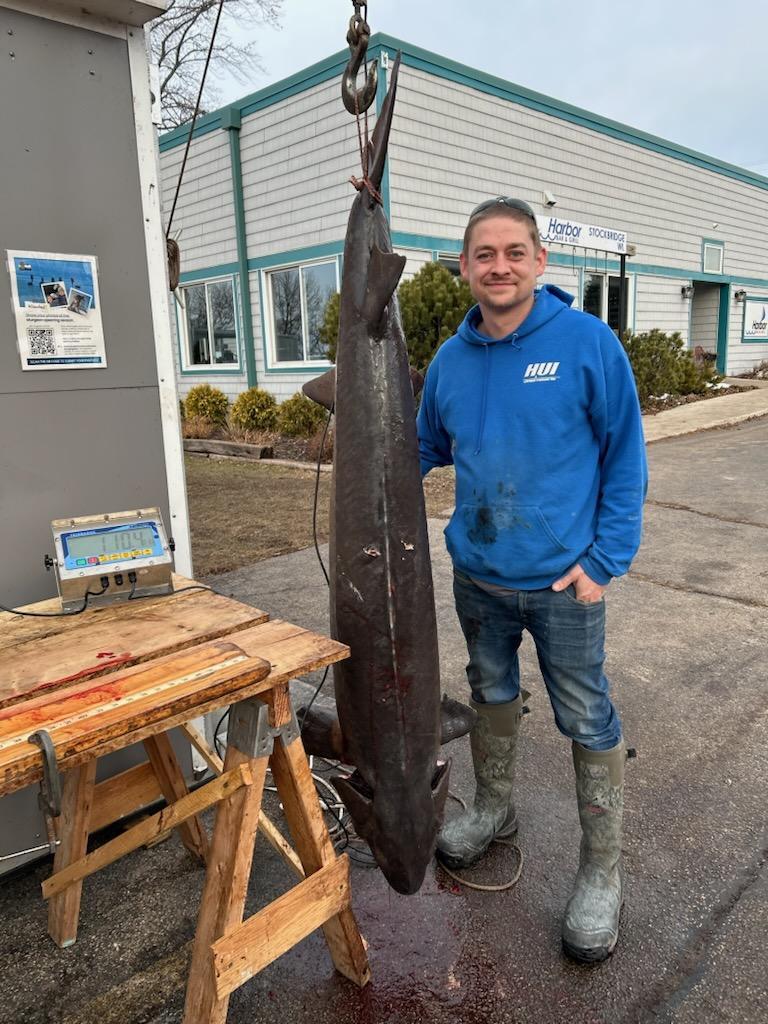 Stockbridge continues to register the most fish, including this nice 110.3-pound, 69.9-inch lake sturgeon speared by Jaguer Schisel.
Sturgeons Of The World
The first sturgeons appeared at least 200 million years ago at the dawn of the Jurassic period. Dinosaurs dominated the landscape while sturgeon occupied massive rivers and deltas of the supercontinent Pangea, which included what we now know as Europe, Asia and North America. The sturgeons of the world today remain limited to the Northern Hemisphere just as their ancestors were back in the Jurassic. However, modern sturgeons are more widely distributed across continents and waterbodies. They are not confined to rivers; they also occur in lakes, estuaries and oceans. If you live in Wisconsin, the sturgeon you are probably most familiar with is the lake sturgeon. They are locally regarded as large, long-lived, bottom feeders that spawn in the rivers in spring and inhabit lakes the rest of the year. So, how does this fish compare to other sturgeon species of the world? There are 25 sturgeon species alive today, with some studies recognizing 27. Here, we highlight some of these species, with an emphasis on their diversity, behaviors and distribution.
Armor In The Atlantic
All sturgeon spawn in freshwater. This is in part because their larvae cannot tolerate saltwater. However, most sturgeon species behave like salmon: they are born in freshwater, migrate to saltwater to feed and mature, then return to freshwater to spawn. This lifecycle is called anadromy. It allows fish to grow in areas with the most prey (saltwater) and produce young in areas with fewer predators (freshwater). On the East Coast of the United States, two sturgeon species show slightly different variations of this.
The Atlantic sturgeon is found in rivers, estuaries and marine waters of the Atlantic Ocean, from Canada to Florida. They are best described as living submarines, reaching lengths of nine to 14 feet and weighing up to 800 pounds. They are heavily armored, with some of the largest scutes of any sturgeon, which cover most of their bodies. By age two (~11.5-18 inches), juveniles may leave their natal rivers and estuarine nurseries to migrate far offshore. Others remain in estuaries until around age six before heading offshore or into other coastal rivers or estuaries. As they mature, they remain at sea for more extended periods with occasional trips back to the estuaries in the summer. By adulthood, Atlantic sturgeon are built for a life at sea where they feed mostly on bryozoans, polychaete worms, crustaceans and other small invertebrates. They will only return to rivers to spawn.
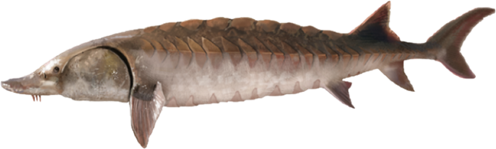 Figure 1: Atlantic Sturgeon (photo by NOAA Fisheries)
The shortnose sturgeon shares the same home range as the Atlantic sturgeon but prefers lower salinity waters found in tidal estuaries and rivers. Reaching lengths of only 3.5 to 4.5 feet and a max weight of up to 50 pounds, they are much smaller than Atlantic sturgeon. Shortnose sturgeon migrate up and down the coast between estuaries in search of food. In the southern part of their range, they typically return to rivers only to spawn.6 In the northern part of their range, however, shortnose sturgeon will also enter rivers to overwinter. This is a classic example of how variable sturgeon behavior can be across populations.
While both species are typically anadromous, they have different strategies for feeding, growing and avoiding predators in saltwater. The Atlantic sturgeon’s thick armor provides protection against predators such as sharks. With few predators to worry about, they can roam the ocean where food is most abundant and grow to larger sizes than their coastal cousins. Meanwhile, the shortnose sturgeon is also highly migratory but spends more time in the brackish waters of estuaries. This enables them to follow shifts in prey distribution along the coast, while avoiding the larger predators of the ocean. To be anadromous is to maximize reward while minimizing risk.
[1] Prangate, Raluca, et al. "An overview of the methods used for genetic analysis of sturgeon populations." International Journal of Conservation Science 16.1 (2025): 283-292.
[2] W.E. Bemis, B. Kynard, ‘Sturgeon rivers: an introduction to acipenseriform biogeography and life history’, Environmental Biology of Fishes, 48(1), 1997, pp. 167–183.
[3] Peng, Zuogang, et al. "Age and biogeography of major clades in sturgeons and paddlefishes (Pisces: Acipenseriformes)." Molecular phylogenetics and evolution 42.3 (2007): 854-862.
[4] Nelson, Troy C., et al. "Research tools to investigate movements, migrations, and life history of sturgeons (Acipenseridae), with an emphasis on marine-oriented populations." PloS one 8.8 (2013): e71552.
[5] Brownstein, Chase D., and Thomas J. Near. "Toward a Phylogenetic Taxonomy of Sturgeons (Acipenseriformes: Acipenseridae)." Bulletin of the Peabody Museum of Natural History 66.1 (2025): 3-23.
[6] Fernandes, Stephen J., et al. "Seasonal distribution and movements of shortnose sturgeon and Atlantic sturgeon in the Penobscot River estuary, Maine." Transactions of the American Fisheries Society 139.5 (2010): 1436-1449.
[7] Dadswell, Michael J. "A review of the status of Atlantic sturgeon in Canada, with comparisons to populations in the United States and Europe." Fisheries 31.5 (2006): 218-229.
[8] Vecsei, P., and D. Peterson. "Sturgeon ecomorphology: a descriptive approach." Sturgeons and paddlefish of North America. Dordrecht: Springer Netherlands, 2004. 103-133.
[9] Fox, Adam G., and Douglas L. Peterson. "Movement and out‐migration of juvenile Atlantic Sturgeon in Georgia, USA." Transactions of the American Fisheries Society 148.5 (2019): 952-962.
No Ice Is 100% Safe
Before heading out on a frozen waterbody, it's crucial to prepare and plan. Here are a few safety tips to remember:
- Have a plan in case you do go through the ice.
- Roll your window down when traveling on the ice and make sure you can easily open your door – drive slow and turn the radio down so that you can use your eyes and ears to watch and listen for potential hazards.
- Recovery for a UTV or another vehicle is the responsibility of the owner/operator. After 30 days, the owner can be fined each day after 30 days.
- Never consume alcohol or drugs before or during your ride.
- Carry a cell phone, and let people know where you are going and when you’ll return home.
- Watch for pressure ridges or ice buckling. These can be dangerous due to thin ice and open water.
Remember, the DNR does not monitor ice conditions. Local fishing clubs, outfitters and bait shops are the best sources for local current ice conditions.
Check out the DNR's Ice Safety webpage for more information on staying safe on the ice, including tips for creating ice claws and what to do if you fall through ice.
Additional information on the Winnebago system sturgeon spearing season can be found on the DNR website.
|