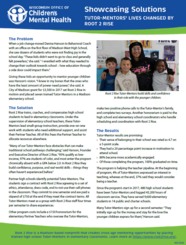
Root 2 Rise places high school Tutor-Mentors in elementary schools to teach and mentor younger children. Root 2 Rise coaches, trains, and compensates the Tutor-Mentors, many of whom have faced obstacles as students. The success for the Tutor-Mentos has been notable, as well as the benefits the elementary schools have gained. Read about it in OCMH’s newest Showcasing Solutions – Tutor Mentors’ Lives Changed by Root 2 Rise.
Showcasing Solutions tells stories of Wisconsin organizations doing innovative work to improve children’s mental health. See all our Showcasing Solutions.
|

Young adults, children, and families with infants and toddlers are facing hunger at alarming rates.
Young Adults
Nearly one in three (32%) young adults (ages 18-24) and 40% of U.S. college students are food insecure. Nearly one in four (24%) young adults reported receiving charitable food in 2025. Although access to safety net supports can help reduce hardships, even when young adults satisfy all eligibility rules for the Supplemental Nutrition Assistance Program (SNAP) and Temporary Assistance for Needy Families (TANF), they often don’t receive the benefits. In 2023, the Urban Institute reported fewer than 50% of eligible young adults received SNAP benefits and fewer than 25% of eligible young adults received TANF. (Urban Institute)
Children
Wisconsin’s children are facing rising hunger and food insecurity. There has been a 60% increase in child hunger in Wisconsin over the last five years – from 12.6% in 2020 to 20.2% in 2024. Now 1 in 5 children are food insecure. Food insecurity is measured by not having money to afford balanced meals and, as a result, skipping meals or eating less. Across the U.S., rural children (39%) are more likely to be food insecure than non-rural children (29%).
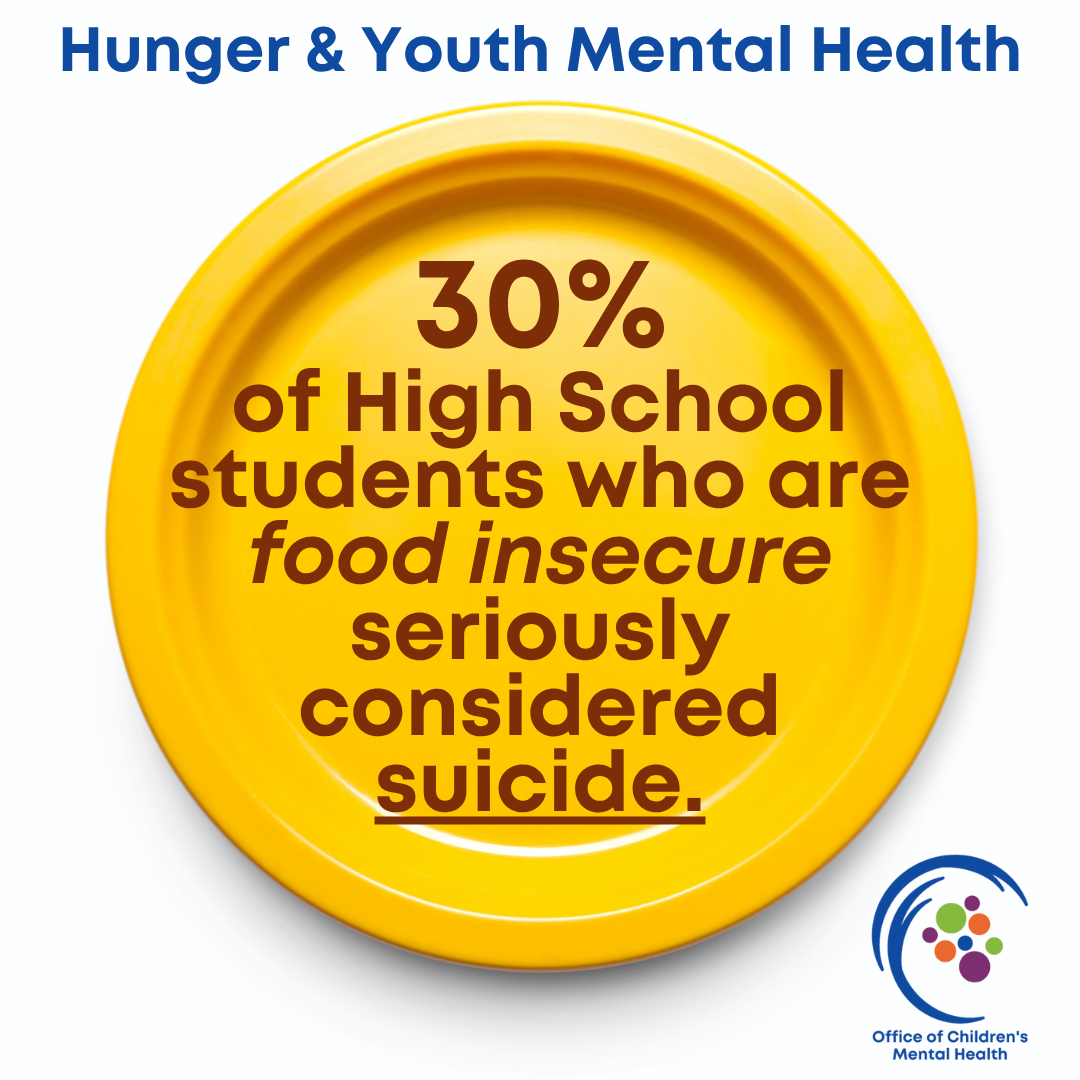
Also of note, is that food insecurity drives binge eating among children, and binge eating is a significant driver of eating disorders. Children with eating disorders is a growing problem in Wisconsin and the nation. Additionally, 30% of high school students who are food insecure seriously considered suicide.
See OCMH’s Child Hunger in Wisconsin Data Bite for research on what helps and OCMH’s Data Bite on Hunger and Youth Mental Health. (For more information on eating disorders, see "Let's Break it Down" below.)
Infants and Toddlers
Families with infants and toddlers are struggling to pay for baby formula, groceries, and other basics (Rattled, RAPID).
- 44% of families with infants and toddlers reported difficulty paying for essentials like food and housing in 2025, the highest rate in five years.
- Food insecurity among parents with infants and toddlers increased from 13% in January 2025 to 24% in December 2025.
The hardship extends beyond families to their child care providers. In March 2026, more than a quarter (27%) of surveyed child care providers who care for formula-fed babies struggled to find and afford formula for the infants in their care.
Less Food Aid Amid Rising Food Costs
After federal changes in 2025, an estimated 5 million fewer people were enrolled in SNAP in June 2026 compared to July 2025. Meanwhile, food prices rose nearly 3% from August 2025 to August 2026, according to the U.S. Department of Agriculture (USDA).
Schools are also facing increased food costs compounded by the loss of federal dollars that support the nation’s school lunch program. According to the USDA, school meals and snacks are more than half of student food intake during the school week (NPR).
As the holidays approach, many feel a sense of giving and want to do what they can to help others in their community. Food banks across the state are busier than ever. If you can donate to a local food pantry, volunteer for food distributions, or drop off healthy snacks to your local school’s social worker, this will positively impact families in your community.
See related OCMH resources for more ways to help:
|

Join Us: Let’s Break it Down – Eating Disorders
Join OCMH as we look at the facts on eating disorders, how they are affecting Wisconsin kids, and what helps.
Eating disorders are serious mental health conditions that are linked with and can deepen other mental health problems such as anxiety and depression. They can sometimes be fatal. OCMH’s next Fact Sheet will explore eating disorders, and OCMH Senior Research Analyst Amy Marsman will break it down in our Let’s Break it Down – Eating Disorders lunchtime learning opportunity. We’ll also hear from clinicians from Rogers Behavioral Health and Aspirus Health who will discuss treating young people with eating disorders.
Friday, December 11, 2026 • 12-12:45 pm • Virtual
Register
This webinar will be recorded and shared on the OCMH website.
|

Children’s Mental Health Prevention
The Children’s Mental Health Network explored children’s mental health prevention in its most recent meeting on November 6, 2026. Meeting participants included:
- NAMI Wisconsin and Mental Health America of Wisconsin, leading mental health organizations, shared their perspective on prevention.
- Three innovative prevention programs working in schools – WEA Member Benefits Foundation’s School-based Mental Health Initiative, Mental Health America Lakeshore’s Resilient Schools, and Random Lake School District’s UNYTUS program.
- Two Wisconsin State Departments and a health system discussed policy as prevention.
- Youth shared their perspectives on prevention.
View the meeting recording, see the meeting slides, meeting minutes, and access meeting resources. The Children’s Mental Health Network meets quarterly to learn about important children's mental health topics. 2027 meeting topics for the Children's Mental Health Network will be announced soon. Sign up to receive notice of the meetings here.
|
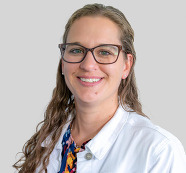
By: Jes Springer, Director of School Based Behavioral Health Services – NorthLakes Community Clinic – Turtle Lake
Try this experiment: Think of the last direction you gave your child. Maybe it was to put on their shoes, empty the dishwasher, or to stop making so much noise. Then, think of exactly how you said it: word choice, tone of voice, finger point, facial expression (crumpled eye brows and all). Now, imagine saying the exact same thing in the same way to your friend, a customer at work, or a stranger shopping next to you at Walmart. Would you say it the same, or make a few changes?
Why is it that we feel we can speak to our own family members, including our children, in such rude, demanding ways? Many times, we do try to say it or ask nicely the first time. And yes, the more we have to repeat ourselves, the more frustrated we become and the niceness goes right out the window. But, how often is it that your first words to your child or your partner are already worn down and sharp?
When working with children in therapy, parents/guardians ask that we help their child learn to be more respectful, have less of an “attitude,” to do what they are told, to be kinder to themselves when making mistakes and to spend less time on screens. These are great goals for them to work toward and we absolutely will do that! However, in the process of helping them, we often discover that they are replicating what they are seeing at home. A parent rudely telling a kid to pick up after themselves, then becoming angry when the kid is rude back. Or getting after a kid for being on their phone too much, while the parent returns to playing games on their own. Even how we treat our partners; do they learn one has all the power, no need to listen to the other?
How about mistakes? As parents, we make a ton of them, myself included. How you handle them is what matters. We teach our children to apologize. Look people in the eye, use the words “I’m sorry” and work to repair any harm caused. How many adults are willing to practice what they preach? It can be very hard to deliver that apology, especially when we have to admit we were wrong to our child, but it is critical for them to learn how to move forward. You are teaching them how to be a respectful adult, an effective leader and a healthy family member. They see our mistakes, just like we see theirs. So, if you catch yourself passing your frustrations of life onto your kid, just call yourself out, apologize genuinely and try again. They will respect you more for it, and maybe even pick up their mess the first time you ask.
|

Articles on Children’s Mental Health for Your Newsletters and Communications
Would you like to receive children’s mental health articles like the one above to publish in your organization’s newsletter or communications? Sign up for OCMH’s Building Mental Wellness Copy & Drop (select “OCMH – Building Mental Wellness Copy & Drop”). You’ll receive a ready-to-use article the third Tuesday of each month. Just “copy and drop” it into your publications. Learn more about Building Mental Wellness Copy & Drop and access our library of articles.
|
Governor and Legislature Transitions. The Joint Committee on Finance will meet on November 10th to approve a transition budget. This action is statutorily required within one week following an election, if the incumbent governor is not re-elected. “The committee shall convene and approve a budget for the newly elected governor to enable the incoming governor to review and analyze the budget, to hire staff and obtain space, and to do such tasks as the committee approves."
Sen. Dianne Hesselbein (D-Middleton) and Rep. Greta Neubauer (D-Racine), the current Democratic legislative leaders, are identifying a range of priorities they intend to tackle in the 2027-28 session. They and members of the Democratic caucus have been meeting to determine not only their agenda, but legislative committees they want to put in place and whether there will be any majority leadership changes.
On November 5th, Senate Republicans announced Sen. Julian Bradley (R-New Berlin) as minority leader. Sen. Romaine Quinn (R-Birchwood) was chosen to be the assistant minority leader.
Legislative Council Study Committee on the Use of Artificial Intelligence in Health Care. On November 12, the Director of the Utah Office of Artificial Intelligence Policy; Wisconsin Department of Safety and Professional Services; and the Wisconsin Department of Justice will make presentations to the Committee. The Committee is currently considering 8 legislative drafts ranging from AI definition to consumer data protection to regulation of AI systems that simulate humanlike relationships. The Committee plans to meet again on December 2nd and introduce legislation in January.

Small Talks about the Impacts of Underage Drinking and Substance Abuse
Small Talks is a campaign that encourages adults to have brief talks with kids about the health and safety impacts of underage drinking and substance use. The short, casual conversations should start at age 8 and continue as children grow.
The Wisconsin Department of Health Services’ campaign launched more than six years ago and has just had a refresh to include substances other than alcohol. Learn more about substance use facts, how to be a good role model, and tips for having the conversations here.
The Child Mind Institute also has resources to help kids stay safe from substances as well as resources for parents:
|
November Awareness Months and Days
There are a number of important areas that call out special awareness in November.
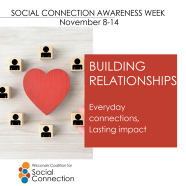
Social Connection Awareness Week – November 8-14
The importance of relationships and the everyday connections that help individuals, organizations, and communities thrive is highlighted. Building relationships happens at every level – individual, organizational, and community. The Wisconsin Coalition for Social Connection provides resources and information.
|

November is National Family Caregivers Month
Mental Health America reminds caregivers how important it is to take care of your own mental health. Explore their caregiver resource center.
|

Native American Heritage Month is Celebrated in November
November provides a designated time to honor the histories, cultures, sovereignty, contributions, and ongoing influence of Tribal Nations, communities, and Indigenous peoples in Wisconsin and across the United States. Learn more:
|

November is Early Childhood Mental Health Awareness Month
November provides a time to spotlight caregivers' significant role in shaping infants' and preschoolers' emotional and social growth. Learn more:
|

International Survivors of Suicide Loss Day is November 21st
Also known as Survivor Day, the International Survivors of Suicide Loss Day encourages friends and family of those who have died by suicide to come together for healing and support. Learn more.
|

November is Rural Health Month
November provides a time to recognize the strength of rural communities and help connect people with resources. See Mental Health America’s Rural Mental Health Resource Center. Since 2011, National Rural Health Day (November 19th) has celebrated the healthcare providers, organizations, and communities making a difference across rural America. Learn more.
|

|