|
This message is being sent to the health alert network, local public health officers, Tribal health directors, local public health department nurses, and infection preventionists.
Wisconsin DHS Health Alert #74: Multi-drug Resistant Shigellosis Cases in Wisconsin
Bureau of Communicable Diseases
November 11, 2026
Key points
- The Wisconsin Department of Health Services (DHS) has recently identified two clusters of multi-drug-resistant (MDR) shigellosis in the southeastern and northeastern regions of the state.
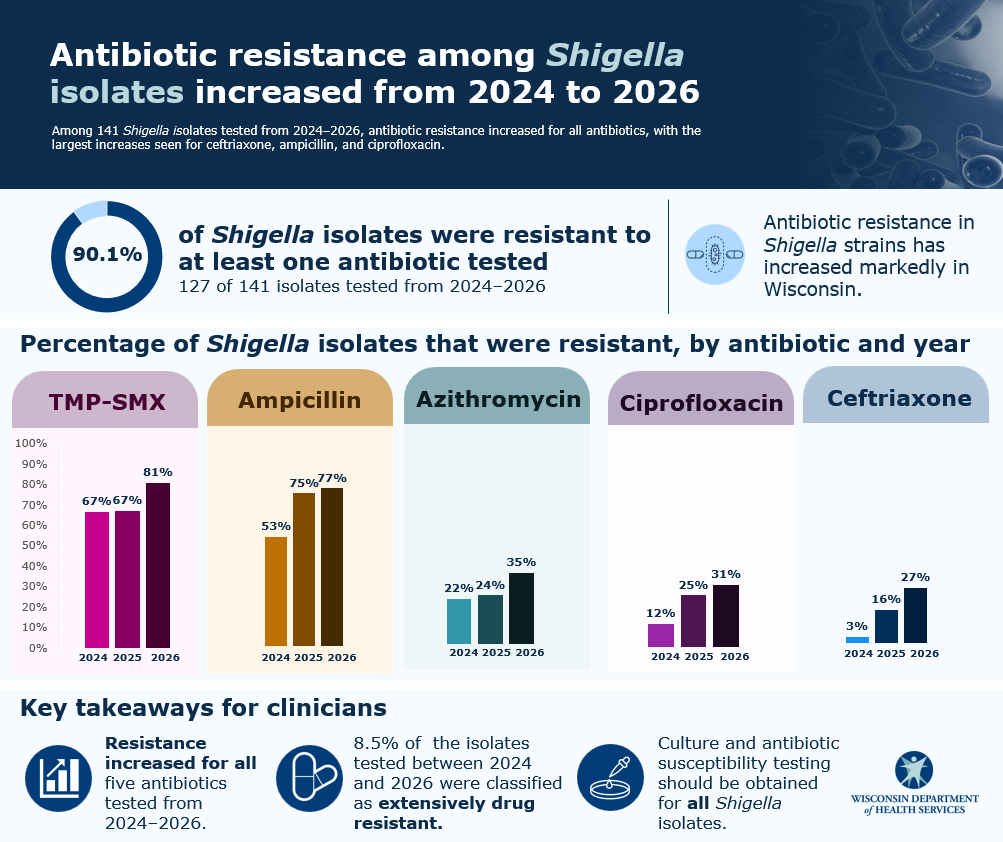
- Antibiotic resistance in Shigella strains has increased markedly in Wisconsin. Of isolates tested from 2024–2026, 8.5% were extensively drug resistant (XDR), defined as resistance to all five of the antibiotics recommended for treatment of shigellosis.
- While most patients with shigellosis do not require antibiotic treatment, culture and antibiotic susceptibility testing (AST) should be obtained for all Shigella isolates, to understand resistance trends and guide therapy in cases that do not resolve with supportive care. Specimens should be sent to the Wisconsin State Laboratory of Hygiene (WSLH) for fee-exempt culture confirmation and AST.
Background
DHS, with data from the WSLH, has identified two clusters of shigellosis with demonstrated antibiotic resistance to ciprofloxacin, trimethoprim/sulfamethoxazole (TMP-SMX), and ampicillin. As of October 16, 2026, these two clusters include eight patients from the southeastern region and five patients from the northeastern region of the state.
Nationally, the number of antimicrobial-resistant Shigella infections has been rising since 2016. The Centers for Disease Control and Prevention (CDC) now estimates that of the 450,000 cases that occur each year in the United States, 242,000 are antimicrobial-resistant.
In Wisconsin, of the 141 clinical isolates submitted to WSLH between 2024 and 2026, the percent resistant to one or more antimicrobials has increased. Figure 1 shows the proportion of isolates resistant to antibiotics.
Figure 1: Percent of Shigella isolates (all species) resistant to antibiotics, 2024–2026
 * Isolates with a ciprofloxacin MIC of 0.12–0.25 µg/mL are categorized "susceptible" by CLSI but are associated with treatment failure, so fluoroquinolones should be avoided at MIC ≥0.12 µg/mL; percentages shown reflect only isolates meeting the CLSI resistant breakpoint and underestimate reduced fluoroquinolone activity.
** Clinical breakpoints predicting treatment outcome are limited and testing is performed mainly by public health rather than clinical laboratories, so these percentages should be interpreted with caution.
A recent CDC publication describes the increasing prevalence of XDR Shigella species. From 2011–15, among approximately 17,000 isolates tested nationally, 0% were XDR; resistant to all five of ampicillin, azithromycin, ceftriaxone, ciprofloxacin, and TMP-SMX). However, in 2023 the proportion of XDR isolates increased to 8.5%. This concerning trend is echoed in Wisconsin where 8.5% of the isolates tested between 2024 and 2026 were classified as XDR. These cases can be difficult to manage. There is currently no FDA-approved oral antimicrobial for XDR Shigella, and approximately one in three patients with XDR infection are hospitalized.
Shigellosis is transmitted fecal-orally through ingestion of contaminated food or water, during sexual or other close contact with an infected person, or by touching surfaces contaminated with Shigella bacteria. Shigella is highly contagious, and outbreaks of shigellosis often occur in schools, childcare centers, close-knit communities, congregate living settings, and within sexual networks, particularly those of men who have sex with men (MSM).
Shigellosis is an acute enteric infection that causes diarrhea that can be bloody, fever, abdominal cramping, and tenesmus. Most gastrointestinal infections are self-limited, and do not require treatment other than oral fluids. However, antimicrobial treatment of shigellosis is recommended for patients with serious illness or who are at high risk for serious disease or complications.
Given the increasing prevalence of antibiotic-resistant strains of Shigella, clinicians should request culture and AST for specimens from patients with acute diarrhea caused by any Shigella species. Results of AST should guide drug selection for patients who require antibiotic treatment.
Recommendations for clinicians
Consider shigellosis as a cause of acute diarrhea, especially among those at greater risk of shigella infection including:
- Young children.
- Gay and bisexual men and other men who have sex with men.
- People experiencing homelessness.
- International travelers.
- People who are immunocompromised, including people living with HIV.
Perform diagnostic testing when shigellosis is suspected:
- Submit specimens for diagnostic testing using stool culture or culture-independent diagnostic test (CIDT). Samples testing positive for Shigella by CIDT should be confirmed by culture.
- Please submit Shigella isolates and CIDT-positive specimens to the WSLH for fee-exempt culture confirmation and AST, which will be reported back to submitters. Isolates will also be sequenced for epidemiologic purposes.
- Refer to the WSLH Laboratory Based Surveillance Plan 2026–2027 (PDF) for details on submission procedures. Contact WSLH at 800-862-1013 with questions.
Treat with antibiotics only when necessary.
According to the 2017 IDSA infectious diarrhea guidelines and the AAP Red Book (2024–2027), antibiotic treatment is reserved for specific high-risk situations. Most immunocompetent patients with Shigella need only rehydration, not antibiotics. Indications for antibiotics include:
- Infants younger than 3 months of age
- Patients with severe disease — for example, requiring hospitalization, invasive disease (bacteremia), or complications
- Immunocompromised individuals, including patients with severe immunosuppression and people living with HIV who are not receiving effective antiretroviral treatment
- Ill, immunocompetent patients with documented fever (in a medical setting), abdominal pain, or bloody diarrhea
- Recent international travelers with body temperature ≥38.5°C and/or signs of sepsis
- Medically fragile hosts, including patients who are elderly, malnourished, or those with significant intestinal or other comorbidities
Additionally, antibiotics may be considered in other settings to reduce the risk of person-to-person transmission. These settings may include:
- Symptomatic, culture-proven patients in high-transmission roles or settings (for example, food handlers, health care workers, childcare workers or attendees, and people living in institutions/congregate settings).
- Household contacts or others with close exposure to high-risk individuals
Select antibiotic treatment based on susceptibility testing.
- First-line agents include ceftriaxone (preferred for hospitalized patients requiring parenteral therapy), ciprofloxacin, and azithromycin. Typical duration is 3 days for ciprofloxacin and azithromycin, and 2–5 days for parenteral ceftriaxone.
Ampicillin and TMP-SMX (oral, 5 days) are alternative regimens that should be used only when susceptibility is documented.
- For Shigella bacteremia, extend treatment to at least 14 days; do not use azithromycin for bacteremia. In severely ill patients requiring empiric parenteral therapy, a carbapenem may be started before susceptibility results return.
- Avoid fluoroquinolones when the isolate's ciprofloxacin MIC is ≥0.12 µg/mL, even if the laboratory reports the isolate as "susceptible," because such strains are associated with treatment failure and prolonged shedding.
- For patients with prolonged diarrhea or treatment failure, obtain follow-up stool cultures at short intervals (for example, twice weekly) until negative.
- XDR shigellosis should be managed in consultation with an infectious disease specialist.
Counsel patients and caregivers about measures to prevent person-to-person transmission.
- Wash hands with soap and water for at least 20 seconds after using the bathroom or changing a diaper.
- If possible, avoid preparing food for others while ill.
- If you work in health care, childcare, or the food service industry, follow the guidance of your local health department about when it is safe to return to work.
- Young children with shigellosis should not attend childcare, pre-K or group activities while they have diarrhea.
- Avoid swimming until you have fully recovered.
- Wait to have sex (vaginal, anal, and oral) for two weeks after you no longer have diarrhea.
- Urge sex partners and other close contacts with similar symptoms to seek health care.
Further information on shigellosis and case reporting can be found on the DHS website or the CDC websites for clinicians or patients.
Sincerely,
Ryan Westergaard, MD, PhD, MPH
Chief Medical Officer and State Epidemiologist
Bureau of Communicable Diseases
Division of Public Health
Wisconsin Department of Health Services
Questions
Questions regarding this health alert may be directed to the Bureau of Communicable Disease at dhsdphbcd@dhs.wisconsin.gov.
|