 HAI Happenings: Quarter Two 2026 Newsletter
This message is being sent to local public health department officers, nurses, and staff; Tribal health directors; infection preventionists; and key DPH staff.
HAI Happenings highlights new and noteworthy topics for all things related to healthcare-associated infections (HAI), including infection prevention and control (IPC), antimicrobial stewardship (AS), antibiotic resistance (AR), surveillance, and more. You can also find links to helpful guidance and resources and learn more about current Wisconsin HAI Prevention Program activities.
Knowledge check
Test your HAI knowledge. See answer at the end of the newsletter.
Does Ebola spread from person-to-person?
|
|
 |
What's new with the HAI Prevention Program?
In the news
-
On May 8, 2026, CDC (Centers for Disease Control and Prevention) released a Health Advisory regarding a multi-country hantavirus cluster linked to cruise ship travel. CDC issued a Health Update on May 18 to inform clinicians and health departments about testing available for patients with suspected hantavirus infection.
-
DHS confirms first cases of Mpox in 2026. Read the news release for more information and resources.
-
CDC is responding to an outbreak of Ebola disease caused by Bundibugyo virus in remote areas of the Democratic Republic of the Congo (DRC) and Uganda. To date, no cases of Ebola disease have been confirmed in the United States and the overall risk to the American public and travelers remains low.
Best practice and guidance updates
Project Firstline spotlight
Environmental services (EVS) workers play a critical role in preventing the spread of germs in health care settings. Project Firstline’s EVS Micro-Learns: Essentials for Infection Control provide brief, guided discussions that support quick, on-the-job training for EVS teams.
Each ready-to-use micro-learn includes a user guide, discussion guide, and job aid, making it easy for health care leaders to incorporate infection control training into existing team meetings.
Check out all six! Also available in Spanish!
Notes from the field
Each quarter we’ll highlight a specialty topic area or setting that the HAI Prevention Program works with and take a deep dive into guidance, recommendations, or notes from the field from our IPs. This quarter, we’re focusing on high-consequence infectious diseases (HCIDs), such as Ebola.
DHS continues to monitor the ongoing Ebola disease outbreak in the DRC and Uganda. While the risk to the general public in Wisconsin remains low, all health care facilities should be prepared to encounter a patient who has traveled to an affected area.
Key preparedness activities for any HCID, including Ebola, are:
- Remaining up to date with CDC, DHS, and local and Tribal health departments (LTHD) updates.
- Reviewing plans and policies, such as those for employee health and clinical care of ill patients.
- Ensuring travel and symptom triage questions are up to date.
- Identifying locations within the facility to care for patients who may have HCID and who will be responsible for caring for ill patients.
- Ensuring the facility has all appropriate personal protective equipment (PPE) available to care for patients who may have HCID.
- Providing comprehensive training on IPC best practices, such as using appropriate PPE.
All health care facilities should be prepared to identify, isolate, and inform:
- Identify any patient that may have HCID.
- Isolate the patient as appropriate at the facility.
- Inform the LTHD about any patient that may have HCID.
More information about Ebola and recommendations for Wisconsin health care facilities can be found in the GovD message sent on May 27, 2026.
Additional resources:
HAI Prevention Program highlights
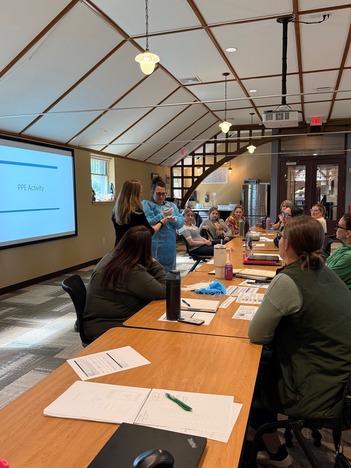
At the end of April, the HAI Prevention Program hosted Infection Preventionist Bootcamp in Sauk City. This two-day, in-person training brought 32 IPs from across the state together to learn about IPC practices and network with others. The training included presentations, discussions, and hand-on activities. Here’s what some attendees had to say:
“I thoroughly enjoyed the IP bootcamp. They did an amazing job of keeping everyone engaged in the learning process.”
“Thank you for sharing the knowledge. It was thought provoking.”
“This was a great session. EVERYONE was so positive and helpful.”
“I always enjoy listening to Ashley speak. Her team go above and beyond with assisting new IP employees. I always get a lot of information from these meetings.”
“This was a very fun training!”
Knowledge check answer
Yes. People can get Ebola disease through contact with body fluids from a person who is infected. A person is only contagious once they begin showing symptoms. You cannot get Ebola from being near someone or passing them in public spaces because it doesn’t spread through the air.
Visit CDC’s Ebola FAQ webpage for more answers to commonly asked questions!
|