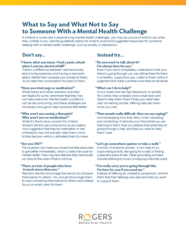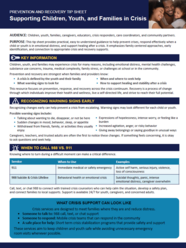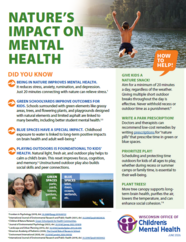
Being in nature improves mental health and playing outdoors is foundational to kids’ health. Those are just two of the positive effects nature has on people that OCMH highlights in its newest Data Bite. See Nature’s Impact on Mental Health here.
OCMH’s Data Bites provide a quick look at a children’s mental health data point. See all our Data Bites here.
|
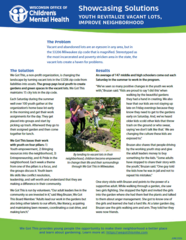
We Got This is a non-profit in Milwaukee that employs young people to improve vacant lots in the 53206 Milwaukee zip code. Each Saturday in the summer the group brings youth together to transform the abandoned lots into gardens. The lots are not the only thing that are changed – the young people are also transforming. Read more about this inspirational story in our newest Showcasing Solutions.
OCMH’s Showcasing Solutions highlights the stories of organizations throughout Wisconsin that are engaged in innovations to improve children’s mental health. See all our Showcasing Solutions here.
|
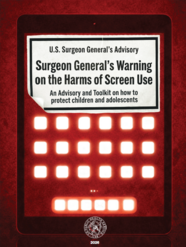
A new Surgeon General’s Advisory has been issued on the harms of screen use, stating harmful screen use among children and adolescents has become a public health concern. The Advisory states that screen use is linked to developmental, mental, and physical health challenges, and poor educational outcomes.
The Advisory offers a toolkit with recommendations on how to reduce the negative impacts of harmful screen use organized around the “5 Ds”: Discuss, Do, Delay, Divert, and Disconnect (see page 22 of the Advisory). The Advisory also offers a call to action to shift the cultural norms around screens across the following domains: Youth, Families, Schools, Health Care Providers, Researchers, Policymakers, and Technology Companies (see pages 24-36 of the Advisory or the Toolkit pulled into a stand-along document).
|
Youth Insights – Easy to Access at One OCMH Location
We’ve gathered a wealth of insights from youth over the last few years and shared that through a number of resources and informational pieces. Now, all those are located on one webpage on the OCMH website. Youth Insights is the page – access it here. You’ll find youth voice in the following children’s mental health categories: connection, academic stress, important current issues (including artificial intelligence and vaping), supporting friends, and mental wellness.
We encourage you to check out this page and download the youth voice flyers that apply to your work/organization. Look for opportunities to bring these to discussion tables and learn from what Wisconsin youth have to say. After all, young people are the experts in young people!
|

Save the Date! Children's Mental Health and Technology – topic for August 7th Children’s Mental Health Network Meeting
Screen use, AI, and cyberbullying are garnering a lot of attention in children’s mental health arenas and for good reason. OCMH will tackle this topic in the August 7, 2026 Children’s Mental Health Network meeting (10 am-12 pm, virtual). As always in these learning meetings, we will bring together a panel of experts to discuss the topic. If you are not already on the Children’s Mental Health Network distribution, we invite you to sign up to receive notice of these meetings. You can do that here. Those on the network distribution list will receive a meeting invitation approximately one month in advance of the meeting.
|
Mental Wellness Resource for Newsletters/Communications
OCMH now provides a monthly short article on youth mental wellness for organizations to “copy and drop” into their newsletters and/or other communications. Building Mental Wellness Copy & Drop provides a ready-to-use message the third Tuesday of each month. To receive it, sign up here (select “OCMH – Building Mental Wellness Copy & Drop”). Interested to see what one looks like? The “Connection Before Correction” (below) was the May Copy & Drop. The June Copy & Drop will look at the connection between physical and mental health.
Feel free to send our Copy & Drop sign-up link to your networks. Copy & Drop is a resource for any organization interested in publishing reliable children’s mental health information
|

By: Alicia R. Oczus, MS LPC, Owner/Psychotherapist – Blackbird Psychotherapy LLC
Parents are often navigating challenges and trying to make decisions in the best interest of their child. This often means setting rules, limits, and boundaries that our kids don’t like and enforcing them with consequences. When this happens, our relationship with our child can “disconnect”, which is a normal thing to happen in any relationship. It is important, however, to repair this with connection. Typically, we think about moments of connection as happening during happy, positive times. The truth is connection during a difficult time is equally important and builds your child’s sense of emotional safety. Once they feel emotionally safe, even if they are still angry, they can better tolerate correction.
The first step is to regulate yourself. Your child can sense your dysregulation, which will make it much harder to connect. Take a breath, soften your posture, and lower your voice. The second step is to move closer, both physically and emotionally. Make eye contact (if they can tolerate this) and physically get on their level. Acknowledge their feelings in the moment, not the negative behavior. Try saying something like, “You are really upset right now” instead of “What were you thinking?” This is the connection that signals to your child that their relationship with you is safe. The third step is to offer correction from within the relationship rather than a divided relationship. Approach the situation with curiosity, not accusations. Once your child feels seen, correction becomes possible. Keep it brief, simple, and specific. The goal is for your child to experience an adult as someone who is ultimately “for” them, rather than against them, even in hard moments. This experience changes correction from something that is a threat into something that they can learn from and integrate.
Connection isn’t a reward for negative behavior, but it is required for correction and relationship repair. Self-regulation is an important first step because children literally “borrow” our calm. When we acknowledge their behavior and emotions with curiosity, we reconnect and reinforce the relationship. Once they are calm and feel emotionally safe, they are better able to engage the logical part of their brain, tolerate correction, and limit-setting. The next time things feel disconnected between you and your child, remember your calm, curiosity, and willingness to reconnect are the most powerful tools you have.
Pictured above: Alicia R. Oczus is pictured with her dog, Rufus. Alicia and Rufus are a therapy dog team.
|

A new brief from the Institute for Family Studies analyzes the distance American kids are allowed to venture from home, how much time they spend online, what devices they use, the level of restrictions on their smartphones, and how much time they spend with friends. Their findings include: by the age of 11, smartphones become the primary medium for internet access among American kids, with over 60% having a smartphone. These phones generally have few parental restrictions placed on them. Meanwhile, nearly 50% of three-year-olds use a tablet, iPad, or Kindle; and many of these children have few or no restrictions. But physical restrictions are in place for many kids. About 60% of 17 year-olds are not allowed to leave their neighborhood unsupervised.
|

June is Pride Month
Pride Month is celebrated each year in the month of June to recognize the impact the LGBTQIA2s+ (lesbian, gay, bisexual, transgender, queer/questioning, intersex, asexual, two-spirit, and countless affirmative ways others choose to identify) people have had on society locally, nationally, and internationally. Learn about the history and Pride traditions here. See Gov. Evers' 2026 Proclamation declaring June 2026 as LBGTQ Pride Month throughout the State of Wisconsin.
The Child Mind Institute has resources for helping protect the mental health of LGBTQ+ teens:
|
Global Loneliness Awareness Week
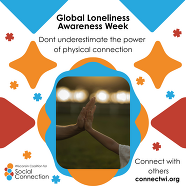
June 15-21, 2026 is Global Loneliness Awareness Week and inspires conversations about loneliness and promotes connection activities across the world. Learn more.
The Wisconsin Coalition for Social Connection’s theme for Global Loneliness Awareness Week is “Take Me Out to the Ballgame!” noting that sporting events are a great way to connect with our communities and others. Check out their resources and information here.
|
Talking to Teens about Firearms
Agree to Agree provides resources for health care professionals on how to talk to teens directly about access to a firearm. They address the following on this webpage: When and how to start the conversation, how to talk about access to firearms, how to talk about noticing when someone may be in crisis, and what to do after the chat. See how to talk to parents about secure gun storage here.
2025 Wisconsin State Health Assessment Released
The Wisconsin Department of Health Services released the 2025 State Health Assessment (SHA) in late May. The report is issued every five years and presents a snapshot of health and well-being across Wisconsin as well as identifies both barriers impacting health outcomes and assets that can be leveraged to support solutions. Read the news release here.
|
Mental Health and Substance Use Service Gaps Analysis
A 2025 analysis of gaps within the mental health and substance use services system across Wisconsin showed gaps in the following areas: workforce, geography, bureaucracy, and culture and linguistics. The study was done by the Wisconsin Department of Health Services Division of Care and Treatment Services and the UW Population Health Institute. See the report here.

Universal Mental Health Screening Learning Lab for School Districts
Thriving Minds in partnership with the National Center for School Mental Health is launching a Universal Mental Health Screening Learning Lab this fall to help districts establish high-quality mental health screening systems in their schools. It is designed to help districts move from initial planning to full implementation for screening. Learn more.
|
Funding Opportunities from the Wisconsin Department of Health Services Division of Care and Treatment Services:
-
Peer Recovery Centers – to support a statewide network of peer-led peer recovery centers for individuals living with a mental health or co-occurring substance use challenge. Peer recovery centers are community-based spaces where individuals support one another through shared lived experience. Learn more.
-
Peer-Run Respites – to develop and operate peer-run respite programs in Wisconsin. Peer-run respites provide short-term, voluntary, recovery-oriented residential support and warmline services. Learn more.
Opportunity to Provide Input – Youth and Family System of Care Enhancement
The Wisconsin Department of Health Services Division of Care and Treatment Services seeks to gather information on innovative approaches to increase support for mental health family support projects and/or employment projects operated by recipients of mental health services statewide in alignment with Wis. Stat. § 46.54. Learn more.
|