|
This message is being sent to local and Tribal health agencies, as well as maternal and child health contacts.
Maternal Health Innovation June Quarterly Newsletter
Welcome to the Maternal Health Innovation (MHI) program’s quarterly newsletter. This newsletter serves to inform the public about our activities, public meetings, training and funding opportunities. You can view past newsletters on our program page.
Maternal Health Innovation program news and updates
Postpartum Medicaid Expansion
On February 19, 2026, the Wisconsin State Assembly passed 2025 Wisconsin Act 102 (passed as SB23/AB97), expanding coverage of women who qualify for medical assistance from 60 days to 365 days. Key benefits of this expansion include improved maternal health, reduced maternal mortality, and financial stability for families. We celebrate Wisconsin's commitment to extending care to ensure pregnant and postpartum individuals have continued access to services that save lives.
|
New Maternal Health dashboards!

MHI is excited to share four new data dashboards in order to provide data access and transparency. Data on maternal health outcomes and experiences are important for understanding, monitoring, and improving the health of Wisconsin mothers and families.
Much of these data haven’t been released previously, including quotes from mothers and recommendations about each topic. Data within the dashboards will be updated annually, and the program anticipates publishing dashboards on additional maternal health topics in the future.
A presentation on the dashboards and maternal health data was held on June 18. Watch the video for an overview of data, sources, and also a live walk-through of the dashboards. There is also a recorded video tutorial for the data dashboards.
|
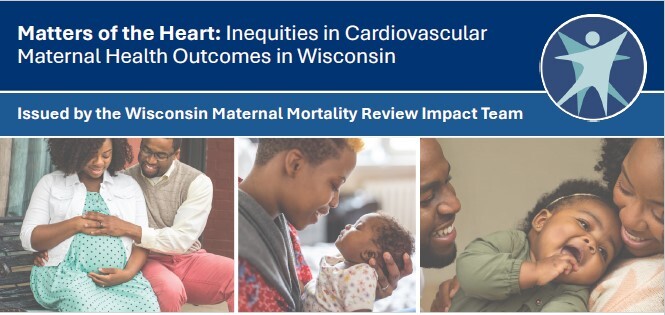
Cardiovascular maternal health issue brief
Protecting Maternal Heart Health report
The National Academies of Sciences, Engineering, and Medicine released a report, Protecting Maternal Heart Health: Prevention and Care Before, During, and After Pregnancy Protecting Maternal Heart Health: Prevention and Care Before, During, and After Pregnancy, finding that, "Clinical preventive services before, during, and after pregnancy—as well as between pregnancies—can help reduce risk and protect long-term cardiovascular health."
The report calls for stronger clinical preventive services, better follow-up after delivery, and improved care coordination across the reproductive life course. Visit the National Academies for related factsheets and materials.
PRAMS spring newsletter
The Wisconsin Pregnancy Risk Assessment Monitoring System (PRAMS) released its Spring 2026 Quarterly Newsletter. PRAMS newsletters share program updates, data highlights, and ways to access PRAMS data. Visit Wisconsin PRAMS to learn more and subscribe to our mailing list to stay informed.
|
Funding announcement
The Division of Children and Families (DCF) has released a Request for Proposal (RFA) to expand evidence-based home visiting services to counties and tribes in the state that are at high risk for poor maternal, child, and family outcomes.
DCF funds and administers contracts for Family Foundation Home Visiting Programs (FFHV) aiming to improve maternal, child, and family outcomes in at-risk communities through the provision of voluntary, high-quality, evidence-based home visiting programming and coordination with needed services.
|
Funding foreshadow opportunity, forecast
The Wisconsin Maternal Mortality Review program is preparing a request for applications (RFA) for an exciting new funding opportunity! Sign up for the MMR mailing list to stay updated on the RFA, which is expected to open this July.
Maternal Health Workforce meetings

The MHI team hosts quarterly maternal health workforce meetings to help ensure we build build community, share resources and provide information on statewide maternal health initiatives. Register for our next virtual meeting Wednesday, August 12, 2026, from 9–10:30 a.m.
|
Upcoming maternal health trainings
Wisconsin Substance Use Summit
The Wisconsin Substance Use Summit is an event focused on actionable strategies to build healthy communities through substance use prevention, intervention, treatment, and recovery services and supports. Learn more about the summit in Green Bay, August 5–6, 2026.
PostpartumSupport International's (PSI) Perinatal Mental Health certification
The Perinatal Mental Health Certification, Step 1 training is being offered as a pre-conference activity at the Wisconsin Substance Use Summit, over August 3–4, 2026.
- This training is designed for nurses, physicians, social workers, mental health providers, childbirth professionals, social support providers, or anyone interested in learning skills and knowledge for the assessment and treatment of perinatal mood disorders.
- Participants will receive a training binder, handouts, and 14.5 continuing education units (CEU) at no additional cost. Completion of this course is the first step in becoming a certified perinatal mental health professional.
Note: CEUs from the Wisconsin Substance Use Summit have been approved by PSI for the Step 2 training towards the Perinatal Mental Health certification.
|