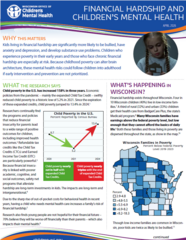
Kids living in financial hardship are significantly more likely to be bullied, have anxiety and depression, and develop substance use problems. Children who experience poverty in their early years and those who face chronic financial hardship are especially at risk.
Financial hardship exists throughout Wisconsin. Four in 10 Wisconsin children (40%) live in low-income families. Additionally, many Wisconsin families have earnings above the federal poverty level but low enough that they cannot afford the basics of daily life. Both these families and those living in poverty reside throughout the state.
There are things that can help – from child tax credits to positive childhood experiences – that researchers have found to work. Because the brain is malleable, there are many opportunities to intervene during childhood and remedy damage that chronic stress can have on a child.
See more research on childhood poverty, family financial hardship, and children’s mental health in our newest Fact Sheet.
Learn more about households experiencing financial hardship in OCMH’s recent Showcasing Solutions on ALICE (Asset Limited, Income Constrained, Employed) in Wisconsin here.
|
Early Action and Responsiveness Lifts Youth (EARLY) Minds Act (H.R. 1735 / S. 799) is bipartisan legislation that would allow states to use Community Mental Health Services Block Grant (MHBG) funds for prevention and early intervention services for youth mental health. The MHBG currently restricts funds to adults with serious mental illness (SMI) or children with serious emotional disturbance (SED) and, therefore, limits early intervention efforts. The Act also requires states to report on prevention strategies and the Substance Abuse and Mental Health Services Administration (SAMHSA) to report to Congress on the impact of these services. Mental Health America (MHA) and many other organizations are encouraging individuals to contact their Congressional representatives on May 15th. For more information and links to your Congressional representatives, see the MHA EARLY Minds Act action page
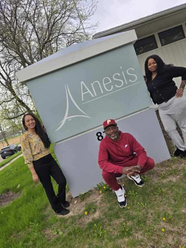
Parent Peer Support Specialists Provide a Vital Role at Anesis Center for Marriage & Family Therapy
Too often people moving through the behavioral health system lack the compassionate understanding of someone else who has “been there” – an individual who has received training to provide peer support. Anesis Center for Marriage & Family Therapy understands the importance of clients feeling understood and creating a connection with a peer who validates their experiences and has implemented parent peer support specialists in their services. They currently have three Parent Peer Support Specialists with plans to grow that to five. Learn more about Anesis’ implementation of parent peer support and how it is helping their clients here.
Showcasing Solutions tells stories of organizations doing innovative things in children’s mental health across Wisconsin. See all our Showcasing Solutions here.
|
Wired for Belonging
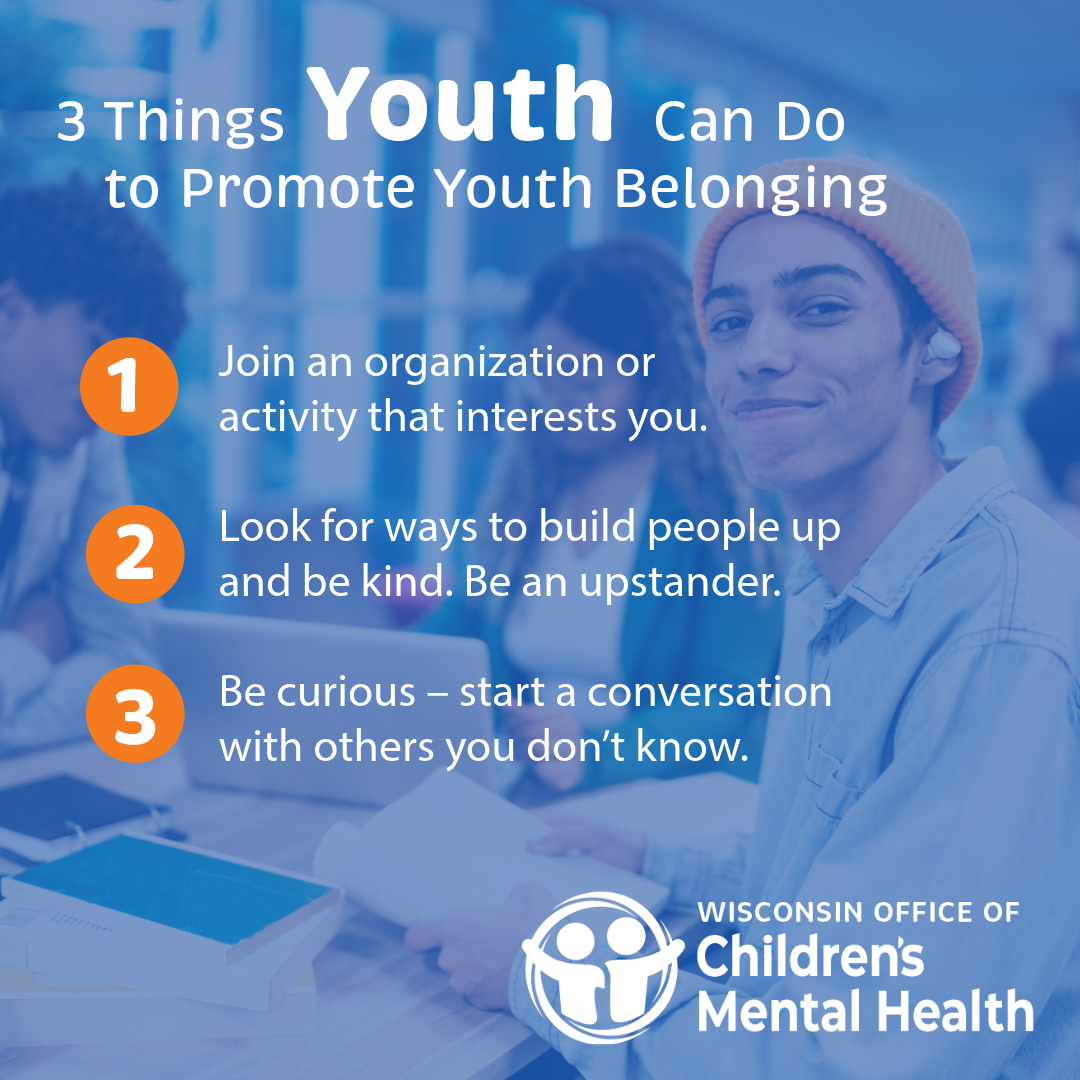
Children’s Mental Health Week was May 3rd-9th, and OCMH promoted “Wired for Belonging” as the 2026 theme. Our special Children’s Mental Health Week web page will be active throughout the year so you can access our resources whenever you need them. Make sure to check out our “3 Things Anyone Can do to Promote Youth Belonging” for:
You will also find social media posts to support the “3 Things” messages on our website.
|
Ready-to-Use Messages on Children’s Mental Health
OCMH is launching a short, monthly message on youth mental wellness that schools and organizations can “copy and drop” into their newsletters or communications. The Building Mental Wellness Copy & Drop will provide a ready-to-use short message and will be emailed the third Tuesday of each month from OCMH. All you have to do is sign up to receive it and then “copy and drop" it into your publications. Topics in the near future will include: connection before correction, the relationship between mental and physical health, everyday actions to improve mental health, sleep and mental health, and many more. Our first Building Mental Wellness Copy & Drop will email May 19th.
Sign up here to receive OCMH's Copy & Drop (select “OCMH – Building Mental Wellness Copy & Drop”).
|
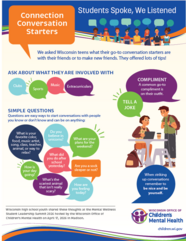
OCMH Shares New Youth Voice Tools on Youth Connection
Students Spoke, We Listened. We asked students attending our OCMH Mental Wellness Student Leadership Summit on April 17, 2026 to share their ideas on youth belonging at school. See what they said:
|

Neurodiversity – Topic of Recent Children’s Mental Health Network Meeting
OCMH’s Children’s Mental Health Network focused on Neurodiversity in its May 1st meeting. An expert panel including parents of neurodiverse children explored neurodiversity and autism including definitions, common signs, diagnosis, treatment, and cross over to mental health. View the meeting recording and access the meeting slides.
The Children’s Mental Health Network meets quarterly and brings together people interested in children’s mental health from across the state to learn about important children’s mental health topics. Remaining 2026 meetings and topics are:
- August 7 – Technology and Children’s Mental Health
- November 6 – Children’s Mental Health in the New Year/Going Forward
Meetings are 10 am-12 pm and virtual.
Sign up here to receive notice of the meetings.
|
May is Mental Health Awareness Month and focuses on fighting stigma and educating the public. Mental Health America’s 2026 theme is “More Good Days, Together,” and NAMI (National Alliance on Mental Illness) focuses on turning silence into connection. Access resources and learn more:
|
Education Funding. Gov. Tony Evers, Wisconsin State Assembly Speaker Robin Vos (R-Rochester), and Wisconsin State Senate Majority Leader Devin LeMahieu (R-Oostburg) announced on May 11 that they have reached agreement on a bipartisan proposal to build upon the bipartisan investments and agreements approved in the 2025-27 Biennial Budget to use a portion of the state’s $4 Billion state surplus to:
- Increase the state’s special education reimbursement rate in state history to attain 50 percent, investing over $600 million in Wisconsin’s K-12 schools, on top of the already historic nearly $1.4 billion provided in the 2025-27 Biennial Budget, including $300 million in property tax relief through general school aids;
- Provide an additional $50 million in property tax relief for Wisconsinites statewide in addition to the above over $300 million in general school aids;
- Eliminate the income tax on cash tips and overtime income for Wisconsin taxpayers; and
- Return over $850 million of the surplus to Wisconsinites, providing direct support to over 3 million Wisconsinites to respond to rising costs.
The Legislature will meet May 12 and 13 on the proposed bipartisan package.
A draft of the bill form of the agreement LRB-6707 is available here.
PATCH Hiring Teen Educators and Teen Consultants
PATCH (Providers and Teens Communicating for Health) works to make sure youth voice shapes adolescent health care. Why? Because they are the experts. PATCH is hiring Teen Educators and Teen Consultants, ages 14-19. Applications are due June 14, 2026. Learn more.
|
Mental Health America of Wisconsin (MHA) – Creating Youth Advisory Council
MHA of Wisconsin is accepting applications from young people to form its first-ever Youth Advisory Council. Selected young people will play a key role in designing the Youth Advisory Council, including shaping its framework, structure, and overall operations. Applicants must be between 18 and 26 years old, reside in Wisconsin, and attend eight scheduled meetings between July 1 and December 14, 2026. Applications are due June 1, 2026. To apply, complete and submit the MHA Youth Advisory Council Application via email to info@mhswisconsin.org with “Youth Advisory Application 2026 “ in the subject line.
|
Wisconsin Office of School Safety – Editorial on Funding Support
The Wisconsin Office of School Safety’s (OSS) Speak Up and Speak Out tip line provides a safe place for students to confidentially report school safety concerns. OSS also provides many resources for schools. While the office is permanent, the funding to support its staff runs out in June 2027. Read a recent editorial addressing this concern.
|
Collaboration to Support Student Mental Health Virtual Discussions
The Department of Public Instruction (DPI) invites school-based mental health professionals, community and mental health providers, and school administrators and staff involved in development and/or supporting mental health plans to participate in virtual discussions on strengthening collaboration to support students struggling with mental health. The focus will include student re-entry after treatment and removing barriers for best practice. Learn more and register.
May is Asian American, Native Hawaiian, and Pacific Islander (AANHPI) Heritage Month
The 2026 theme of the Federal Asian Pacific American Council for AANHP month is “Power in Unity: Strengthening Communities Together.” The theme highlights the importance of leveraging collective power, telling stories, and being bridge builders in communities. Learn more.
|

|