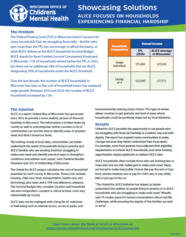
The Federal Poverty Level (FPL) in Wisconsin doesn’t account for many households that are struggling financially – families who earn more than the FPL but not enough to afford the basics, or what ALICE defines as the ALICE Household Survival Budget. ALICE stands for Asset Limited, Income Constrained, Employed. In Wisconsin, 11% of households earned below the FPL in 2023, but there are an additional 24% of households that are ALICE, meaning 35% of households under the ALICE threshold.
Learn more about ALICE data and how local communities can use it to understand the poverty needs in their area. See OCMH’s newest Showcasing Solutions on ALICE here.
See all our Showcasing Solutions here.
See related OCMH data pieces:
|
The Office of Children’s Mental Health (OCMH) is launching a short, monthly message on youth mental wellness that you can “copy and drop” into your newsletter or communication. Our Building Mental Wellness Copy & Drop will provide a ready-to-use short message on youth mental wellness and be emailed the third Tuesday of each month from OCMH. All you have to do is sign up to receive it and then “copy and drop” it into your publications/communications. Sign up here (select “OCMH – Building Mental Wellness Copy & Drop”).
Topics in the near future will include: connection before correction, the relationship between mental and physical health, everyday actions to improve mental health, sleep and mental health, and many more. Our first one will be emailed May 19th.
Feel free to send this link to your networks – this Copy and Drop resource is for any organization interested in publishing reliable children’s mental health information.
|

By Michelle Haese, DHS Director of Substance Use Initiatives
After years of devastating losses, 2024 brought a landmark shift in the opioid overdose epidemic with Wisconsin showing one of the largest declines in overdose deaths across the nation. The decline reflects the cumulative impact of years of sustained public health investment in services across the continuum of care.
While no single factor explains the decline, the evidence points to a public health ecosystem that is functioning as intended. Widespread naloxone distribution in pharmacies, community organizations, public health vending machines, and through first responders has placed life-saving medication in more hands than ever before. Expanded access to Medications for Opioid Use Disorder (MOUD) has lowered barriers to care for people with opioid use disorder. Overdose prevention tools like fentanyl test strips have given people who use drugs the information they need to make safer decisions in real time. The 2024 data are cause for genuine hope, but they are also a reminder that the communities most affected require continued investment in substance use services.
Last week, the Wisconsin Department of Health Services (DHS) and the Wisconsin Department of Justice (DOJ) announced their plans to invest $31 Million in opioid settlement funds as part of the state’s share of the $794 million settlement. This two-year plan will sustain the programs that have proven to be effective, grow strategies with the highest impact, and target priority populations across Wisconsin.
Wisconsin’s youth are a priority as the state continues to address the misuse of opioids and other substances. The state has invested millions of dollars in school-based and after school prevention programs, provided tools for adults in their lives to talk to them about the risks of substance misuse, and made communities aware of the risks.
While DHS and DOJ celebrate the decline in opioid overdose deaths, they look forward to the day when that number is zero, and all Wisconsinites have a healthier future.
|
Heads Up: Children’s Mental Health Week is May 3rd-9th
“Wired for Belonging” is OCMH’s theme for Children’s Mental Health Week 2026.
As human beings, we are wired for belonging. During this Children’s Mental Health Week we are emphasizing the simple things anyone can do to promote youth belonging. Look forward to ideas on how anyone can promote youth belonging – adults, parents, youth, schools, and neighborhoods. We’ll also have ready-to-use social media posts and other great children’s mental health resources. Watch for a special communication from us on Children’s Mental Health Week 2026 the last week of April.
|

Neurodiversity – Topic of Children’s Mental Health Network May 1st Meeting
The Children’s Mental Health Network will focus on neurodiversity in its May 1st meeting. We’ll explore neurodiversity and autism, the importance of integration verses inclusion, and hear from parents. As always, the meeting will include experts in the field and opportunities for attendees to join the discussion.
The Children’s Mental Health Network meets quarterly and brings together people interested in children’s mental health from across the state to learn about important children’s mental health topics. Remaining 2026 meetings and topics are:
- May 1 – Neurodiversity
- August 7 – Technology and Children’s Mental Health
- November 6 – Children’s Mental Health in the New Year/Going Forward
Meetings are 10 am-12 pm and virtual.
Sign up here to receive notice of the meetings.
|
On March 17th the Senate took up more than 100 bills that were under consideration by one or both bodies of the Legislature. The following is a summary of a few of those bills that could affect children’s mental health, bills the Governor signed into law, those that the Governor vetoed, and others that are still under consideration by the Legislature.
Signed into law by Governor Tony Evers
Postpartum Medicaid Expansion 2025 Act 102 (SB23 / AB97). This Act expands coverage of women who qualify for Medical Assistance from 60 days to 365 days. Key benefits of this expansion include: improved maternal health, reduced maternal mortality, and financial stability for families. Until signed on March 18, Wisconsin was one of only two states that did not extend postpartum coverage for one year. Maternal health is always important to children, but especially so during the first year of life.
Task Force on Protecting Kids. The following are bills, emanating from discussion at the Task Force, that were signed into law:
-
Creation of Civil Cause of Action for Sexual Extortion 2025 Act 215 (AB 923 / SB 902).This Act establishes a civil cause of action allowing victims of sexual extortion, or their representatives, to sue for damages and legal costs regardless of the status or outcome of any criminal proceedings. Notably, it also permits wrongful death suits if the extortion is found to be a substantial factor in a victim’s suicide.
-
Children’s Online Digital Safety Awareness Campaign 2025 Act 219 (AB 966 / SB954). This Act requires the Department of Justice to conduct a children’s online digital safety awareness campaign, bringing attention to the potential dangers of internet use by children, and distributing resources to prevent children’s exposure to harmful content on the internet.
-
Sexual Extortion as an Internet Crime 2025 Act 218 (AB 964 /SB 953).This Act defines the crime of sexual extortion as an Internet crime against a child for the purposes of Internet Crimes Against Children (ICAC) administrative subpoenas, if the crime victim was under the age of 18 at the time of the offense.
-
Law Enforcement of Internet Crimes Against Children 2025 Act 216 (AB 957 / SB 955). Provides $400,000 to the Department of Justice each year of the 2025-27 biennium for law enforcement of internet crimes against children.
Video Recording in Residential Care Centers for Youth 2025 Act 184 (SB 485). This Act allows residential care centers for children and youth, group homes, or shelter care facilities to use video surveillance in common areas of their facilities to better protect youth and staff if incidents occur. It specifies that video surveillance may not be used as a substitute for one-on-one monitoring of a child who is at high risk for self-harm. The video recording data is protected with the exceptions to that confidentiality following current law exceptions for other records kept by the Wisconsin Department of Children and Families, county welfare agencies, and other such licensed child care centers.
Health Care Providers providing excused Absences. 2025 Act 101 (AB 982 / SB 920). This Act removes registered nurses as one of the types of health care providers that can provide a written statement excusing a child from school. The bill retains advanced practiced registered nurses and other health care providers as health care providers that may sign such a statement.
Bills vetoed by Governor Tony Evers
Gender Transition Medical Intervention (AB 104 / SB 157 / Veto Link) would have prohibited healthcare providers from providing treatments or interventions if they are done with the intent of “changing the minor’s body to correspond to a sex that is discordant with the minor’s biological sex.” Certain exclusions would have existed, such as when a genetic disorder of sex development was diagnosed. If a provider was found guilty of providing or referring to these services, they would have been at risk of having their license revoked.
Gender Transition Civil Cause of Action (SB-405 / Veto Link) would have created a civil cause of action for a minor injured by a gender transition procedure.
School Policies (AB-103 / Veto Link) would have required school boards to create a name and pronoun usage policy stating that a minor pupil’s parent or legal guardian determines the names and pronouns school staff are allowed use to refer to the minor pupil. Research has shown that youth whose preferred pronouns are ignored are more likely to die by suicide.
College Sports (AB-102 / Veto Link) would have required University of Wisconsin and technical college institutions to designate athletic teams or sports based on the biological sex of participating students, or as co-ed or mixed sex, and prohibited students of the male biological sex from participating on an athletic team or in a sport designated for females or women, defined as the sex as determined at birth.
Athletic Sports (AB-100 / Veto Link ) would have required school boards to designate athletic sports and teams based on the sex of the participants at birth and reflected on the participants' birth certificates.
Parental Access to Health Records of Minors (SB 799 / Veto Link): Under current state law, parents are entitled to minor’s health records, but some exceptions exist to protect an adolescent’s sensitive health information. This bill would have expanded parental and guardian access to a minor's health records by removing existing exceptions for HIV testing results and the written objections of developmentally disabled minors aged 14 or older.
Bills still under consideration by the Legislature
Prohibition on the use of wireless communication devices during the school day (AB 948 / SB 957). These companion bills would require school boards to adopt a policy to prohibit the use of wireless communication devices during the school day. These bills require that the policy contain the same exceptions mandated under 2025 Wisconsin Act 42 which required school boards to prohibit cell phone use during instructional time but to make exceptions for emergencies and managing a student’s health care. This measure passed the Assembly and was recommended by Senate Education, but was not passed by the Senate.
The following bills have recently been progressing in the Senate Committee on Mental Health, Substance Abuse Prevention, Children and Families.
-
SB 524/ AB 524 This bill would raise the legal age for purchasing tobacco products and provide a legal age for vaping. This bill would raise the age for purchasing cigarettes from age 18 to 21 and impose the same age for purchase of electronic vaping devices. 3.5% of middle school students and 7.8% of high school students report using e-cigarettes. This bill was recommended by both the Senate and Assembly Committees on State Affairs but didn’t make it to Senate floor for a vote.
-
SB 701 / AB 711 unanimously passed out of the Senate Committee on Mental Health and the Assembly referred it to their Committee on State Affairs, however, it received no further action. This bill would have increased funding to the Family Foundations home visitation program by $1.2 million for fiscal year 2026-27.
SB 926 / AB 946. This bill would require the Department of Public Instruction to implement a pilot program during the 2026-27 and 2027-28 school years to give at least 50,000 high school pupils in this state access to an electronic multicomponent behavioral health prevention tool. The tool would be required to be available in both English and Spanish and provide access to online behavioral health education resources, peer-to-peer support services, and online private sessions with mental health professionals. The Assembly Committee on Mental Health recommended its passage and the Senate Committee on Mental Health held a hearing, but no further action was taken.
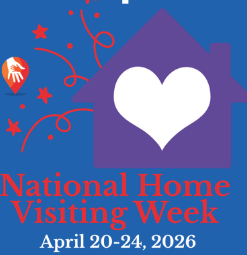
National Home Visiting Week is April 20-24, 2026
Wisconsin home visitors are more than just "helpers"—they are highly trained experts in child development, maternal health, and crisis support. They are the bridge between families and the resources they need to thrive. We encourage you to celebrate their contributions during National Home Visiting Week.
|

Family Strengthening Month is April
April marks Family Strengthening Month in Wisconsin, an annual observance dedicated to highlighting the strengths families draw on to build safe and nurturing environments for children. This observance reflects a shared commitment to promoting the overall well-being of children and families throughout Wisconsin. This month provides communities, organizations, and individuals with resources and activities to demonstrate their commitment to children and families. This year’s toolkit offers a range of ideas to inspire action and raise awareness. Access those tools here.
|

April is National Stress Awareness Month
April is recognized as National Stress Awareness Month to bring attention to the negative impact of stress. Managing stress is important to a healthy lifestyle. We encourage all to be aware of the importance of caring for our own mental well-being and supporting each other through challenges. Learn more.
|

April is Alcohol Awareness Month
Alcohol and other drug use, as well as many other habits, can become addictive. April is Alcohol Awareness Month and raises awareness and understanding of alcohol use and misuse. SAMHSA (Substance Abuse and Mental Health Services Administration) provides information and a social media toolkit. Access this here.
|
Suicide Prevention Funding Opportunity
The Wisconsin Department of Health Services Division of Care and Treatment Services is seeking applications for funding to support suicide prevention programming focused on improving the quality of clinical care in health and behavioral health care systems. Applications are due May 15, 2026. Learn more.
|

|