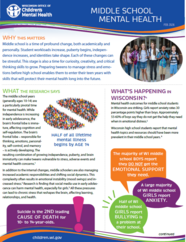
Middle school is a time of profound change for young people. Puberty, increased academic demands, identity formation, and social pressures are just a few of the things youth ages 10-14 face. All these pressures can lead to chronic stress that reshapes the brain, affecting learning, relationships, and health. Wisconsin middle school girls report anxiety rates 30 percentage points higher than boys, and 55-60% of boys say they do not get the help they need when they are in emotional distress. Learn more about middle school mental health and what parents/caregivers, schools, providers, and communities can do in OCMH’s newest Fact Sheet. Read the Middle School Mental Health Fact Sheet.
|
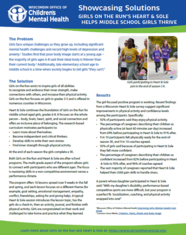
Girls face unique challenges as they grow up, including significant mental health challenges and record high levels of depression and anxiety.
Girls on the Run’s Heart & Sole program focuses on girls grades 6-8, inspiring them to embrace their inner strength, make connections with others, and increase their physical activity. This is particularly important for middle school aged girls as too often they hear messages in society that tell them “they can’t.”
Learn more about Girls on the Run’s Heart & Sole and the results they achieve in physical activity and confidence levels among participants in OCMH’s newest Showcasing Solutions.
Showcasing Solutions shares stories about innovative things organizations across Wisconsin are doing to improve children’s mental health. See all our Showcasing Solutions here.
|
As I watch daily what is unfolding in Minneapolis around immigration along with the increasing numbers of individual events cropping up in Madison, Milwaukee, and elsewhere in our state, I can’t help but think about the children affected and all that is being added to, rather than subtracting from, the youth mental health crisis.
Our OCMH vision for Wisconsin’s children is that they are safe, nurtured, and supported to achieve their optimal mental health and well-being.
Safe. Our youth were already telling us that they don’t feel safe because of school shootings and having to practice lockdowns. Now that is being augmented by witnessing classmates who fear that their parents won’t be home after school. Students see the empty chairs of their classmates who are too afraid to leave home, too afraid to go to school, too afraid to go to practice, too afraid to be separated from their parents.
When students are absent, there are serious consequences to mental health and relationships, but also to educational success. What’s more, we know that all students are impacted by peer absences, including the students who are at school. In other words, absences due to fear of family separation can affect the whole classroom community.
At our February Children's Mental Health Network meeting: Profile of Today’s Youth -- Beyond the Headlines, we heard from students what is weighing on them, and we heard from Dr. Brian Krolczyk, UW – Stevens Point who said something that really struck me: “kids see what their parents are feeling.” We, at OCMH, have been saying for years that when parents are worried about finances, the kids know it and feel it whether the parents talk about it or not. Now there is so much more worry on parents’ faces for kids to see.
The National Child Traumatic Stress Network has a number of resources to help parents, providers, schools, and youth cope with traumatic events, community violence, and family separation. The thread woven throughout these tipsheets is that youth need to feel safe and supported.
So many in our Children’s Mental Health Network tell us that they are overwhelmed and feeling powerless to affect what is going on around them. Yet we can all help kids feel safe and supported by simply connecting with them. Some of the most powerful actions we can take are as simple as reading to a child, playing a game, watching an uplifting movie, or asking youth about their thoughts and opinions. Reaching out creates positive childhood experiences for them and is the key to re-energizing ourselves.
There are so many small, yet significant ways to connect with others and so many young people right now who need to know that there is a supportive adult who sees them and cares that they are well. Take a few minutes this month to connect with a young person for their sake – and for yours.
|

OCMH’s first 2026 Children’s Mental Health Network meeting was February 6th and explored what it is like to be a youth today. Young people shared their thoughts on stressors, friendships and relationships, and hopefulness and resilience. A mental health practitioner and resiliency expert also contributed to the discussion.
Meeting materials include the meeting presentation with data slides and resources on resiliency from resiliency expert Brian Krolczyk, PhD, NBC-HWC from the University of Wisconsin – Stevens Point. Access those here (scroll down to the February 6th meeting materials).
The Children’s Mental Health Network meets quarterly and brings together people interested in children’s mental health from across the state. Each meeting focuses on an important children’s mental health topic. Remaining 2026 meetings and topics are:
- May 1 – Neurodiversity
- August 7 – Technology and Children’s Mental Health
- November 6 – Children’s Mental Health in the New Year/Going Forward
Meetings are 10 am-12 pm and virtual. Sign up to receive notice of the meetings here.
|
Many issues of significance for children’s mental health have been introduced with several receiving committee hearings just before the legislature ends its session later this month or next.
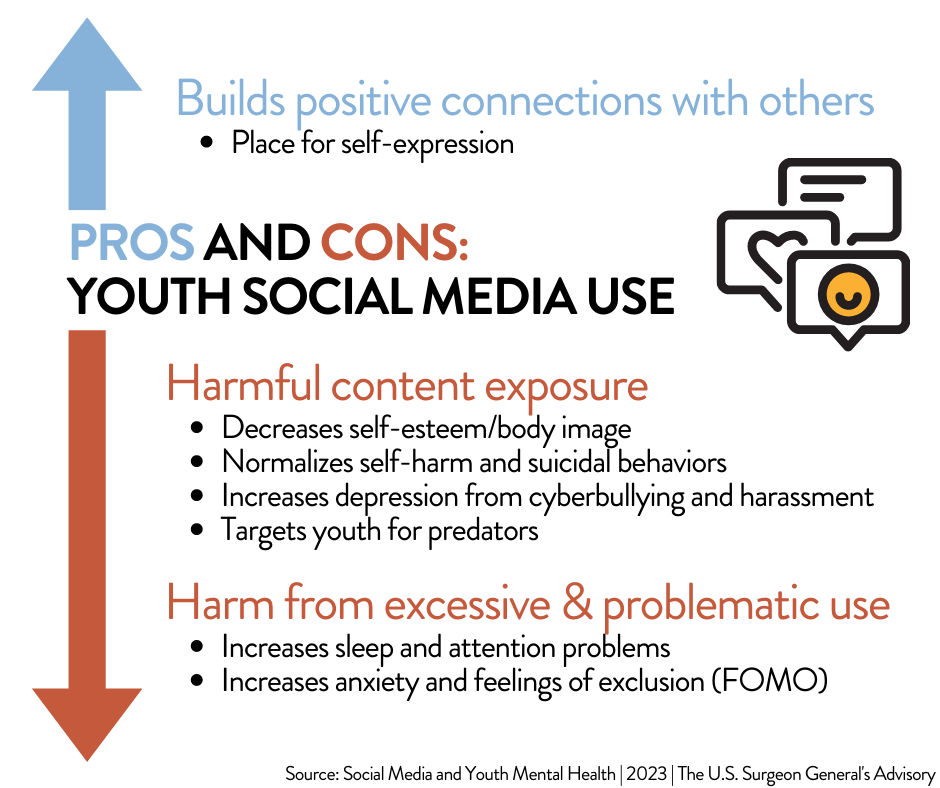
Task Force on Protecting Kids. Youth in the U.S. report increases in depressive symptoms and cyberbullying rates with an increased time spent on online platforms. This Assembly Speaker Task Force on Protecting Kids focused on the impact of social media and digital technology on youth development and mental health. Multiple bills have been introduced by Task Force members.
-
AB 948 / SB 957. This bill requires that, by July 1, 2027, each school board must adopt a policy prohibiting the use of wireless communication devices by students during the school day. [Senate Education. Assembly Education Hearing 2/5/26]
-
AB 958 / SB 956. This bill authorizes four additional full-time positions and additional funding for the Department of Justice to support enforcement of Internet crimes against children. [Senate Judiciary & Public Safety. Assembly Criminal Justice & Public Safety Hearing 2/3/26]
-
AB 960 / SB 933.This bill requires a social media platform to ensure that a mental health warning label appears each time a user accesses the platform and that it disappears only when the user exits the social media platform or acknowledges the potential for harm and chooses to proceed. [Senate Utilities, Technology & Tourism. Assembly Mental Health & Substance Abuse Prevention.]
-
AB 961 / SB 938. This bill establishes clear and uniform requirements for warning labels on explicit content distributed for commercial purposes both in print and digital formats. [Senate Utilities, Technology & Tourism. Assembly Children & Families Hearing 2/5/26]
-
AB 962 / SB 937. This bill establishes age verification and other requirements for app store providers and app developers. Under this bill, an individual who is in Wisconsin and creates an account with an app store must verify their age and have parental consent for downloads and purchases. [Senate Utilities, Technology & Tourism. Assembly Children & Families Hearing 2/5/26]
-
AB 963 / SB 936. This bill is designed to protect children from addictive social media platforms. It applies to large social media platforms and establishes clear criteria for identifying minor accounts, requiring parental consent, prohibiting advertising, and prohibiting addictive features such as autoplay, algorithmic profile-based feeds, and engagement metrics. [Senate Utilities, Technology & Tourism. Assembly Children & Families Hearing 2/5/26]
-
AB 964 / SB 953. This bill defines that the crime of sexual extortion is an Internet crime against a child for the purposes of Internet Crimes against Children Administrative Subpoenas, if the crime victim was under the age of 18 at the time of the offense. [Senate Judiciary & Public Safety. Assembly Criminal Justice & Public Safety Hearing 2/3/26]
-
AB 966 / SB 954. This bill requires the Department of Justice to conduct a children’s online digital safety awareness campaign, bringing attention to the potential dangers of internet use by children, and distributing resources to prevent children’s exposure to harmful content on the internet. [Senate Judiciary & Public Safety. Assembly Criminal Justice & Public Safety Hearing 2/3/26]
-
AB 959 / SB 932.This bill establishes that artificial intelligence is not a person and cannot own, control, or hold title to property. [Senate Utilities, Technology & Tourism Hearing 2/4/26]
-
AB 967 / SB 968. This bill provides funding to the Department of Children and Families to increase parental education on social media and its effects on children under the Family Foundations home visitation program. [Assembly Children & Families Hearing 2/5/26]
-
LRB-5458/1 and LRB-6146/1. This draft bill is a call to pass an Age-Appropriate Design Code for Wisconsin. It establishes a clear framework to protect minors online by requiring digital platforms to build strong privacy and safety into their products from the start. This bill holds companies accountable for their platform designs.
Human Trafficking Package. Several bills have been introduced relating to human trafficking and child victims.
-
AB 824. This bill adds lodging establishments, premises that serve alcoholic beverages, tattoo establishments, job recruitment centers, community-based residential facilities, and public and private elementary and secondary schools to the list of places that must be encouraged to display Department of Justice posters providing information regarding a human trafficking resource center hotline.
-
AB 834 / SB 864. This bill requires that courtroom support be provided for any child victim or child witness of human trafficking crimes and that their identifying information be sealed and not disclosed to the public in any criminal proceeding for human trafficking in which the child is a victim or witness.
-
AB 861 / SB 849. This bill expands the ability of child trafficking victims to seek justice by allowing them to bring a civil action against their traffickers regardless of whether a criminal conviction was obtained, provided the action is filed before the victim reaches age 35.
Safe Storage for Gun Safety. AB 952 / SB 948, AB 953 / SB 946, AB 951 / SB 945, AB 945 / SB 923, AB 954 / SB 947. These bills relate to requiring the secure storage of firearms, providing secure storage devices such as a safe or trigger lock at a firearm sale, that businesses that sell firearms secure the firearms when the business is unattended, and a requirement to report lost and stolen firearms. [Assembly Criminal Justice & Public Safety. Senate Licensing, Regulatory Reform, State and Federal Affairs]
Recess in Public Schools. AB810 / SB 805. This bill would require public schools to schedule at least 60 minutes of recess each school day for pupils in grades kindergarten to six. It defines “recess” as time for supervised, unstructured physical activity, play, organized games, or social engagement with other pupils. It also states that recess may not be withheld as a disciplinary action to a student unless there is an immediate safety concern. [Senate Education. Assembly Education]
Cutting Costs for Childcare. In a January 22nd press release, Governor Tony Evers heralded the new “Get Kids Ready” School readiness program which is Wisconsin’s first-ever entirely state-funded childcare program. A group of proposals expanded the Wisconsin Shares child care subsidy by increasing income eligibility limits, adjusting copayment amounts, and including “like-kin” as eligible providers. The program also aims to strengthen the childcare workforce by increasing funding for workforce training and technical assistance. The program would be free for families and provide direct payments to childcare providers to provide school readiness programs to four-year-olds during the 2026-27 school year and subsequent years.
Governor Evers on SAMHSA Funding. In January, the federal administration abruptly terminated an estimated $2 billion in Substance Abuse and Mental Health Services Administration (SAMHSA) grants. 24 hours later the decision was reversed, but the action caused confusion nationwide. Because of this decision, Governor Tony Evers sent a letter to members of the Wisconsin congressional delegation urging them to secure investments in mental and behavioral health programs in Wisconsin. He also urged bipartisan support for the US Congress to fully fund the Community Mental Health Services Block Grant ($15 million) and the Substance Use Prevention, Treatment, and Recovery Services Block Grant ($28 million). These grants provide essential services to Wisconsinites through September 2026.

February is Black History Month
Black History Month is an annual celebration of achievements by Black individuals and communities and a time for recognizing their central role in U.S. history. The 2026 theme is “A Century of Black History Commemorations.” Learn more.
|

Art Contest on Belonging for Students
The WEA Member Benefits/WEA Member Benefits Foundation’s annual student art contest invites Wisconsin public school students in grades K-12 to share their vision of “Belonging.” The entry form will be posted on their website April 1st and run through May 1st. See more information here.
|

Play While You Wait Toolkit for Public Spaces
Supporting kids and families in public spaces is what the Play While You Wait Toolkit is all about. It provides easy‑to‑use materials for clinics, offices, and locations where families wait to help parents and caregivers engage with their children while waiting for appointments rather than turning to technology and media. Access the toolkit here.
|
Differences between 988 and 911
Do you know when to call 988 verses 911? This Fact Sheet describes the differences between 988 and 911 so people know when to reach out for behavioral health support verses emergency services.
|

National Poll of Youth Invites Youth to Sign Up
MyVoice is a national text messaging poll of youth based at the University of Michigan. Their mission is to empower 14- to 24-year olds from across the U.S. to voice their opinion on issues that are important to them. Youth signing up now will be eligible to join the 2026 group, which will begin receiving text message surveys in March 2026.
|
Digital Safety Toolkit
The Wisconsin Coalition Against Sexual Assault (WCASA) released a Digital Safety toolkit to educate people on image-based sexual abuse and sextortion. This toolkit provides an overview of image based sexual abuse, with special attention given to sextortion. This resource covers key concepts in digital safety, including digital citizenship, media literacy, consent, suicide prevention, and sextortion prevention.
|

|