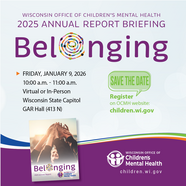
OCMH will release its 2025 Annual Report at a briefing event on Friday, January 9, 2026, 10-11 am. The event will be in person and virtual – in person at the Wisconsin State Capitol, GAR Hall (413 N).
Register here
If attending virtually, a Zoom meeting link will be emailed prior to the event.
Feel free to share our 2025 Annual Report Briefing invitation.
The 2025 Annual Report, titled Belonging, highlights children’s mental health data and trends with a call out to belonging and loneliness. The report also includes the Wisconsin Child Well-Being Indicators Dashboard which publishes 42 child well-being indicators across four areas: quality of life, social and economic factors, clinical care, and health behaviors. The briefing event will present data highlights and feature youth speakers.
|
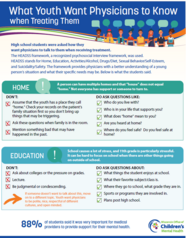
How doctors engage with teens in appointments can matter just as much as what they talk about. A new Doctor to Doctor podcast by the Wisconsin Chapter – American Academy of Pediatrics explores how clinicians can best communicate with teens about their health. Listen to the “Talking with Teens in Clinic” podcast here.
For more insight, see OCMH’s piece on “What Youth Want Physicians to Know When Treating Them.”
|
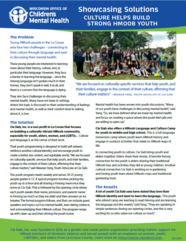
Cia Siab, Inc., in La Crosse, focuses on culturally-specific services that help youth and their families engage in their culture. Learning the Hmong language is key and something young HMoob people are interested in. Read their story in OCMH’s newest Showcasing Solutions.
Showcasing Solutions shares innovative things organizations are doing in children’s mental health across the state. See all OCMH’s Showcasing Solutions here.
|
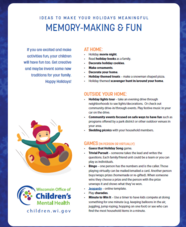
Make Your Holidays Meaningful
The holidays are a wonderful time to connect with loved ones, spend time together, and build memories. OCMH shares ideas on activities that are fun, creative, and can help make the holidays meaningful. See which you’d like to do:
|
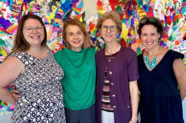
Happy Holidays from OCMH!
Your team at OCMH wishes you and your loved ones the happiest of holidays as we close out 2025 and look forward to 2026! Thank you for your work to support the mental health and well-being of Wisconsin’s youth!
- Linda Hall – Director
- Karen Katz – Operations Lead
- Amy Marsman – Senior Research Analyst
- Andrea Turtenwald – Family Relations Coordinator
|
Payments for Tribal-Regulated Child Care Providers. LRB-4252/1. Under current state law only child care providers licensed or regulated by the Department of Children and Families or those contracted by a school board are eligible to receive subsidies from Wisconsin Shares. This bill would expand the definition of child care providers eligible to receive Wisconsin Shares to include providers who are regulated by a Tribe and create a regulatory pathway for access to the subsidy program when a child care program is regulated by a federally-recognized Tribe.
Missing Child Alerts. SB 466 / AB 477. Missing Child Alerts are issued for children under the age of 18 that do not qualify for Amber Alerts if they are thought to be unable to return home without assistance due to physical or mental condition or disability or if they are under 10 years of age. This bill would raise the mandatory age for a missing child alert to 12 years of age. Passed by Senate, currently in the Assembly.
Distributing material harmful to minors on the Internet. AB 105 / SB 130. This bill prohibits businesses from knowingly and intentionally distributing and publishing material harmful to minors on the internet, specifically on a website that contains a substantial portion of this material, unless reasonable age verification is performed. “Material harmful to minors” is defined as material that is designed to appeal to prurient interests, that principally consists of descriptions or depictions of actual or simulated sexual acts or body parts, and that lacks serious literary, artistic, political, or scientific value for minors. In addition, this bill prohibits business entities from knowingly and intentionally publishing or distributing obscene material or an obscene depiction of a purported child on the Internet. Passed Assembly and passed out of Committee in Senate. Currently available for scheduling in the Senate.
SAFE Kids Act. LRB-3702. The SAFE Kids Act creates prohibitions related to the treatment of minors by Social Media Platforms. The bill protects children, while still allowing them to use social media without unrealistic limits on tech companies or users. The bill requires age verification for social media users, prohibits social media companies from targeting minors with advertisements, prohibits the collection and monetization of children’s data, and restricts the use of algorithms that present recommended or paid content to minors. It also requires the Department of Justice to maintain a website where complaints can be submitted. 1 in 5 teens report their use of social media to be “almost constant” and some studies have linked social media use with an increased risk for anxiety and depression in teens.
Funding for WIC. SB574 / AB 578. Fiscal stress on the home is a major contributor to anxiety and depression in children. Through state and federal funds, Department of Health Services (DHS) provides benefits to eligible low-income individuals under the supplemental food program for women, infants and children, known as WIC. As was recently seen, when a federal government shutdown occurs, the uncertainty of the federal funding for these programs trickles down to the families and children who rely on them. This bill provides additional state funding to DHS during a federal shutdown so that the WIC benefits remain available at the level prior to lapse. Referred to the Senate Committee on Licensing, Regulatory Reform, State and Federal Affairs.
Note: This Legislative Update was prepared by Dr. Kellie Snooks, who is lending some of her Fellowship time to OCMH. Dr. Snooks, DO, MPH FAAP is an Assistant Professor of Pediatrics at the Medical College of Wisconsin and an Attending Physician in Pediatric Critical Care at Children’s Wisconsin. Dr. Snooks was selected as the 2025- 2026 National Academy of Medicine State Health Policy Fellow, sponsored by Advancing a Healthier Wisconsin Endowment Fund. She will spend a year embedded in the Wisconsin Department of Health Services, working on Child Health Policy relevant topics. Outside of health policy, Dr. Snooks focuses her academic career on violence and injury prevention in youth.
First-ever Hmong-Language QPR
The Hmong American Center announced the release of the first-ever Hmong-language QPR (Question, Persuade, Refer) Suicide Prevention materials. The project is the result of a collaborative effort involving the Hmong American Center, Marathon County Health Department, New Beginnings for Refugees, Aspirus, and the National QPR Institute. To learn more and access the training, visit here and: 1) hover over “In Person Training,” 2) click on “Find an Instructor,” and 3) enter your zip code to search for local instructors and use the email form to request a class.
See OCMH’s related resource, Addressing Asian American Suicide in Wisconsin in English and Hmong.
Four Years On: Children’s Mental Health Remains a National Emergency
Four years after the American Academy of Child and Adolescent Psychiatry (AACAP), the American Academy of Pediatrics (AAP), and the Children’s Hospital Association (CHA) declared a national emergency for children’s mental health, the issue remains urgent. Children nationwide continue to struggle with anxiety, depression, suicidal thoughts, and other mental health conditions. Too many families face barriers to accessing pediatric mental health services, often experiencing long delays for specialized care. Emergency departments continue to see higher numbers of youth in mental health crisis. Each of the three organizations reissued press releases drawing the nation’s focus back to this. See these individual press releases:
|
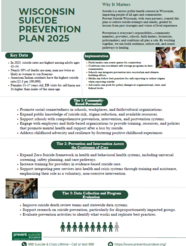
Wisconsin Suicide Prevention Plan 2025 One-Pager
Prevent Suicide Wisconsin released the Wisconsin’s Suicide Prevention Plan 2025 earlier this fall and now has a one-page summary of the full report. See that here.
See OCMH related data on suicide:
|
Resource for Supporting Young Minds
Mental Health America created Supporting Young Minds which is designed to equip both youth and the caring adults in their lives with free, practical mental health tools. The collection includes actionable guides and activities on building resilience and building adult allies. Learn more.
|
MHA-WI Peer-to-Peer Grant
Mental Health America of Wisconsin has a funding opportunity for elementary, middle, and high schools in Wisconsin to train students to recognize the signs of suicide. Applications are due January 16, 2026. Learn more.
|
Wisconsin Office of Violence Prevention Launches $10 Million Grant Program
A new grant application is open to support initiatives and programs that help prevent violence across Wisconsin. This aims to support initiatives and programs at school districts, law enforcement agencies, domestic violence organizations, firearm retailers, and local governments, among others, to help crack down on crime and prevent violence, including intimate partner and gun violence, across Wisconsin. Applications are due January 16, 2025, 2 pm. Learn more.
Maternal and Child Health Grief and Bereavement Support Funding Opportunity
The Title V Maternal and Child Health (MCH) Services Block Grant, administered by the Wisconsin Department of Health Services (DHS), provides funding and support to local and Tribal Health agencies and other organizations to improve the health and supporting the well-being of mothers, infants, children, and families. This funding opportunity provides statewide, comprehensive support and prevention resources to parents and families who have experienced sudden infant death syndrome or other forms of infant loss. Application due December 14, 2025. Learn more and apply.

|