 HAI Happenings: Quarter Four 2025 Newsletter
This message is being sent to local public health department officers, nurses, and staff; Tribal health directors; infection preventionists; and key DPH staff.
HAI Happenings highlights new and noteworthy topics for all things related to healthcare-associated infections (HAI), including infection prevention and control (IPC), antimicrobial stewardship (AS), antibiotic resistance (AR), surveillance, and more. You can also find links to helpful guidance and resources and learn more about current Wisconsin HAI Prevention Program activities.
Knowledge check
Test your HAI knowledge. See answer at the end of the newsletter.
True or False: An acute respiratory illness (ARI) is characterized by having two or more of the following symptoms: cough, shortness of breath, sore throat, runny nose, headache, myalgia, chills, fatigue, or fever.
|
|
 |
What's new with the HAI Prevention Program?
-
The HAI Program hosted a workshop for local and Tribal health departments (LTHDs) on Legionnaires’ disease outbreak investigations. This interactive workshop walked through a mock outbreak and discussed Legionella risk factors, infection prevention best practices, and how LTHDs can collect and interpret evidence to identify a root cause of an outbreak. Missed the workshop? No worries! You can view the recording on our Resources for Local and Tribal Health Departments webpage.
- Starting in 2026, the LTHD Workshops will be held twice a year. Stay tuned for more information in the new year!
-
In collaboration with our dental partners, the HAI Program updated our Oral Health Antibiotic Toolkit! The toolkit now provides a number of decision-making tools that can help providers make prescribing decisions.
-
Artificial joints and dental procedures, are antibiotics needed? Check out the newly update resource and use the discussion points to have conversations with your patients who have artificial joints.
-
A cool new resource is now available to make hand hygiene audits and compliance reporting easier! Take a look at the Hand Hygiene Observation Tracking Workbook can be used to record and analyzing hand hygiene observations.
In the news
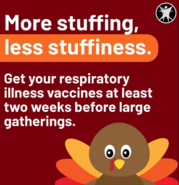
DHS issued a news release urging Wisconsinites to get vaccinated now to be protected for the holidays and beyond. The news release shares vaccine recommendations, how to schedule a vaccine appointment, and resources for those who do not have insurance.
|
Best practice and guidance updates
-
The Society for Healthcare Epidemiology of America (SHEA) released new multisociety guidance for nursing homes. The updated guidance and recommendations look to strengthen IPC in nursing homes.
-
DHS encourages long-term care and other health care facilities to be proactive in planning for and preventing outbreaks. This GovD message shares steps health care facilities can take to keep residents, patients, and staff safe and healthy this holiday season. Guidance and recommendations shared include ARIs and gastrointestinal illnesses.
-
Check out new respiratory virus data! DHS has launched new wastewater testing for respiratory viruses and updated respiratory virus data dashboards to help Wisconsinites stay informed and protected.
-
A new respiratory illness webpage provides a summary of data reported on outpatient and urgent care health care visits for illnesses defined as influenza-like illnesses (ILI).
Project Firstline spotlight
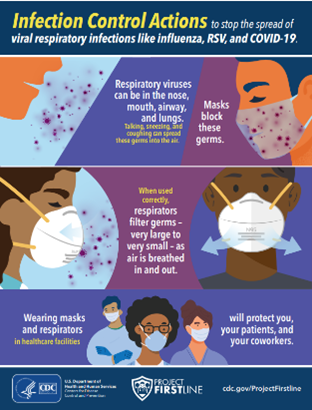
It’s respiratory season once again! COVID-19, flu, and RSV are not only spreading in communities but the risk of spread in health care settings is increased too. Check out Project Firstline’s infection control guidance for respiratory viruses. Read up on the latest recommendations and find resources!
|
Notes from the field
Each quarter we’ll highlight a specialty topic area or setting that the HAI Prevention Program works with and take a deep dive into guidance, recommendations, or notes from the field from our IPs. This quarter, we’re focusing on multidrug-resistant organisms (MDROs).
MDROs have the potential to spread rapidly, increase antibiotic resistance, and cause difficult-to-treat infections. Here in Wisconsin, we are seeing a concerning rise of reportable MDROs such as Candida auris. These MDROs are commonly spread through direct contact with colonized or infected patients or residents, by the hands or clothing of health care personnel, or through contaminated surfaces in the environment.
Because there are specific infection prevention and control strategies required to reduce the risk of spreading MDROs to others, a patient’s or resident’s MDRO status should be communicated each time they transfer. Communication failures have been identified as a key contributor to the spread of MDROs between facilities in Wisconsin and in other states. Patients or residents with MDROs receive health care in multiple settings, putting facilities across the health care continuum at risk for transmission and outbreaks.
Implementing strong communication strategies, both internally and externally, can help mitigate spread. Strategies include:
-
Using communication tools. Implement internal communication strategies such as infectious disease banners in electronic health records and applicable transmission-based precautions or enhanced barrier precautions door signage. For external communication, consider using health care facility transfer forms.
-
Engaging and communicating with staff. Involve staff in developing the transfer communication process and provide them with the communication tools they need. Regularly check in with them to see if communication is effective.
-
Building partnerships across the care continuum. Develop collaborative, trusting relationships with other healthcare facilities you routinely work with and strive to use consistent communication strategies to create strong transfer networks.
HAI Prevention Program highlights
November 18–24 was U.S. Antibiotic Awareness Week (USAAW)! USAAW is an observance that promotes safe antibiotic use, reducing the potential for antibiotic resistance, and decreasing the spread of infections caused by resistant organisms. The HAI Program proudly works with many health care and public health partners to support antibiotic resistance surveillance statewide and provide technical assistance around antibiotic use and resistance. To learn more about antibiotic resistance and the resources we provide, visit the antimicrobial stewardship webpages.
Knowledge check answer
True! Find more information about ARIs, including the updated staff exclusion and return to work guidance, on our Prevention and Controlling Respiratory Illness Outbreaks in Long-Term Care Facilities and Other Health Care Settings webpage.
|