 HAI Happenings: Quarter Three 2025 Newsletter
This message is being sent to local public health department officers, nurses, and staff; Tribal health directors; infection preventionists; and key DPH staff.
HAI Happenings highlights new and noteworthy topics for all things related to healthcare-associated infections (HAI), including infection prevention and control (IPC), antimicrobial stewardship (AS), antibiotic resistance (AR), surveillance, and more. You can also find links to helpful guidance and resources and learn more about current Wisconsin HAI Prevention Program activities.
Knowledge check
Test your HAI knowledge. See answer at the end of the newsletter.
True or False: All health care staff caring for patients with suspected or confirmed measles should wear a fit-tested NIOSH-approved N95 or higher level respirator even if they have immunity.
|
|
 |
What's new with the HAI Prevention Program?
-
The HAI Program is hosting a quarterly workshop for local and Tribal health departments (LTHDs) on September 30. This interactive workshop will walk participants through a case study inspired by real events involving a Candida auris (C auris) case. Participants will review the processes for investigating a C. auris outbreak in a health care facility. Participants will also have a chance to practically apply their infection prevention and control knowledge to the scenarios being discussed. Learn more about the LTHD Infection Prevention workshop and register on our Resources for Local and Tribal Health Departments webpage.
-
The HAI Prevention Program hosted a fall Infection Preventionist Bootcamp session in Green Bay. This two-day, in-person training brought over 30 IPs from across the state together to learn about IPC practices and network with others. The training included presentations, discussions, and hand-on activities. Be on the lookout for more information on upcoming Bootcamps!
-
Wisconsin statewide inpatient antibiograms have been added to our Antibiogram webpage. We’ve summarized antibiotic resistance data submitted to the National Healthcare Safety Network by Wisconsin hospitals to create the statewide antibiograms.
-
The HAI Program has published a number of new resources this quarter:
-
Recommendations for Prevention and Control of Targeted Multidrug-Resistant Organisms (MDROs) for Prison and Jail Settings is available! Check out this latest MDRO guide that provides recommendations for preventing and controlling MDROs in prison and jail settings.
-
Health care provider script and patient factsheets are now available. These tools consist of a script for health care personnel to educate patients on various HAI topics, as well as a take-home factsheet for patients so they can revisit the information shared. Topics include:
-
Check out our new educational video series called IPC in 3! This educational video walks through how to read a disinfectant label and why it’s important to read and understand the instruction for use before using a disinfectant product. There is also an accompanying one-pager.
In the news
Best practice and guidance updates
-
DHS continues to recommend the COVID-19 vaccine for all Wisconsinites 6-months and older. On September 16, DHS issues a statewide standing medical order that allows most Wisconsinites to receive a COVID-19 vaccine with a prescription. View the news release to learn more.
-
On August 4, 2025, DHS released a Health Alert detailing the first confirmed measles cases in Wisconsin. The message shared guidance for health care providers on preparing to care for patients with suspected of confirms measles.
-
Additional guidance for providers and infection preventionists was shared in a GovDelivery messaged shared on August 22, 2025.
-
The DHS Immunization Program has measles resources for health care providers. Check out the Measles Guidelines document for surveillance and control guidance. Also visit the Measles Readiness Toolkit to help prepare for measles cases in your community. Want more resources? Visit the DHS Measles webpage.
Project Firstline spotlight
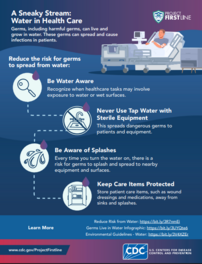
Project Firstline recently released Infection Control Micro-Learns focused on water in health care! Check out the newest resources:
|
Notes from the field
Each quarter we’ll highlight a specialty topic area or setting that the HAI Prevention Program works with and take a deep dive into guidance, recommendations, or notes from the field from our IPs. This quarter, we’re focusing on safe injection practices.
August was National Immunization Awareness Month. Just as it is important for all of us to stay up to date on vaccinations, following safe injection practices is also crucial. Unsafe injection practices can lead to serious illness from bloodborne pathogen or bacterial contamination.
Injection safety is a core component of standard precautions and includes practices such as:
- Preparing medication in a designated, clean prep area.
- Using aseptic technique.
- Disinfecting the access point of the vial.
- Using needles, syringes, and single-dose vials for one patient only.
- Dedicating multi-dose vials to a single patient when possible.
- Accessing multi-dose vials in a centralized location and not bringing the vial into the patient care area unless dedicating as single use.
- Wearing personal protective equipment when appropriate.
Facilities should ensure staff are trained and competent on safe injection practices to reduce the risk of disease transmission associated with unsafe injection practices.
HAI Prevention Program highlights
September is Dental Infection Control Month!
Did you know that the HAI Program aims to enhance infection prevention and control education in dental and oral health clinics across the state. The HAI Program to provides resources to assist dental and oral health clinics in developing effective IPC measures that ensure the health and safety their staff and patients, while also building relationships with public health. Check out our Infection Prevention in Oral Health Settings webpage to find IPC considerations, recommendations, and administrative resources.
|
Knowledge check answer
True! Review the CDC’s Interim Infection Prevention and Control Recommendations for Measles in Healthcare Settings for more guidance on controlling measles in health care settings.
|