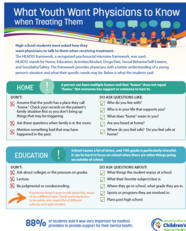
We asked teens what they want physicians to know about them when they receive treatment, and they had a lot to say. We captured their opinions in our new resource – “What Youth Want Physicians to Know When Treating Them.” It is a great tool for all medical providers. Learn how to approach tough topics and honor teen’s feelings.
Topics covered include: home, education, activities and alcohol, diet and drugs, self-esteem and sexuality, and safety and suicide. We’ve used a “don’t” and “do” framework which makes the teen’s comments easy to remember.
See the new resource here.
|

OCMH urges sustainable investments be made in school-based mental health services. In his 2025-2027 State Budget proposal, Gov. Evers recommended an ongoing $83.9 million for school mental health, with the greater of $100,000 or $100 per student enrolled in the previous year. However, last week the Joint Finance Committee on a partisan vote (12-4) recommended one-time funding of $10 million in each year of the biennium.
Children spend the majority of their days in school, and that is where many receive mental health services. Although 84% of schools provided individual-based mental health treatment last year, less than half say they can keep up with the demand.
School-based mental health services include more than individual therapy. School-based mental health is a continuum of support and can include building students’ stress management skills, developing the ability to resolve conflicts without aggression, screening students for negative mental health, and understanding how to get help if a student or their peers need it.
“We’ve all heard of the long wait lists for kids to get mental health help,” said Linda Hall, Director - Wisconsin Office of Children’s Mental Health (OCMH). “Our kids can’t wait for a spot to open on a provider’s waitlist. We need to help kids today, and one of the most strategic investments we can make is in school-based mental health.”
School-based mental health is a major component of OCMH’s priorities for the 2025-2027 State Budget. See the full list of OCMH’s children’s mental health budget priorities here.
|
OCMH’s Children's Mental Health Initiatives document is an inventory of the known initiatives happening in Wisconsin that impact children’s mental health and well-being. The inventory highlights larger collaborative as well as stand-alone agency initiatives. Users can explore programs with substantial funding ($100,000 or more), identify which agencies and organizations are driving these programs, and connect with ongoing efforts to collaborate or avoid duplication. The focus of the Initiatives inventory is on state agencies and required statewide entities along with coalitions, councils and cross-agency collaborations. We also list statewide associations that work in this space. The information reflects updates as of December 2024 and does not contain updates on current federal funding levels given the widespread uncertainty around recent funding issues.
|
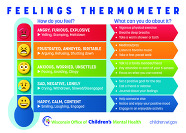
OCMH Feeling Thermometer – Great Summer Tool for Families
It is summer vacation, many kids are home, and some families are spending more time together. That can be great, but it can also cause times of stress. OCMH wants to remind families of our Feelings Thermometer – a great tool to identify and cope with emotions. The thermometer identifies feelings and suggests ways to shift moods when things get tough or behaviors are challenging. We suggest families use it daily to check in with each other! See our Feelings Thermometer and additional information here. It is available in 11 languages – just scroll down on the webpage and print your preferred language. Then hang it on your fridge so it is available when you need it.
We also have an Early Childhood Feelings Thermometer specifically tailored to our youngest children, ages 0-5. It is ideal for child care providers and adults working with young children. Access it here in 3 languages as well as our accompanying Thermometer Gauge which allows young children to point to the emotion they are feeling.
Child care providers – we have limited quantities of the Early Childhood Feelings Thermometer and gauge printed on 8.5 X 11" card stock in English and Spanish. If you would like to request copies, email us at OCMH@wisconsin.gov.
|
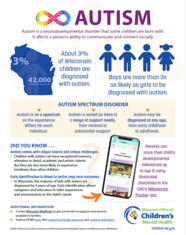
Newest OCMH Data Bite is on Autism
Autism is a neurodevelopmental disorder that some children are born with. It affects a person’s ability to communicate and connect socially.
Did you know...
- Autism comes with unique talents and unique challenges.
- Early identification is linked to better long-term outcomes.
See the Data Bite on Autism here.
|
Newest Showcasing Solutions - Acceptional Minds Helps Kids with Autism
Families with a child newly diagnosed with Autism often find themselves lost in the transition to a new lifestyle. Acceptional Minds, located in Green Bay, WI, focuses on children with Autism and others who are struggling. See how they do it in OCMH’s newest Showcasing Solutions here.
|
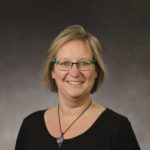
OCMH Lived Experience Partner Sue Mitchell Metz Wins HOPES Award
Prevent Suicide Wisconsin presented Sue Mitchel Metz its HOPES Award at its recent conference in May. The HOPES Award, which stands for Helping Others Prevent and Educate About Suicide, is presented annually to those who have demonstrated exceptional dedication to suicide prevention in Wisconsin. A licensed RN, Sue is a local advocate for mental health and suicide awareness with a goal to eliminate stigma associated with mental illness. She dedicates much of her free time as a volunteer helping those who have lost a loved one to suicide, suffer with suicidal ideation, or are in crisis.
|
988 Suicide and Crisis Lifeline Grants. AB 303 / SB 307. Requires the Department of Health Services to award grants to organizations that provide crisis intervention services and crisis care coordination to individuals who contact the national 988 Suicide and Crisis Lifeline from anywhere within the state. No funding is attached to the bill. Despite the higher than expected utilization of 988, the proposed federal budget does not allocate funding for it. The 988 hotline is operated by Family Services Northeast Wisconsin under a contract with DSH. Both the Assembly and Senate bills have been referred to committee.
Telehealth for UW System Students. AB 299 / SB 306 Require the University of Wisconsin System to contract with a vendor for the provision of virtual mental health services for students enrolled in UW System institutions with not more than 30,000 full-time enrolled undergraduate students. Services must be designed to complement existing institution-based mental health offerings and expand students’ access to mental health support services beyond traditional business hours. Demand for mental health services far exceeds what Universities are able to provide on-site. Senate Mental Health recommended passage on a 4-1 paper ballot on June 11.
Psychiatric Residential Treatment Facilities AB 111 / SB 106 - Establish a certification process for certifying psychiatric residential treatment facilities (PRTFs) to provide inpatient psychiatric services for individuals under age 21, under the direction of a physician. The bill also specifies that PRTF services are a reimbursable Medical Assistance (MA) benefit. The Senate Mental Health Committee voted 5-0 by paper ballot on June 11 to recommend passage.
Gun Safe & Firearm Safety Devices Tax Exemption. AB 10 / SB 12 – This bill which began as a tax exemption for the sale of gun safes was expanded to include firearm safety devices that prevent unauthorized access to the firearm or prevent it from being operated without first deactivating the device. Assembly Ways & Means and Senate Agriculture and Revenue have both recommended passage on unanimous votes.
Mental Healthcare is Healthcare. A package of bills aimed at addressing the critical and urgent mental health needs of Wisconsinites is being circulated by Democratic legislators. Most of the bills would increase support for school mental health. Support for increased, sustainable funding for school mental health is OCMH’s number one budget priority. The draft bills, which have not been assigned to a committee for consideration, are: LRB-0013, -1677, -1678, -1680, -1681, -1682, -1683, -1691, and -1700.
#Safe Summer. Six firearm safety measures that were included in Gov. Tony Evers’ proposed budget, but were removed by the Legislature at the beginning of its budget deliberations have been introduced into both the Assembly and Senate by Democratic legislators. Firearm Safety is prominently featured on OCMH’s budget priority list, since death by firearm is the number one cause of death for youth. The draft bills, which have not been assigned to a committee for consideration, are: LRB 0827/LRB 1276, LRB 0829/LRB 3082, LRB 1598/LRB 3517, LRB 3342/LRB 3489.

Interagency Council on Mental Health Invites Wisconsinites to Take Survey
In 2024, Governor Tony Evers created the Interagency Council on Mental Health and brought together 10 state agencies to create a statewide action plan to address Wisconsin's mental health crisis. The Council invites Wisconsinites to share their thoughts on mental health by taking a survey. They want to hear from people with a range of experience with mental health including people with lived experience, those who provide care or treatment to people with mental health conditions, and mental health advocates. The survey is open through June 30th.
|
Updated 988 Promotional Materials Available
New social media posts, static and animated ads, billboards, posters, videos, and more promoting 988 are now available from the Wisconsin Department of Health Services (DHS). Access them here. The updated pieces ensure there is a clear understanding about what the 988 Suicide & Crisis Lifeline is and how it works in Wisconsin.
DHS has an ongoing online 988 campaign running until mid-September. Additionally, ads on gas pumps, media in bars, and billboard advertising throughout the state is running through August.
The 988 in Wisconsin data dashboard is updated monthly to offer insights on the impact of 988 in Wisconsin. See data for calls, texts and chats, and demographics. Data points include county-level data, top reasons for contacting 988, and percentage of contacts resolved with the 988 counselor and no need for outside intervention. View the 988 in Wisconsin data dashboard.
|
Tracking Federal Funding’s Effect on Public Education in Wisconsin
The Wisconsin Department of Public Instruction has created a webpage to offer up-to-date information on federal funding, highlight the importance of these funds, and to provide tools and resources needed to advocate for Wisconsin’s education future. See a detailed list of federal program and funding cuts and federal funding by school district. Access the webpage here.

June is Pride Month
Pride Month is celebrated each year in the month of June to recognize the impact the LGBTQIA2s+ (lesbian, gay, bisexual, transgender, queer/questioning, intersex, asexual, two-spirit, and countless affirmative ways others choose to identify) people have had on society locally, nationally, and internationally. View Gov. Evers’ proclamation for Pride Month here. Learn about the history of LGBTQ here, the history of the LGBTQIA2s+ movement in America here, and Wisconsin’s LGBTQ+ history here.
|
|