 HAI Happenings: Quarter One 2025 Newsletter
This message is being sent to local public health department officers, nurses, and staff; Tribal health directors; infection preventionists; and key DPH staff.
HAI Happenings highlights new and noteworthy topics for all things related to healthcare-associated infections (HAI), including infection prevention and control (IPC), antimicrobial stewardship (AS), antibiotic resistance (AR), surveillance, and more. You can also find links to helpful guidance and resources and learn more about current Wisconsin HAI Prevention Program activities.
Knowledge check
Test your HAI knowledge. See the end of the newsletter for the answer.
When transferring a patient or resident between health care facilities, what information is important to communicate?
|
|
 |
a. Current infection, colonization, or history of positive culture with a multidrug-resistant organism
b. Current symptoms (such as cough, fever, or diarrhea)
c. Any indwelling medical devices
d. Current precautions (such as contact or airborne precautions)
e. All of the above
f. None of the above
What's new with the HAI Prevention Program?
Infection preventionist coverage has changed. The Wisconsin HAI Prevention Program recently restructured its infection preventionist (IP) team, increasing the number of infection preventionists providing direct, regional, IPC support to health care facilities and local and Tribal health departments (LTHDs) across Wisconsin. |
|
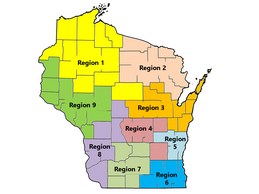 |
Previously, IP coverage followed the Wisconsin public health regions and five infection preventionists were designated to Wisconsin’s 72 counties. Updated coverage follows new regional boundaries unique to the HAI Prevention Program IP team. This change better allows IPs to build and strengthen close, working relationships with LTHDs and health care facilities in their designated region. This change went into effect March 3, 2025.
The HAI Prevention Program’s experienced IPs continue to provide infection prevention support to LTHDs and various health care settings including acute care, long-term care, ambulatory care, dialysis, and oral health as well as on a variety of topics such as multidrug-resistant organisms and One Health. Services are always educational, collaborative, non-regulatory, and free of charge.
Visit our HAI Program Contact Information webpage to view the new regional map and for additional HAI Prevention Program contacts.
In the news
-
A case of oropouche virus was detected in a Wisconsin resident. Oropouche virus is spread primarily by infected biting midges (also called “no-see-ums”) and some mosquitos. It can also be passed from an infected pregnant person to their fetus. Oropouche virus has been found in parts of South America, Central America, and the Caribbean. People who have traveled to these areas are at risk for infection. Learn more about oropouche virus testing, diagnosis, and treatment.
-
On March 7, 2025, CDC (Centers for Disease Control and Prevention) released a health alert on measles and provided guidance related to travel.
-
On February 22, 2025, Lyons ReadyCare and Sysco Imperial Frozen Supplemental Shakes were recalled due to the potential for the products to be contaminated with Listeria monocytogenes. Frozen supplemental shakes were sold to institutional settings, including long-term care facilities and hospitals, nationwide. As of February 24, 2025, according to the U.S. Food and Drug Administration (FDA), 38 people infected with the outbreak strain of Listeria monocytogenes have been reported in 21 states. Twelve deaths have been reported.
-
CDC (Centers for Disease Control and Prevention) released a two Health Alert Network (HAN) advisories covering Influenza A in hospital patients and Ebola outbreak in Uganda.
Best practice and guidance updates
-
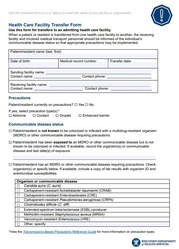
Facilities are encouraged to use the recently published HAI Prevention Program health care facility transfer form (PDF) when transferring patients or residents to another health care facility to communicate communicable disease status.
Communication failures at the time of transfer have been identified by the Wisconsin HAI Prevention Program as a key contributor to the spread of communicable diseases, especially multidrug-resistant organisms (MDROs), between facilities. When a patient or resident is transferred from one health care facility to another, the receiving facility and involved medical transport personnel should be informed of the individual’s communicable disease status so that appropriate precautions may be implemented. The template health care facility transfer form was developed by the HAI Prevention Program, in collaboration with partners. The form can be used to inform receiving health care facilities of a patient or resident’s communicable disease status. The form is fillable and can be used as is or adjusted to meet the needs of your facility or organization.
|
Project Firstline spotlight
Did you know? CDC’s Project Firstline partners with a number of organizations in health care, public health, and academia, one of those being the American Medical Association (AMA). The AMA puts out a number of Project Firstline related materials including webinars, podcasts, and training modules.
Check out this webinar series which addresses IPC challenges in various health care settings and provides recommendations for health care staff.
National kidney month: protect your patients on dialysis
March is national kidney month! Kidneys are essential organs that help blood and remove fluid and toxins from the body. When someone is in kidney failure, dialysis treatments may be needed to filter out fluid and toxins in the kidneys. Did you know our program provides specialized infection prevention education and assistance for dialysis settings? Visit our infection prevention in dialysis website to learn more.
HAI Prevention Program highlights
In case you missed it, starting in 2025 the HAI Prevention Program established quarterly virtual LTHD Infection Prevention Workshops. This month, the program held the first workshop taking participants through a virtual environment of care tour where they learned to identify and mitigate infection risks in a health care facility. Learn more about the LTHD Infection Prevention Workshops and upcoming opportunities on our Resources for Local and Tribal Health Departments webpage.
Knowledge check answer
e. All of the above
|