Wisconsin COVID-19 news, data, Governor’s news, and resources for the week of October 3, 2022.
DHS News
DHS-Supported Community Testing Sites to Shift to Rapid Antigen Testing
Throughout October, the Wisconsin Department of Health Services’ (DHS) Community Testing Support Program (CTSP) sites statewide are shifting to a new model of testing that first uses point of care (POC) antigen tests to provide rapid results to individuals. Testing sites will continue to provide PCR testing when confirmatory results are needed for individuals with symptoms who have a negative antigen result.
To find a community testing site near you, visit our webpage. It is updated daily to show all testing sites that have been reported to DHS. The map and the list of sites include important information about each site’s requirements around appointments, walk-ins, age groups served, and contact information for the site. Anyone in need of testing is encouraged to contact their local testing site in advance to confirm hours, and any need for an appointment or pre-registration.
Stay Healthy this Fall: COVID-19 At-Home Tests and Booster Shots Still Available with No Out-of-Pocket Cost
DHS and the Office of the Commissioner of Insurance (OCI) are reminding Wisconsinites that COVID-19 at-home tests and booster shots are still available with no out-of-pocket cost.
DHS continues to urge all Wisconsinites to stay up to date with COVID-19 vaccines. Updated COVID-19 boosters are recommended for everyone ages 12 and up and are designed to give broad protection against COVID-19, including better protection against the currently circulating Omicron variant.
Pharmacies, health centers, and clinics are continuing to offer appointments at a variety of locations across the state. People are encouraged to check with their primary care provider, local or tribal health department or clinics, or visit vaccines.gov to find vaccination sites near them. Health plans are also required to cover the cost of COVID-19 vaccines, including boosters, through the end of the federally declared public health emergency.
A full version of this release is available here.
COVID-19 Testing Resources for You
If you are feeling ill or if you may have been exposed to someone who has tested positive for COVID-19, using a COVID-19 self-test is a safe and highly effective method for detecting COVID-19 infection.
COVID-19 self-tests can be purchased at local pharmacy or retail stores, and each Wisconsin household is eligible to order a package of COVID-19 self-tests that contain five tests for free at sayyescovidhometest.org. All health plans are also required to cover the cost of over the counter, at-home rapid COVID-19 tests for their members. COVID-19 tests may either be covered by the insurer with no upfront cost or reimbursed by the insurer.
If you think any package of COVID-19 tests you have at home may be expired, check before you throw it out!! The FDA has extended the expiration dates for many of the COVID-19 self-tests that are widely available at stores and pharmacies. To check if your package of COVID-19 tests has an extended expiration date, people can find more information here on all the FDA-authorized brands, as well as specific information on iHealth brand tests that includes a tool to search your package’s expiration here.
In addition to at-home self-tests, community testing sites remain accessible across Wisconsin. Find a site near you by dialing 211 or visiting the DHS Community Testing information page.
Keeping Wisconsin Kids Healthy
Children and teens are at risk for serious COVID-19 illness and can spread the virus to others—even if they don’t have symptoms. Updated COVID-19 vaccines are now recommended for everyone ages 12 and older. For resources to support your family’s health and well-being during the COVID-19 pandemic, visit the COVID-19 Resources for Parents and Guardians page.
Know the Facts: COVID-19 Vaccines and Pregnant People
Experts in fertility, maternal care, and public health strongly urge all individuals who are pregnant now or are wanting to have children in the future to get a COVID-19 vaccine. Pregnant people are at an increased risk for severe illness from COVID-19. Getting sick from COVID-19 infection when pregnant can cause preterm birth, stillbirth, and other pregnancy complications.
Millions of people have safely gotten the COVID-19 vaccine, thousands of whom have given birth or become pregnant after getting the vaccine. Studies looking into the safety and effect of vaccines on fertility and pregnancy have all shown that the COVID-19 vaccines are safe for people who are pregnant, or who want to have a child in the future. There is currently no evidence that COVID-19 vaccines cause fertility problems in women or men. Vaccination either before conception or early during pregnancy is the best way to reduce maternal and fetal complications. Vaccinated people are far less likely than unvaccinated people to get COVID-19. COVID-19 vaccination will help keep you from getting severely sick, being hospitalized, or dying from COVID-19.
Most people who get COVID-19 have mild illness and can treat themselves at home with rest, hydration, and over-the-counter medications to decrease fever and discomfort. For people at higher risk of experiencing severe COVID-19 illness, medications called monoclonal antibodies and oral antivirals are available throughout the state.
COVID-19 oral antivirals are pills taken by mouth at home after someone has tested positive for COVID-19. They help the body fight off the virus that causes COVID-19 and are proven to reduce serious symptoms that can lead to hospitalization and death. A prescription is required for these medications. These treatments need to start within five days of symptom onset, so it is important that people who develop symptoms of COVID-19 do not delay – they should test and seek treatment right away.
Data
Know Your Community Level
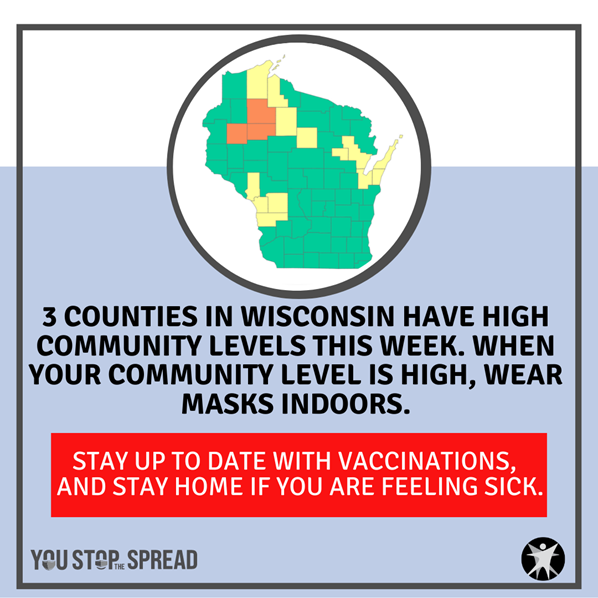
Wisconsin’s seven-day average of new COVID-19 cases has continued to decreased to around 858 new cases a day. Taking steps to control the spread of COVID-19 is important, especially to make sure hospitals have the capacity to provide the full range of health care. In addition, many people, particularly older adults, and people with underlying health conditions, remain at risk of serious illness, hospitalization, and death.
As of September 29, 2022, CDC data indicate 3 Wisconsin counties are in the “high” COVID-19 Community Level category: Barron, Rusk, and Sawyer. In addition, 13 Wisconsin counties are experiencing a medium COVID-19 Community Level, and 56 are experiencing a low COVID-19 Community Level. Residents in counties with a high COVID-19 Community Level are recommended to wear a well-fitting mask or respirator in public indoor settings, regardless of vaccination status.
Click here for more county level data.
In addition, DHS urges all Wisconsinites to take the following actions to help keep COVID-19 levels low in our communities:
-
Know the COVID-19 Community Level where you live or are traveling to and follow the associated guidelines.
-
Stay up to date on COVID-19 vaccines by getting all recommended vaccines and booster doses.
-
Get tested for COVID-19 if you have symptoms or were exposed to someone with COVID-19. Self-tests can be purchased at local pharmacy or retail stores. In addition to at-home self-tests, community testing sites remain accessible across Wisconsin. Find a site near you by dialing 211 or visiting the DHS Community Testing information page.
-
Stay home if you are sick or test positive for COVID-19 and talk to a health care provider or visit a community clinic to ask about available treatments. For free, confidential assistance finding a doctor or community clinic near you, dial 211.
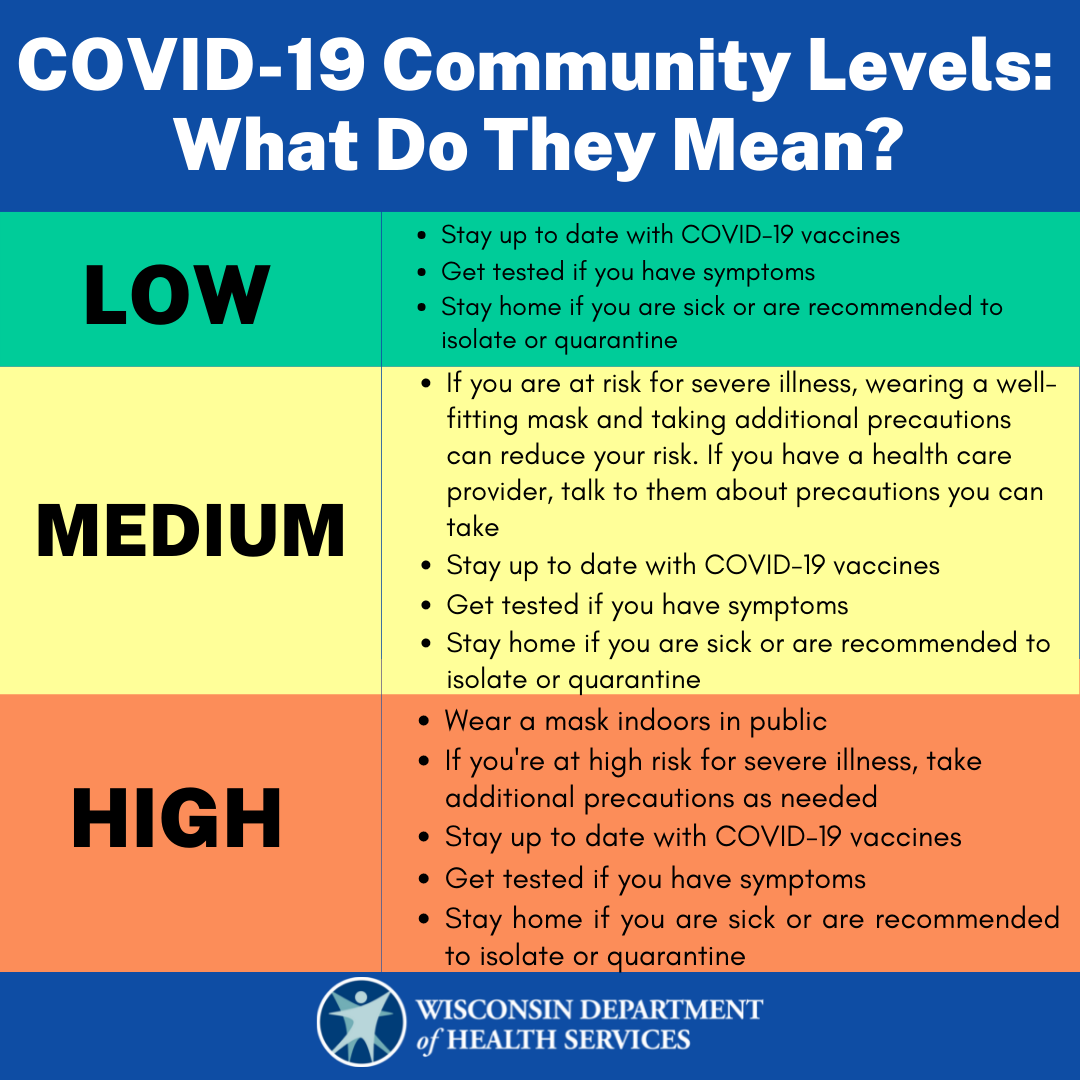
Individuals who have symptoms of COVID-19, have tested positive, or were exposed to someone with COVID-19 should continue to follow isolation and quarantine recommendations.
To find the latest guidance for your community, visit COVID.gov.
COVID-19 by the Numbers
• Cases
• Deaths
• Disease Activity
• Race and Ethnic Disparities
• Vaccine
Governor's News
Gov. Evers Announces More than 48,000 Households Have Received Over $200 Million in Help from Wisconsin Emergency Rental Assistance Program
From the governor's desk - The WERA program helped keep thousands of families in their homes during the pandemic; assistance is still available
The Wisconsin Emergency Rental Assistance (WERA) Program is open to Wisconsin residents who demonstrate a risk for experiencing housing instability, who have seen their income impacted by the coronavirus pandemic, and who earn a household income at or below 80 percent of the county median income. Rental and utility assistance payments are made directly to the landlord or utility provider on behalf of the tenant. More information is available at doa.wi.gov/Pages/WERA.aspx.
A full version of this release is available here.
Resources
Access to Health Care
 211 is Wisconsin’s statewide community referral service available to help you find community and health resources related to COVID-19, as well as resources that can help Wisconsinites access support around housing, finances, food access, childcare, or emotional support. Find an online directory to identify further information by topic, or available resources. And remember, if you want free, confidential personal assistance on these or other topics, dial 211 OR 877-947-2211, text your ZIP code to 898-211 or visit 211Wisconsin.org. A friendly voice is there to talk with you every day.
Other Languages, Graphics, and Print Materials
DHS materials are available in multiple languages as electronic files you can view online or download and print. You can use these materials at home or for your business. Visit the DHS website to view what resources are available to you.
Social Media
Follow DHS on social media for the most up-to-date information on the COVID-19 response and vaccine rollout.
Newsletter
Looking for previous newsletters? To view past versions of this newsletter, visit the DHS website.
|
|