This email is being sent to local health officers, tribal health directors, COVID-19 vaccinators, COVID-19 vaccine stakeholders, HERC coordinators, and key DHS staff. It includes key and supplemental information from the DHS COVID-19 Vaccine Program Update Webinar held on December 21.
Pfizer Pediatric and New Pfizer Tris 12+ Vaccines Get Shelf-Life Extensions
The Food and Drug Administration (FDA) has approved a shelf-life extension from 6 to 9 months for the Pfizer Pediatric vaccine (orange cap, 5- to 11-year-old, diluent required) and the new Pfizer Tris 12+ (gray cap, age 12+, no diluent), which will be available to order beginning January 5, 2022. These shelf-life extensions take effect immediately.
The date printed on the Pfizer Pediatric vaccine (orange cap) and the new Pfizer Tris 12+ (gray cap) vaccine vials indicate the manufacture date and not the expiration date. Originally, the expiration date was 6 months from the manufacture date.
The expiration date for Pfizer Pediatric vaccine (orange cap) and the new Pfizer Tris 12+ (gray cap) has now been extended to 9 months (while held at ultracold frozen temperatures.)
The FDA fact sheets for both products now read, “regardless of storage conditions, vaccines should not be used after 9 months from the date of manufacture printed on the vial and cartons." The updated expiry dates for both the orange and gray cap vials, based on 9 months from the date of manufacture are listed below.
|
Printed Manufacturing Date
|
9-Month Expiry Date*
|
|
06/2021
|
Feb. 28, 2022
|
|
07/2021
|
Mar. 31, 2022
|
|
08/2021
|
Apr. 30, 2022
|
|
09/2021
|
May 31, 2022
|
|
10/2021
|
Jun. 30, 2022
|
|
11/2021
|
July. 31, 2022
|
|
12/2021
|
Aug. 31, 2022
|
|
01/2022
|
Sept. 30, 2022
|
|
02/2022
|
Oct. 31, 2022
|
*Date of expiration always falls on the last day of the month
Updated Emergency Use Authorizations Fact Sheets
A reminder that the shelf-life extensions for the Pfizer Pediatric vaccine (orange cap) and the new Pfizer Tris 12+ (gray cap) require providers to update their Wisconsin Immunization Registry (WIR) inventory lots in a timely manner.
Please contact the WIR Help Desk with any questions at dhswirhelp@dhs.wisconsin.gov or 608-266-9691.
Johnson & Johnson Booster Recipients Not Approved or Recommended for Third Dose/Second Booster
DHS supports the Centers for Disease Control and Prevention’s (CDC) recommendation expressing a clinical preference for individuals to receive an mRNA COVID-19 vaccine (Pfizer-BioNTech or Moderna) over Johnson & Johnson’s (Janssen) COVID-19 vaccine, for primary series and booster doses.
The CDC’s Advisory Committee on Immunization Practices (ACIP) reaffirmed that receiving any vaccine is better than being unvaccinated. Individuals who are unable or unwilling to receive an mRNA vaccine will continue to have access to Johnson & Johnson’s COVID-19 vaccine.
Some people may benefit from the Johnson & Johnson COVID-19 vaccine in these cases:
- When a person has a contraindication to mRNA COVID-19 vaccines (such as a severe allergic reaction after a previous dose or to a component of an mRNA COVID-19 vaccine),
- When a person would otherwise remain unvaccinated for COVID-19 due to limited access to mRNA COVID-19 vaccines, or,
- When a person wants to receive the Johnson & Johnson COVID-19 vaccine despite the safety concerns identified.
Vaccinators should discuss the CDC recommendation with patients who prefer the Johnson & Johnson COVID-19 vaccine to ensure that they are fully informed about the risks.
At this time, it is recommended that recipients of the Johnson & Johnson’s (Janssen) COVID-19 vaccine receive a booster dose at least 2 months after their initial vaccination. Johnson & Johnson recipients who have already received a booster dose, regardless of COVID-19 vaccine type, are NOT approved or recommended for another booster or third dose at this time.
DHS Community-Based Vaccination Clinics Schedules
All DHS community-based vaccination clinics will be closed on December 24 – 26, and December 31 – January 2. These clinics are located in Dane, Douglas, Eau Claire, Marathon, Racine and Rock Counties.
Clinic Locations and Regular Operating Hours
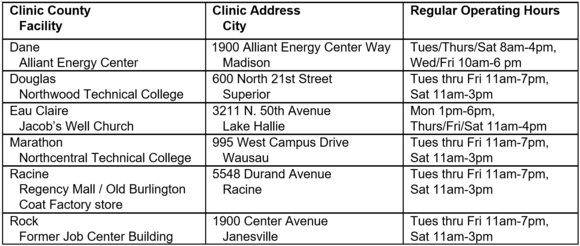 You can see the DHS community-based vaccination clinic hours and other information on the following webpage: https://www.dhs.wisconsin.gov/covid-19/vaccine-registry.htm
Correction: Wisconsin Providers Cannot Opt Out of Moderna Ancillary Kits
During the DHS COVID-19 Vaccine Program Update Webinar held on December 21, a web link to CDC was shared that was intended to give providers information on opting out of Moderna ancillary kits. DHS followed up with CDC and found that Wisconsin providers cannot opt out of Moderna ancillary kits, therefore, DHS asks thatproviders with an excess of ancillaries they cannot use consider donating them to schools, shelters, or other healthcare partners in their area.
How to Pronounce ‘Omicron’
For those still struggling with how to say Omicron (aa·muh·kraan), here is a link to an audio pronunciation.
Wisconsin COVID-19 Vaccine Program Webinar Schedule
Weekly COVID-19 Vaccine Program updates are held on Tuesdays from 11 a.m. – 12 p.m.
Register for the meeting series here. Watch recordings of past webinars here.
There will not be a webinar on Tuesday, December 28 or Tuesday, January 4.
Webinars will resume on a bi-weekly basis on Tuesday, January 11.
If you are already registered for the webinars, you do not have to re-register as we move to the 2022 every other Tuesday schedule.
|