This email is being sent to local health officers, tribal health directors, COVID-19 vaccinators, COVID-19 vaccine stakeholders, HERC coordinators, and key DHS staff.
Reflection
As of November 24, Wisconsin has administered more than 7.5 million doses of COVID-19 vaccine.
- 58.8% of all Wisconsin residents have received at least one dose.
- 55.9% of all Wisconsin residents have completed the vaccine series.
As of November 23, 942,446 additional and booster doses have also been administered in Wisconsin.
Thank you, Wisconsin vaccinators, for your continued hard work and dedication.
Thanksgiving Holiday Vaccine Ordering and Delivery Cadence
No COVID-19 vaccine will be delivered from Wednesday, November 24, to Sunday, November 28. Deliveries will resume on Monday, November 29.
- Orders placed between 8:00 a.m. on Friday, November 19, and 8:00 a.m. on Wednesday, November 24, will be delivered the week of November 29.
- There will be no shipping from Wisconsin hubs from Thursday, November 25, through Sunday, November 28.
Important Updates on Vaccine Ordering Processes
Going foward, all COVID-19 vaccine orders will be submitted through the COVID-19 Vaccine Ordering Survey. Until further notice, the Wisconsin Immunization Registry (WIR) will not be used for ordering COVID-19 vaccines. DHS is moving to a survey format to more efficiently and equitably receive and fill orders given current constraints. The survey opened on November 24.
The link to the survey for ordering COVID-19 vaccine is also available in WIR. Users will need to log into WIR and navigate to the announcements section. The link will also be included as a standing item in future weekly update to vaccinators. You may also bookmark the direct link as it will not change. Note for VFC and VFA providers: Please continue ordering your routine vaccines through WIR.
Order Processing Schedule
Hub orders will be processed daily Monday through Friday from orders submitted by 12:00 p.m. through the survey. Hub orders submitted after 12:00 p.m. will be held and processed the following day.
Direct ship orders will be processed weekly on Thursdays. Vaccine orders submitted after 12:00 p.m. on Thursdays will be held and processed the following Thursday. For more clarification, see the order delivery timeline section on the DHS COVID-19: Guidance for Vaccinating People Ages 12 and Older webpage or email dhscovidvaccinator@dhs.wisconsin.gov.
Minimum Vaccine Ordering Amounts
|
Vaccine Type
Delivery Method
|
Ordering Amounts:
|
|
Pfizer
HUB
|
Minimum of 30 doses. Increments of 30 doses. Maximum 900 doses
|
|
Pfizer
Direct Ship
|
Minimum of 1170 doses. Increments of 1170 doses.
|
|
Pfizer (5-11Y)
Direct Ship Only
|
Minimum of 100 doses. Increments of 100 doses.
|
|
Moderna
Direct Ship Only
|
Minimum of 100 doses. Increments of 100 doses.
|
|
Janssen
Direct Ship Only
|
Minimum of 100 doses. Increments of 100 doses.
|
Moderna Ordering Updates
As noted above, vaccinators will use the COVID-19 Vaccine Ordering Survey to order Moderna COVID-19 vaccine beginning November 29. It is critical that vaccinators continue to leverage the Wisconsin COVID-19 Vaccine Exchange to ensure Moderna vaccine is available to providers with a need.
Moderna Expiration Date Process
An important component to keeping an accurate inventory is ensuring expiration dates are correct. There have been a number of updates to the expiration dates of Moderna lots. All lots have now been updated in the Moderna expiration date website. Due to recent scrutiny from the CDC regarding Moderna inventory nationwide, and to ensure providers with inventory listed in WIR are working with correct expiration dates, DHS has implemented a new inventory accuracy process:
- An email will be sent to vaccinators from the vaccine supply coordinator with a deadline to update expiration dates and inventory counts. Instructions on how to complete that process in WIR will be included. If a vaccinator has expired inventory, the email will provide directions on how to submit a completed wastage form. Wastage forms can be found here. Completed forms need to be sent to dhscovidvaccinator@dhs.wisconsin.gov with “EXPIRED” in the subject line.
- If there is no response received from the vaccinator, a phone call will be made by the regional manager, who will walk through the process of inventory count by lot, updating in WIR, and changing expiration dates. At the end of the call, the vaccinator’s inventory will be accurate.
Remember: The Moderna vials must be maintained in the frozen state for the extension to be applicable. Extension does not apply to thawed vials.
Moderna Shelf-Life Extension
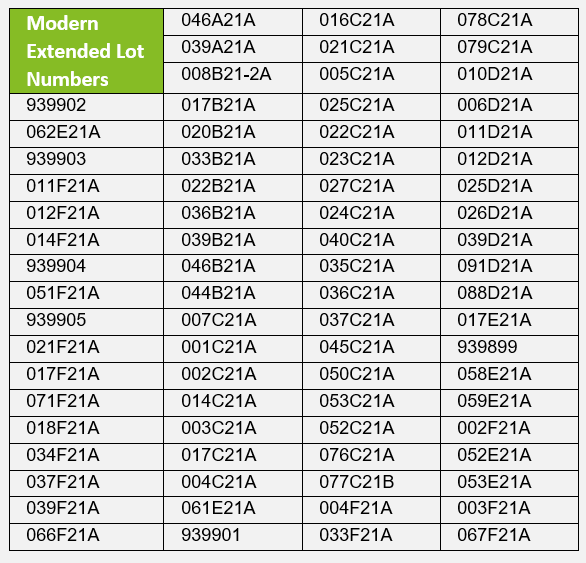
Moderna has completed the process of updating their database to reflect all of the 78 lots that have been extended. The list below represents all of the lot numbers. Moderna’s Look Up Tool remains the official indicator of product expiry, and we highly encourage you to continue to monitor your lot numbers at:
https://www.modernatx.com/covid19vaccine-eua/providers/vial-lookup#vialLookUpTool
Remember: Moderna vials must be maintained frozen for the extension to be applicable. The extension does not apply to thawed vials.
 Pfizer Pediatric Vaccine for Children Ages 5-11 Years
In order to accurately demonstrate the need for the pediatric Pfizer COVID-19 vaccine in Wisconsin into the future, it is imperative that our inventory is up-to-date, and all vaccinators are working together to use and redistribute vaccine.
Please remember to:
- Promptly add administered doses to WIR.
- Update inventory daily in WIR.
- Check inventory for accurate expiration dates and update in WIR.
-
Do not stockpile; order only what you need.
- Use the Wisconsin COVID-19 Vaccine Exchange to partner with other vaccinators to fulfill needs.
Additional Vaccination Guidance
- Direct ship orders may be subject to delays based upon weather or other factors outside of the state’s control. State holidays will also impact all delivery schedules. DHS recommends not scheduling appointments until you have received vaccine.
- Vaccinators will receive an automated confirmation email from the shipper confirming delivery on all direct shipped orders.
- Order only what need; avoid stockpiling.
Syringe Extraction Guidance
The Advisory Committee on Immunization Practices (ACIP) and the Centers for Disease Control and Prevention (CDC) do not yet have any official guidance regarding use of syringes with 0.2 mL tick marks to draw up doses of Moderna booster vaccine (0.25mL) and Pfizer pediatric diluent (1.3mL). Vaccinators using syringes that have tick marks at 0.2 mL intervals should use their best judgment to draw up halfway between the tick marks to extract the proper volume. For example, Moderna booster vaccine should be drawn between 0.24mL and 0.26mL. Pfizer diluent should be drawn between 1.2mL and 1.4mL. Alternately, if vaccinators have syringes in their private inventory that they are more comfortable using, they may use this syringe to administer the vaccine and replace syringes from their private supply with those from the ancillary supplies kit.
Pfizer recommends the use of a syringe with appropriate graduations to dilute with the directed 1.3 mL of saline. The impact to the final dose with a 1.2 or 1.4 mL dilution volume would be within 4% of the target dose. This suggests that using a syringe with 0.2 mL graduations and estimating the 1.3 mL volume will not significantly impact the intended dose.
Ancillary Kit Deficiency Reporting
Vaccinators are encouraged to report any issues with equipment in the ancillary kits that are shipped with their federal vaccine orders. There are four steps to reporting to ensure enough information is gathered so problem trends in packaging and shipping can be identified.
- Report deficiencies to McKesson directly, the customer service desk is charged with responding to problems and identifying trends.
- Report deficiencies to the Wisconsin Department of Health Services (DHS). This helps identify trends in problem equipment.
- If an error or injury occurs during vaccine administration, enter the information into Vaccine Adverse Event Reporting System (VAERS) at https://vaers.hhs.gov/reportevent.html.
- Because syringes are a medical device, complete FDA form 3500: https://www.accessdata.fda.gov/scripts/medwatch/.
Be prepared to provide photos, lot number, order number, date ordered and dates received when filing a report for a deficient ancillary kit.
National Influenza Vaccination Week Webinar: Improving Routine, Influenza, and COVID-19 Vaccination This Winter
The COVID-19 pandemic has highlighted the importance for all people to be up-to-date on their routine vaccinations, as well as their yearly influenza vaccine. Many children fell behind on routine vaccines and well-child visits during the pandemic. Routine, influenza, and COVID-19 vaccines are essential to helping children, families, and communities stay healthy.
National Influenza Vaccination Week (NIVW) provides healthcare workers and vaccination partners the opportunity to proactively communicate the potentially serious complications from influenza, the benefits of vaccination, and that there is still time to receive an influenza vaccine for this season if they haven’t done so. Additionally, influenza vaccine can be given with a COVID-19 vaccine for individuals who are eligible, including everyone 5 years and older. Both COVID-19 and influenza vaccines are needed this season. As long as influenza remains a potential public health threat, efforts to vaccinate and raise awareness about the importance of vaccination should continue throughout flu season to protect as many people as possible against flu.
Please join the Public Health Foundation (PHF) for a webinar featuring immunization experts from the Centers for Disease Control and Prevention (CDC) during National Influenza Vaccination Week (NIVW).
Monday, December 6, 2021 from 1:00 – 2:00 p.m. CST
Click Here to Register
New and Updated Resources
Updated Clinical Guidance from CDC
Updated Communication and Education Resources from DHS
- New videos, featuring Dr. Ryan Westergaard and Dr. Jasmine Zapata, are now available on DHS’s COVID-19 playlist on YouTube, addressing topics from pediatric vaccinations, pregnancy, and booster dose recommendations.
In Case You Missed It
Wisconsin COVID-19 Vaccine Program Webinar Schedule
Weekly COVID-19 Vaccine Program updates are held on Tuesdays from 11 a.m.-12 p.m.
Register for the meeting series here. Watch recordings of past webinars here.
Please note: as of November, there is a new meeting series link and you will need to re-register.
FDA Expands Eligibility for COVID-19 Vaccine Boosters
DHS supports the recommendation that anyone 18 and older receive a booster dose of COVID-19 vaccine at least six months after having received their second dose of the Pfizer-BioNTech (Pfizer) or Moderna vaccine. All adults are now eligible to receive booster doses, and booster doses are strongly recommended for everyone 50 and older, who are at the greatest risk for severe disease.
After rigorous review of all available data, the Food and Drug Administration (FDA) authorized and the Centers for Disease Control and Prevention's (CDC) Director recommended anyone 18 and older receive a booster dose of the Pfizer or Moderna COVID-19 vaccine at least six months after the completion of their Pfizer or Moderna vaccine primary series.
Vaccine Providers Using State Resources Cannot Bill Through Other Sources
DHS is reminding COVID-19 vaccine providers who are using state resources, such as WING or AMI, to support COVID-19 vaccination, whether it be full support or partial support, cannot bill patients or their insurance, or receive payment from insurance for the administration of the COVID-19 vaccine.
In addition, the CDC requires all vaccinators to provide vaccines at no cost to patients. Vaccine providers not using state resources may charge patients who have insurance an administrative fee as long as that fee is covered by public or private insurance plans and is not passed onto the patient. Vaccinators cannot collect a co-payment or any other charges directly from a patient.
DHS also continues to remind vaccine providers, whether they use state support or not, that they cannot require people to provide an ID in order to receive the COVID-19 vaccine.
CDC Issues EUI and Clinical Considerations for Pfizer-BioNTech Vaccine Doses to People Who Were Vaccinated Outside U.S. or Part of a Clinical Trial
On November 17, the CDC issued Emergency Use Instructions (EUI) and updated clinical considerations to allow the administration of Pfizer-BioNTech COVID-19 vaccine as an additional primary dose for individuals who are immunocompromised, or a booster dose to certain people who completed a vaccine primary series outside the U.S. or as part of a clinical trial with certain World Health Organization (WHO)-approved COVID-19 vaccines not currently authorized by the Food and Drug Administration (FDA).
This ensures that eligible people who were vaccinated outside of the U.S. with WHO-approved vaccines, or who received certain non-FDA authorized COVID-19 vaccines through participation in some clinical trials, are able to achieve the additional protection and benefits of a booster dose.
The new guidance mirrors CDC’s recommendations about who is eligible to receive boosters and additional primary doses, allowing an additional primary dose of the COVID-19 vaccine by Pfizer-BioNTech in certain immunocompromised persons aged 12 years and older, and/or a single booster dose of Pfizer-BioNTech COVID-19 vaccine in certain adults 18 years and older who completed their primary vaccination with a non-FDA-authorized COVID-19 vaccine.
Vaccine recipients who match the above criteria must be given the Emergency Use Instructions Fact Sheet for Recipients and Care Givers. The EUI provides information about emergency use of FDA-approved medical products that may not be included in or differ in some way from the information provided in the FDA-approved labeling (package insert).
The following links provide additional information about the CDC’s EUI and updated clinical considerations:
Vaccinators should enter this booster or additional dose in the WIR like any other COVID-19 vaccine.
Vaccinator Matching Survey
In an effort to continue to reach Wisconsinites who are unvaccinated in their communities, DHS is asking vaccinators who are interested in partnering with community-based organizations to hold on-site vaccination clinics to please fill out the Vaccinator Matching Survey.
By filling out this survey, vaccinators agree to be added to a list that DHS will provide to organizations of all types (faith-based, community-based, employer, school, etc.) interested in being matched with a vaccinator to hold an on-site clinic.
While this survey has been sent out in the past, DHS requests that all willing vaccinators please fill out the survey again to ensure an accurate, up-to-date resource. We will not be referencing or sharing old lists from previous submissions.
Access to COVID-19 vaccination in a trusted, community-based setting continues to be a driving factor in people’s COVID-19 vaccination decision. Community-based vaccination initiatives are successful both because they offer convenience, breaking down barriers to vaccination, and also because people may be reassured by seeing individuals in their trusted social circles get vaccinated and therefore be more likely to get vaccinated themselves. Given the high level of disease transmission throughout our state, reaching the unvaccinated population continues to be a priority.
Fill out the Vaccinator Matching Survey here.
Pfizer COVID-19 Vaccine Medical Updates and Immunization Site Training Sessions
Pfizer Vaccines US Medical Affairs, with its partner BioNTech, continues to host daily Medical Updates and Immunization Site Training Sessions for all providers on the storage, handling, and administration for currently available vaccine presentations of its COVID-19 vaccine. In addition to Medical Updates, session topics will include:
- Use of vaccine for:
- Children 5 through 11 Years of Age
- Individuals 12 Years of Age and Older
- Storage, Handling, Preparation, & Administration for the multiple presentations of the vaccine
- Recent medical updates regarding the vaccine
- An overview of healthcare provider resources
- Question and answer session
To access current and future training sessions, please visit: https://www.pfizermedicalinformation.com/en-us/medical-updates
These sessions will be updated to reflect new information and changes as they evolve. Such updates will be identified at the start of each session and further explained during each presentation.
Please click on the links below to join the sessions at the designated times.
Date and Time Password
|