This email is being sent to local health officers, tribal health directors, COVID-19 vaccinators, COVID-19 vaccine stakeholders, HERC coordinators, and key DHS staff.
Reflection
As of September 2, Wisconsin has administered more than 6.1 million doses of COVID-19 vaccine.
- 54.9% of all Wisconsin residents have received at least one dose.
- 51.6% of all Wisconsin residents have completed the vaccine series.
$100 Reward Program Extended
Governor Tony Evers and the Wisconsin Department of Health Services announced that eligibility for the $100 COVID-19 Vaccine Reward Program will be extended to September 19. The program opened August 20 and is available to anyone ages 12 and up in Wisconsin who gets their first dose of COVID-19 by September 19.
Please continue to help get the message out about this time-limited reward program and to widely share, use, or adapt the social media graphics, and fliers found on the Wisconsin Department of Health Services (DHS) COVID-19: Vaccine Partner and Vaccinator Resources webpage.
We also ask that you, as a Wisconsin COVID-19 vaccinator, consider encouraging patients to register for the program during their 15-30 minute observation period, make outbound calls to folks to who aren’t vaccinated to inform them of the incentive, and enter all vaccination information into the Wisconsin Immunization Registry (WIR) as quickly as possible to ensure there aren’t significant delays when trying to verify vaccinations for the reward.
COVID-19 Vaccine Booster Logistics Survey
The Wisconsin Department of Health Services (DHS) is engaged in logistical planning for how implementation in Wisconsin may affect our vaccinators, partners, and the public.
DHS is asking all vaccinators to fill out a short survey to guide the State’s strategy around booster dose planning and implementation. The survey will remain open until 5:00 p.m. on Wednesday, September 8.
Fill out the survey here.
Your input is critical to this planning process. We thank you in advance for your time and consideration.
Labor Day Weekend Considerations
As a reminder, there will be no Pfizer vaccine deliveries on Monday, September 6, and no Moderna direct ship vaccine deliveries on Monday, September 6, or Tuesday, September 7.
Reminder: Update Information on Vaccines.gov
It is critical that vaccinators continue to ensure all public-facing information on Vaccines.gov is correct. Vaccines.gov is the principal resources used by the public to find COVID-19 vaccine.
DHS encourages vaccinators to consider the following when updating their public profile information on Vaccines.gov:
-
If you are offering walk-in hours, make sure you indicate that in the appropriate field in your profile. This is a field offered by Vaccines.gov.
- In the “Notes” section:
- Include information about what accommodations are available for individuals with disabilities and how they can contact your organization in advance.
- Include information about parking, entrances, and other access details.
- Include information in Spanish and/or other languages spoken by individuals in your community when possible.
Support:
The CDC and VaccineFinder offer a number of resources for providers. Starting with VaccineFinder Checklist for Providers found on the COVID-19 Vaccine Provider Information webpage is recommended.
DHS will also continue to provide Vaccines.gov support to vaccinators.
For support with inventory or address issues, please email dhscovidvaccinator@wi.gov with the subject VACCINES.GOV, and a DHS representative will respond within 1-3 business days.
For all other support, please use the Contact Us link on Vaccines.gov.
Johnson & Johnson Direct Shipping to Resume on September 7
As of September 7, Wisconsin will again be able to order Johnson & Johnson COVID-19 vaccine from the federal government. Supply remains limited and this may affect order fulfillment. We apologize for the inconvenience and will continue to keep vaccinators informed on this supply issue as more information becomes available.
As a reminder, vaccinators should continue to order Johnson & Johnson in the Wisconsin Immunization Registry (WIR) via the Manage Orders screen.
ACIP Meeting Recap
On August 30, the Advisory Committee on Immunization Practices (ACIP) recommended the use of Pfizer-BioNTech (Comirnaty) COVID-19 vaccine for people 16 and older. ACIP’s recommendation follows the U.S Food and Drug Administration’s (FDA) approval of this vaccine for use as a two-dose series for people 16 years and older, and included a careful examination of available data.
The Pfizer-BioNTech COVID-19 vaccine is also recommended under an Emergency Use Authorization (EUA) as a 2-dose primary series for adolescents 12 through 15 years old; and an additional (third) dose for people 12 years of age and older who are moderately to severely immunocompromised.
This decision does not affect how the Pfizer-BioNTech COVID-19 vaccine is given, but it reinforces the safety and effectiveness of the vaccine shown in clinical studies and by the millions who have already received the vaccine. In addition, the decision does not affect CDC’s recommendations for using the Moderna and Johnson & Johnson’s COVID-19 vaccines for people 18 years of age and older.
In the last hour of the meeting, the members discussed what data is needed to create a framework for COVID-19 booster doses. The committee did not take any votes related to additional or booster doses.
The next scheduled ACIP meeting will be September 17. Once the dates are determined, they will be available on the ACIP website.
Pfizer-BioNTech Vaccine Extended Expiration Date
The FDA has approved an amendment to the EUA for Pfizer-BioNTech, extending the expiration dates of COVID-19 vaccine from six to nine months.
Cartons and vials of Pfizer-BioNTech COVID-19 vaccine may remain in use for three months beyond the expiry date printed on the label as long as authorized storage conditions between -90°C to -60°C (-130°F to -76°F) have been maintained.
Please note: the ultra-cold temperature range has been broadened to include -90° C (-130°F). Frozen vials stored at -25°C to -15°C and refrigerated vials (2°C to 8°C) are not eligible for extension.
For vials with expiration dates in the future, updated expiry dates for vaccine maintained in ultra-cold storage are shown below.
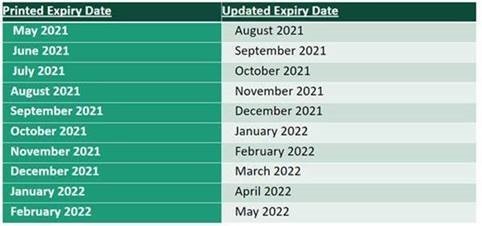 In addition, the shelf-life extension from six to nine months when stored at -90°C to -60°C is also applicable to batches that might have expired prior to this amendment, provided they have been stored at -90°C to -60°C.
No changes have been made to the vaccine itself to enable extension of expiry dating. This change is based on stability data generated on batches manufactured over approximately the past nine months of COVID-19 vaccine development, from the batches that supplied early clinical trials through the commercial scale batches currently in production.
Please refer to the current EUA Fact Sheet.
Additional information on Pfizer storage and handling may be found at:
Administration Overview for Pfizer-BioNTech COVID-19 Vaccine | CDC.
BUD Case Scenarios
With the Pfizer-BioNTech COVID-19 Vaccine expiration date extension, there have been a number of questions about how this might impact beyond-use date (BUD). Below are a few case scenarios you might encounter.
- Case scenario #1: You move a vial of Pfizer vaccine from freezer storage to the refrigerator on August 15. It is marked with the expiration date of August 2021 (August 31, 2021). Can you store this vaccine for the full 31 days allowed for refrigeration storage, or do you need to administer it by August 31, 2021?
- Yes, you can store this vaccine vial for the full 31 days (i.e., through September 15, 2021). The recent expiration date extension changes the expiration date to November 2021. The BUD replaces the manufacturer’s expiration date (now November 2021) and should be noted on the label along with the initials of the person making the calculation.
- Case scenario #2: You move a vial of Pfizer vaccine from ultra-cold storage to the freezer on August 23. It is marked with the expiration date of August 2021 (August 31, 2021). Can you store this vaccine for the full two weeks allowed in the freezer? After that time, can you still move it to the refrigerator and store for an additional 31 days?
- Yes, you can store this vaccine vial for the full two weeks in the freezer (through September 6, 2021), move it to the refrigerator, and store for an additional 31 days (October 7, 2021). The recent expiration date extension changes the expiration date to November 2021. The BUD replaces the manufacturer’s expiration date (now November 2021) and should be noted on the label along with the initials of the person making the calculation.
- Case scenario #3: You move a vial of Pfizer-BioNTech COVID-19 vaccine from the freezer to the refrigerator on August 1, 2021. Since the expiration date has been extended, can you store this vial in the refrigerator through November 31, 2021?
- No, you cannot store this vial through the extended expiration date. A vial can be stored in the refrigerator between 2°C and 8°C (36°F and 46°F) for up to one month (31 days) regardless of the expiration date extension.
Clinical guidance and resources for storing, preparing and administering the vaccine, including labels to assist with tracking the BUD can be found here.
CDC COCA Call: 2021-2022 Influenza Vaccination Recommendations and Guidance on Coadministration with COVID-19 Vaccines
The Centers for Disease Control and Prevention (CDC) has announced a Clinician Outreach and Communication Activity (COCA) Call on September 9 at 2pm EDT.
Topic: 2021-2022 Influenza Vaccination Recommendations and Guidance on Coadministration with COVID-19 Vaccines
During this COCA Call, presenters will provide updates on the Advisory Committee on Immunization Practices (ACIP) recommendations for the 2021-2022 influenza vaccination season and guidance for coadministration of influenza and COVID-19 vaccines.
https://www.train.org/main/course/1100143/live_event
There will be a web on-demand version of the call available after the live event.
New and Updated Resources
Updated Clinical Guidance from CDC
-
MMWR: COVID-19 Vaccination Coverage Among Adolescents Aged 12-17 Years – United States, December 14, 2020-July 31, 2021
-
MMWR: Outbreak Associated with SARS-CoV-2 B.1.617.2 (Delta) Variant in an Elementary School – Marin County, California, May-June 2021
-
MMWR: COVID-19 Case Rates in Transitional Kindergarten Through Grade 12 Schools and in the Community – Los Angeles County, California, September 2020-March 2021
Updated Communication and Education Resources from CDC
In Case You Missed It
Wisconsin COVID-19 Vaccine Program Webinar Schedule
Weekly COVID-19 Vaccine Program updates are held on Tuesdays from 11 a.m.-12 p.m.
Register for the meeting series here. Watch recordings of past webinars here.
Note: There will be no webinar on Tuesday, September 7.
Coadministration of COVID-19 and Influenza Vaccines
You may administer COVID-19, influenza and routine vaccines without regard to timing (both live, attenuated, and non-live influenza vaccines). This includes administration of COVID-19 and influenza vaccines on the same day, as well as coadministration at any time interval.
With influenza season approaching, CDC recognizes there may be compelling logistical advantages to offering patients COVID-19 and influenza vaccines on the same day, and you may encourage patients to receive these on the same day.
When deciding whether to coadminister another vaccine(s) with COVID-19 vaccine, consider:
- Whether the patient is behind or at risk of becoming behind on recommended vaccines
- The patient’s risk of vaccine-preventable disease
- The reactogenicity profile of the vaccines
- The likelihood of avoiding a missed opportunity to vaccinate
Best practices for multiple injections include:
- Label each syringe with the name and the dosage (amount) of the vaccine, lot number, the initials of the preparer, and the exact beyond-use time, if applicable.
- Separate injection sites by 1 inch or more, if possible.
- Administer the COVID-19 vaccines and vaccines that may be more likely to cause a local reaction (i.e., adjuvanted influenza vaccines) in different limbs, if possible.
The available clinical guidance is below:
-
MMWR: Prevention and Control of Seasonal Influenza with Vaccines: Recommendations of the Advisory Committee on Immunization Practices, United States, 2021–22 Influenza Season
Hear From an Expert: How to Get Prepared for the Upcoming Influenza Season
Registration for the national broadcast, Hear From An Expert: How To Get Prepared For The Upcoming Influenza Season, is now open. The broadcast will take place on Wednesday September 22, 2021, and will focus on the importance of influenza immunization during the 2021-2022 season. It will feature Dr. Audrey M. Stevenson, PhD, MPH and Dr. Vincent P. Hsu, MD, MPH, FACP.
Drs. Stevenson and Hsu are renowned vaccine experts and will cover the following objectives during the broadcast:
- Reinforce the importance of influenza immunization for the upcoming 2021-2022 season
- Highlight the impact of influenza on older adults and those with chronic health conditions
- Discuss best demonstrated practices for preparing the entire office for the upcoming flu season
- Dispel myths about influenza and share best practices for encouraging vaccination among patients
Off-Label Use of COVID-19 Vaccines
Providers are responsible for adhering to all requirements outlined in the Centers for Disease Control and Prevention (CDC) COVID-19 Vaccination Program Provider Agreement. Specifically, providers must administer COVID-19 vaccines in accordance with all program requirements and recommendations of CDC, the ACIP, and the FDA. This applies to both EUA and FDA approved COVID-19 vaccines. Accordingly, use of these products outside of those that have been approved and authorized by FDA (often referred to as “off-label use”) is not recommended. It would violate the provider agreement and could expose providers to the following risks:
- Administration of the product off label may not be covered under the PREP Act or the PREP Act declaration; therefore, providers may not have immunity from claims.
- Individuals who receive an off-label dose may not be eligible for compensation under the Countermeasures Injury Compensation Program after a possible adverse event.
- CDC has defined the scope of the CDC COVID-19 Vaccination Program in terms of how the USG-provided vaccines may be used in the program. Providers giving off-label doses would be in violation of the CDC Program provider agreement, potentially impacting their ability to remain a provider in the CDC program.
- Administration fees may not be reimbursable by payers.
Interchangeability of COVID-19 Vaccine Products
The Centers for Disease Control and Prevention (CDC) released the following guidance on the interchangeability of COVID-19 vaccine products:
Every effort should be made to determine which vaccine product was received as the first dose to ensure completion of the vaccine series with the same product. In exceptional situations in which the mRNA vaccine product given for the first dose cannot be determined or is no longer available, any available mRNA COVID-19 vaccine may be administered at a minimum interval of 28 days between doses to complete the mRNA COVID-19 vaccination series. In situations where the same mRNA vaccine product is temporarily unavailable, it is preferable to delay the second dose (up to six weeks) to receive the same product than to receive a mixed series using a different product. If two doses of different mRNA COVID-19 vaccine products are administered in these situations (or inadvertently), no additional doses of either product are recommended at this time. Such persons are considered fully vaccinated against COVID-19 two weeks after receipt of the second dose of an mRNA vaccine.
|