This email is being sent to local health officers, tribal health directors, COVID-19 vaccinators, COVID-19 vaccine stakeholders, HERC coordinators, and key DHS staff
Reflection
As of Monday, over 50 percent of all Wisconsin residents have received at least one dose of COVID-19 vaccine. This important milestone is a testament to the critical work, dedication, and perseverance of you, Wisconsin’s vaccinators. Thank you.
COVID-19 Vaccine Holiday Deliveries
No vaccine orders will be delivered on Monday, July 5, as it is a federally observed holiday. Additionally, no Moderna or Johnson & Johnson (Janssen) vaccine orders will be delivered on Tuesday, July 6. If you receive Pfizer vaccine from a hub, please note that hubs will be closed Friday, July 2 - Monday, July 5.
ACIP Updates
On June 23, the CDC’s Advisory Committee on Immunization Practices (ACIP) meeting included a discussion around cases of myocarditis and pericarditis after mRNA COVID-19 vaccination and considerations around the need for booster doses of COVID-19 vaccines. There were no votes during this meeting.
Myocarditis
ACIP maintained the stance that myocarditis cases continue to be extremely rare and the benefits of the COVID-19 vaccine clearly continue to outweigh the risks in adolescents and young adults.
Boosters
There is currently not enough data to recommend booster doses at this time. After discussion, the general ACIP consensus was that variants, safety, and special populations need to be monitored and studied further to make any booster dose recommendations. Populations to monitor include adults 65 years of age and older, immunocompromised individuals, health care personnel, and health care workers. By September, COVID-19 vaccine manufactures are anticipated to provide safety and immunogenicity data of booster doses and in early fall, additional data should be available on COVID-19/variant epidemiology.
Updated Pfizer and Moderna EUAs
On June 25, the FDA revised the Pfizer and Moderna Emergency Use Authorizations (EUA) regarding the suggested increased risks of myocarditis and pericarditis following vaccination. Updated versions of the Moderna and Pfizer EUA Fact Sheets for Providers and Fact Sheets for Recipients and Caregivers are now posted on the FDA website.
Health Equity: What Did We Learn From COVID-19 and What is Next?
The National Institute for Health Care Management Foundation (NIHCM) recently published a series of infographics highlighting how different racial and ethnic groups have been impacted by COVID-19.
-
Black Americans & Health Equity
-
Black Americans have faced an increased risk of being hospitalized and dying from COVID-19 compared to White Americans. This disproportionate burden placed a spotlight on the ongoing impact of systemic racism and long-standing inequities on the health of Black Americans. This infographic highlights many of these factors and opportunities for advancing health equity.
-
Native Americans & Health Equity
- American Indians have been hospitalized from COVID-19 at 3.3 times the rate of White Americans. These challenges are rooted in the historical impacts of colonization and exacerbated by health disparities. Systemic factors such as limited access to medical services, and lack of access to broadband and running water, served as barriers that prevented many Tribal Nations from implementing COVID-19 safety measures and providing key virtual health care services.
-
Hispanic Americans & Health Equity
- Long-standing social and economic inequities – including language barriers, overrepresentation as frontline workers, and lower access to insurance benefits – have left Latinx Americans at increased risk of contracting COVID-19 and having more severe cases of the disease. Hispanic and Latinx Americans have been 2.8 times more likely to be hospitalized and 2.3 times more likely to die from COVID-19 than White Americans.
DHS Community-Based Vaccination Clinic Closures
As demand continues to soften at the DHS Community-Based Vaccination Clinics and the focus is on smaller, more targeted vaccination events, DHS has identified the closing dates for all of the DHS Community-Based Vaccination Clinics. Barron County, Douglas County, and La Crosse County will have their last day on July 9, and Marathon County, Racine County, and Rock County will close their doors on July 16.
New and Updated Resources
Updated Clinical Guidance from CDC
Updated Communication and Education Resources from CDC
Updated Communication and Education Resources from DHS
In Case You Missed It
Wisconsin COVID-19 Vaccine Program Webinar Schedule
Weekly COVID-19 Vaccine Program updates are now held on Tuesdays from 11 a.m.-12 p.m.
Note: Due to the holiday, there will be no webinar next Tuesday, July 6.
Pfizer Vaccine Allocation Updates
As of June 24, DHS will no longer deliver Pfizer COVID-19 vaccine from hubs in quantities less than 30 doses. If you place an order for less than 30 doses, your order will be denied. Pfizer COVID-19 vaccines will be delivered in the following increments:
-
30-150 doses (in 30-dose increments)
- 150-450 dose trays (in 150-dose increments)
-
Orders larger than 450 will need to be requested in increments of 450 (for example, 450, 900, 1350, 1800, etc.)
Note: Order increments of 1170 doses are no longer available.
The shipping cadence for vaccine and ancillary kit orders will remain the same.
Recorded Webinar Available on Increasing COVID-19 Vaccination in Emergency Departments, Urgent Care, and at Discharge
On June 23, DHS and the Wisconsin Hospital Association (WHA) held a webinar about increasing COVID-19 vaccination in emergency departments, urgent care, and at discharge. Health partner panelists from Prevea Health, Marshfield Clinic, and Froedtert & the Medical College of Wisconsin discussed lessons learned from the field and Dr. Ryan Westergaard, Chief Medical Officer in the Bureau of Communicable Diseases and State Epidemiologist, shared implementation guidance.
Join the Centers for Medicare & Medicaid Services (CMS) for the We Can Do This COVID-19 Vaccine Campaign Toolkit Webinars
The U.S. Department of Health and Human Services (HHS) We Can Do This campaign is a national initiative working hand in hand with trusted leaders and community organizations to continue to build confidence in COVID-19 vaccines and get more people vaccinated. This campaign offers tailored resources and toolkits for stakeholders to use to provide COVID-19 vaccine information to at-risk populations.
CMS is partnering with the campaign to offer several webinars to walk through each toolkit and its resources and train community organizations, local voices and trusted leaders to use the campaign tools for vaccine outreach efforts to diverse communities.
Upcoming Campaign Webinar:
-
Thursday, July 8, 12:00-12:30 p.m. CT: Older Adults Toolkit – Register here
Recordings will be available soon for past campaign webinars.
Myth Buster of the Week
Throughout the pandemic, myths and misinformation have been shared and reshared. Over the next few weeks in our weekly updates, we are going to highlight a common myth or misconception and points that you can use to combat the misinformation.
Remember, COVID-19 vaccines may still feel new to some people, and it’s normal for people to have questions about them. When talking with people about the vaccine, listen to their questions with empathy and help them to find the root cause of their concerns to help them feel supported in their decision.
Do the COVID-19 vaccines protect against the variants, including the Delta variant?
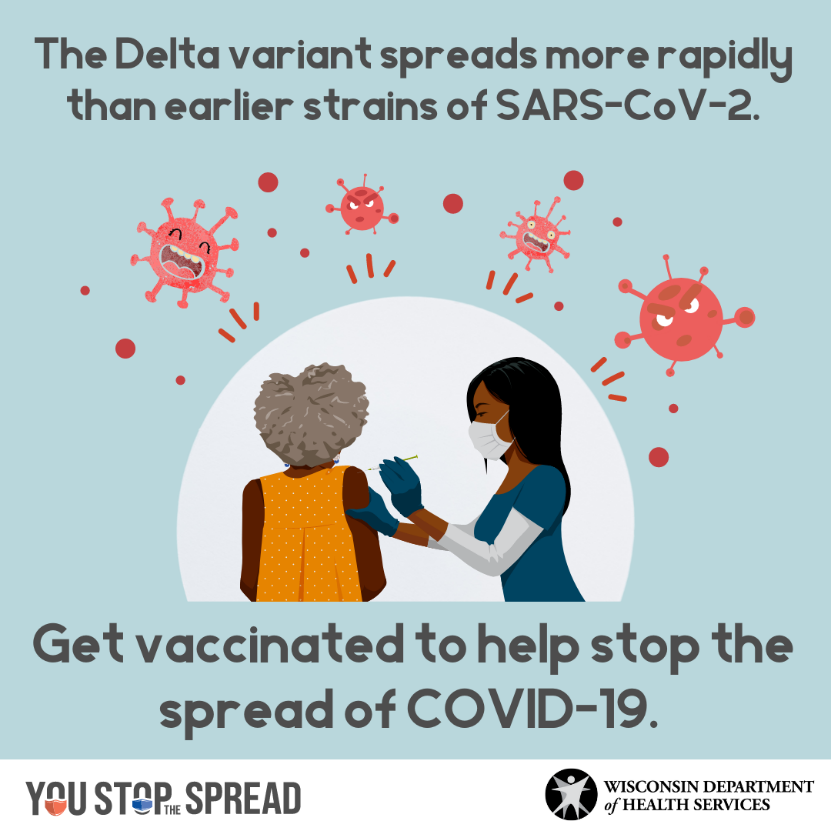
The CDC recently classified the Delta variant as a variant of concern. Fortunately, the COVID-19 vaccines available in the U.S. have shown to still provide good protection against all the known COVID-19 variants, including the Delta variant. For those receiving a two-dose vaccine, protection is significantly higher after both doses are given.
-
The COVID-19 vaccines provide good protection against hospitalization and death for the known COVID-19 variants, including the Delta variant.
- If you previously had COVID-19 illness and have not yet been vaccinated, CDC and health experts don’t know if you’ll have immunity, or protection, against the COVID-19 variants. This is why, even if you’ve already been sick, it is important to get the COVID-19 vaccine.
- Data from the Wisconsin Electronic Disease Surveillance System show that of the 433 deaths due to COVID-19 between March 1 and June 24, 2021, only 21 were in fully vaccinated people – less than 5%.
-
Getting vaccinated is important because you can help stop the spread of the virus and help prevent mutations that may reduce the efficacy of existing vaccines.
-
The sooner people get vaccinated against COVID-19, the less opportunity we give the virus to continue mutating.
|