Novel Coronavirus (2019-nCoV) Update:
New CDC Testing Criteria and Traveler Movement and Monitoring Guidance
This bulletin is being sent to local health officers, tribal health directors, local public health nurses, and infection preventionists.
This message provides updated information and CDC guidance on the 2019-nCoV outbreak for:
Health Care Providers (Updated 1/31/20)
Local and Tribal Public Health Agencies (Updated 2/3/20)
For the most current information, continue to check the CDC 2019-nCoV Situation Summary webpage and the Department of Health Services (DHS) Outbreaks and Investigations webpage.
Join us this Friday, February 7 at 2 p.m. during a webinar for public health partners to provide an overview of the current situation.
Live webinar link: https://livestream.com/accounts/14059632/events/8988482
A recording of this webinar will be available at the link above.
 Updated Infection Prevention and Control Recommendations
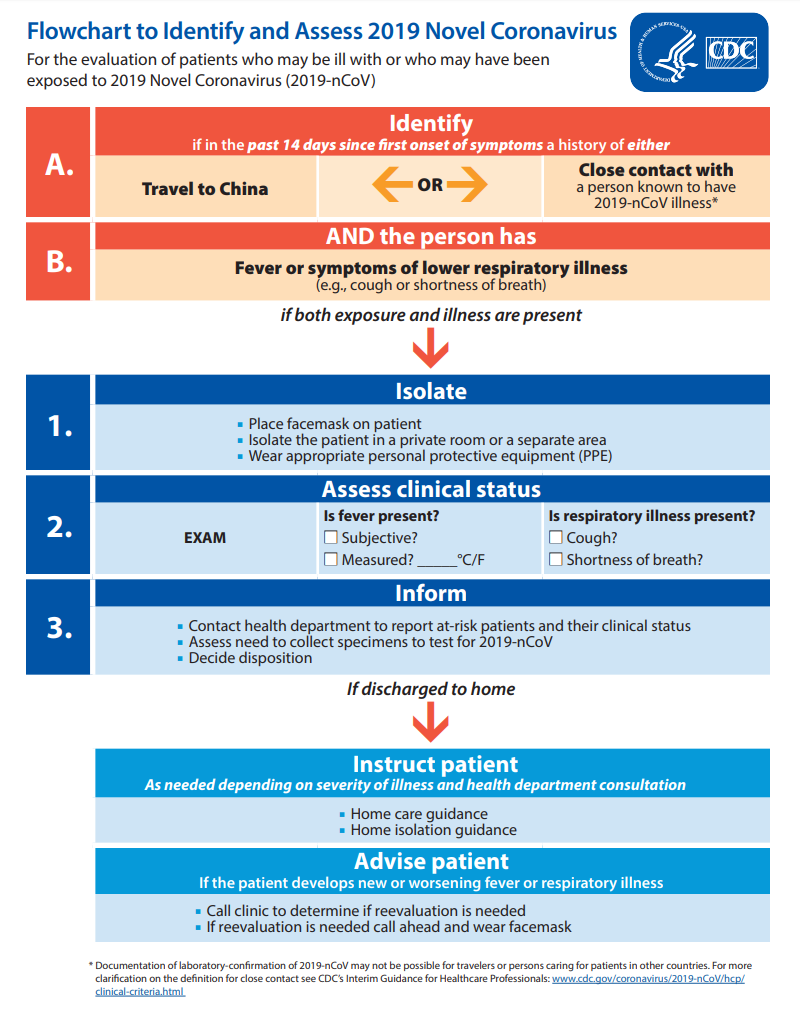
CDC currently recommends a cautious approach to patients under investigation. Patients should be asked to wear a surgical mask as soon as they are identified and be evaluated in a private room with the door closed, ideally in an airborne infection isolation room, if available. Health care personnel entering the room should use standard precautions, contact precautions, airborne precautions, and use eye protection (e.g., goggles or a face shield).
Updated January 31, 2020
Criteria to Guide Evaluation of Patients Under Investigation (PUI) for 2019-nCoV
Patients in the United States who meet the following criteria should be evaluated as a PUI in association with the outbreak of 2019-nCoV.
Fever AND signs/symptoms of lower respiratory illness (e.g., cough or shortness of breath) requiring hospitalization AND a history of travel from mainland China within 14 days of symptom onset.
OR
Fever AND signs/symptoms of lower respiratory illness (e.g., cough or shortness of breath) AND a history of travel from Hubei Province, China within 14 days of symptom onset.
OR
Fever OR signs/symptoms of lower respiratory illness (e.g., cough or shortness of breath) AND any person, including health care workers, who has had close contact with a laboratory-confirmed 2019-nCoV patient within 14 days of symptom onset.
The criteria are intended to serve as guidance for evaluation and are subject to change. The most up-to-date criteria are available on the CDC website. Patients should be evaluated on a case-by-case basis if their clinical presentation or exposure history is equivocal (e.g., uncertain travel or exposure).
Contact DPH at 608-267-9003 for consultation and approval of testing for 2019-nCoV.
For Local and Tribal Public Health Agencies
On February 3, CDC released Interim US Guidance for Risk Assessment and Public Health Management of Persons with Potential 2019 Novel Coronavirus (2019-nCoV) Exposure in Travel-associated or Community Settings. CDC’s recommendations for management of people with potential exposure to 2019-nCoV, including monitoring and the application of travel or movement restrictions, are summarized in tables for both symptomatic and asymptomatic individuals. DPH has developed a flowchart summarizing these guidelines, available on the PCA Portal.
Contact the DPH Bureau of Communicable Diseases at 608-267-9003 (or the DPH emergency on-call staff at 608-258-0099 after hours) for consultation.
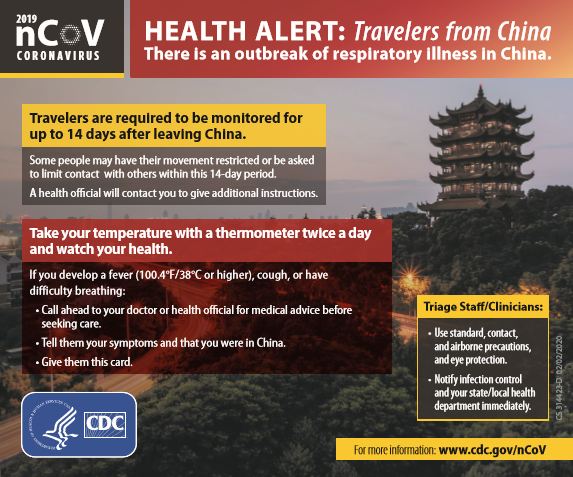
Travelers returning from China are routed to and screened upon entry at 11 designated airports in the U.S. and provided the following information in English and Mandarin.
Questions
The Department of Health Services Outbreaks and Investigations webpage is updated regularly and includes state-specific information and links to important resources.
Please contact Tom Haupt (608-266-5326), Influenza and Respiratory Diseases Surveillance Coordinator, or Anna Kocharian (608-267-9004), Epidemiologist, if you have any general questions about these guidelines.
|