|
|
The U.S. Department of Agriculture (USDA) Value-Added Producer Grant (VAPG) program helps U.S. agricultural producers enter into value-added activities that generate new products from raw agricultural commodities; create and expand marketing opportunities; and increase producer income through enhanced product value and market reach. Planning Grants up to $50,000 and Working Capital Grants up to $200,000 are awarded through a nationally competitive process.
The goal of the Dairy Business Innovation Alliance Grant (DBIA) program is to promote the dairy industry within the 11-state region. Dairy farmers and processors are eligible to request up to $150,000 in reimbursable grant funding for projects that diversify on-farm activities, create value-added products, enhance dairy by-products, or expand/create export programs.
The purpose of this USDA National Institute of Food and Agriculture (NIFA) program is to fund integrated projects that enhance the ability of producers and processors who have already adopted organic standards to grow and market high‑quality organic agricultural products, and to increase resilience in American farming systems. Priority concerns include biological, physical, and social sciences, including economics.
This USDA NIFA Agriculture and Food Research Initiative - Education and Workforce Development (EWD) focuses on developing the next generation of research, education, and extension professionals in the food and agricultural sciences. Awards range from $10,000 to $650,000.
|
|
|
The United Stated Department of Agriculture, Small Business Administration, Small Business Development Center, and Apex Accelerator have partnered to equip agricultural enterprises and other small businesses with the tools, resources, and knowledge required to navigate the product-to-market journey. Participants can expect to enhance their understanding of converting innovative ideas to buyer-ready products.
The Wisconsin Department of Agriculture, Trade, and Consumer Protection has exciting opportunities to join the Division of Agricultural Development’s team. If you or someone you know have an interest in mission-driven work to grow Wisconsin's agricultural economy while promoting quality food and the health of our state, please consider sharing or applying. To learn more about a role supporting ag and economic development, please visit the wisc.jobs page for posts about new and current openings.
This competency-based program spans two full growing seasons and includes on-the-job training, classroom instruction, an increasing hourly wage, and plenty of ongoing opportunities to connect with and learn from the broader farmer community. Field days, monthly cohort calls, and regular check-ins keep peer-to-peer learning front and center. To learn more, fill out this brief survey and you’ll be contacted to set up a time to talk about the program.
This event provides an opportunity for local food suppliers and school nutrition buyers to connect and build relationships for future sales. Vendors may include local farmers and producers, food hubs and aggregators, and processors offering local products such as fruits and vegetables, dairy, meat, grains, and value-added products. Hosted by the Bureau of School Nutrition, this event will be held as part of the annual School Nutrition Summer Training, with the main audience being school nutrition professionals (directors, managers, and employees), including buyers. Request a vendor booth at the link above by June 1, 2026.
|
|
Driftless Area Berry Growers Expand New Product Line Via Equipment Investment
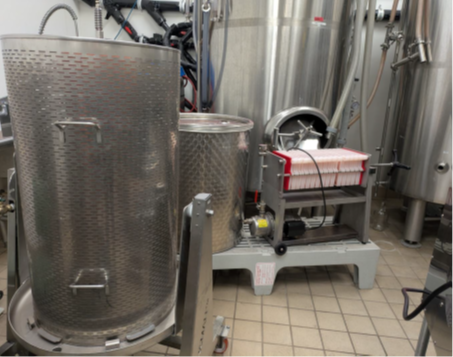
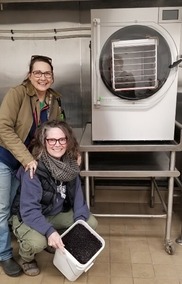
RFSI-funded cold press juicer, filter pump, and freeze dryer.
The Driftless Berry Grower group (DBG), under the leadership of Good Thunder Farm in Richland Center, Wisconsin, received a Resilient Food Systems Infrastructure (RFSI) Grant award to purchase equipment for storage, juicing, freeze drying and distilling elderberries, aronia berries, and currants. With production space at Viroqua’s Food Enterprise Center, this group of 12 small, beginning berry farmers is building capacity for processing these medicinal crops while strengthening rural economies. DBG has also been accepted into the Food Finance Institute’s Agroforestry Food Accelerator program, which offers marketing and business planning consulting.
The Viroqua Aronia Company is in full production mode with their new ability to juice the backlog of several hundred thousand pounds of aronia that has been in storage. After launching their new brand, they have engaged 14 new retail partners and begun selling their small-batch pressed aronia juice online. A big success was deploying new bag-in-box equipment which allows for a larger shelf-stable product and easy shipping. They have also begun selling their dried aronia powder.
Meanwhile, DBG’s elderberry growers have collaborated on creating an educational display about elderberry that has been used at marketing and educational events. Several growers have captured new markets: Anderson Family Farm is selling to a jam and value-added producer in central Wisconsin and Gale Shea is working with a mead maker near Reedsburg. Good Thunder Farm has engaged the La Crosse People's Coop and Vitruvian market to sell their frozen and shelf-stable freeze-dried berries. They also continue to provide freeze-dried berries for the popular sweet and salty Hazel Heart Farms snack mix.
|
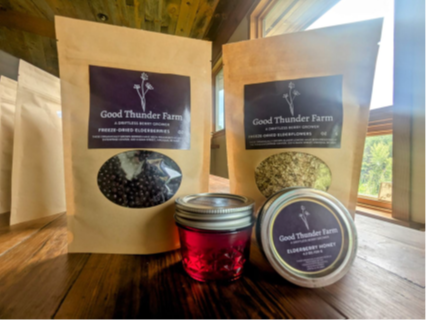 |
Value-added products pictured including freeze-dried elderberries, freeze-dried elderflowers, and elderflower honey.
The Tribal Elder Community Food Box Program expands markets for Indigenous food producers to provide for community elders through intertribal collaboration and partnership with hunger relief organizations. These relationships foster connection through sharing food, culture, and nutrition education. Hunger Task Force recently welcomed Dan Cornelius, a member of the Oneida Nation and founder and operator of Yowela Farms, to its McCarty Education Kitchen for a conversation about Indigenous food systems, food sovereignty and traditional foods as medicine.
|
|
|
|
|