|
November 17, 2015 | Happy November!
In today's Wisconsin Farm to School newsletter, you will find:
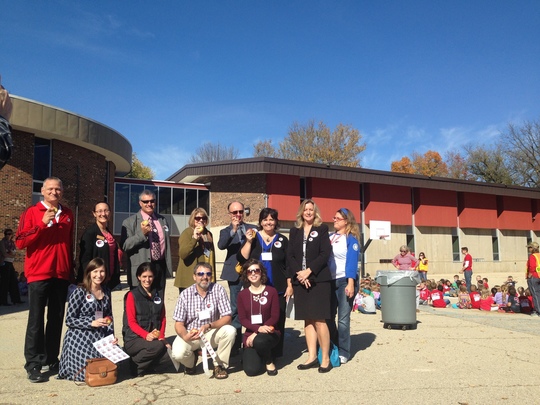 The WI Farm to School Advisory Council CRUNCHES with Mount Horeb School District!
A big THANK YOU to Food Service Director Michelle Denk and all of the Mount Horeb School District for hosting the WI Farm to School Advisory Council the day of the Great Lakes Great Apple Crunch. We had a wonderful time!
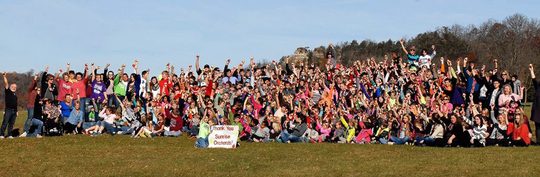 North Crawford School District Crunched with 485 participants! Soldiers Grove, WI knows how to support their healthier generation thanks to Sunrise Orchards of Gays Mills, WI! #GreatAppleCrunch
You CRUNCHED and we heard it!
Congratulations! Over
200,000 participants from WI were part of nearly 600,000 students,
school staff, and farm to school supporters across the Great Lakes region who
CRUNCHED to celebrate Farm to School month! Here are some follow up steps
to help you amplify and extend the message of the Crunch!
Social media: Please continue to collect and
share stories. Share pictures and stories onto the Great Lakes Great Apple Crunch
Facebook page. Please continue to use the hashtags, it's the easiest way for me
to find you! #GreatAppleCrunch #F2SMonth #FoodDay2015 and #wiapplecrunch Post
to Facebook, Twitter and Instagram. Be sure to share to the GL GA Crunch page,
and scan through all the social media for really good stories about the
amazing things going on in our region. Make
sure to have appropriate school photo release forms for any students featured
in your photos.
Garden Contest: Contest photos must be shared to the Great
Lakes Great Apple Crunch Facebook page with the hashtag #WIAppleCrunch
or emailed to WIFarmtoSchool@wisconsin.gov
by midnight on Nov. 26, 2015. Finalists will be selected by McKay Nursery and
announced in the beginning of February 2016 on the McKay Nursery Facebook
page. The public will vote for their favorite finalist on the McKay Facebook
page by “liking” their favorite finalists. The three Finalists with the most
“Likes” will be named as contest winners and announced in the WI Farm to School
Newsletter and on the McKay Nursery Facebook page by March 2016. The three
winning schools will win Fruit Packages to be shipped in the Spring 2016. All
Wisconsin schools with a school garden or ability to plant edible perennial
plants on school property are eligible to apply. Fruit Package prizes must be
used on school grounds.*Fruit Package will consist of available products in
spring 2016.

Proposals now accepted
for National Farm to Cafeteria Conference
Organizers of the 8th National Farm to Cafeteria Conference are seeking
proposals for workshops, posters and lightning talks to feature during the two-day
gathering in Madison, Wis., June 2-4, 2016. This event is the premier gathering
of individuals and organizations working to source local food for institutional
cafeterias and foster a culture of food and agricultural literacy across
America. Cafeterias in schools and early care, colleges and universities,
hospitals, prisons and other institutional settings serve tens of millions of
Americans every day, placing the farm to cafeteria movement at the forefront of
the fight to end obesity and strengthen local food systems. The 2016 conference
theme Moving Forward Together lifts up new and innovative partnerships to
continue building momentum and ensure long-term sustainability in the movement.
The application period is open now through Dec. 4, 2015. Learn more
at farmtocafeteriaconference.org.
November
is Native American Heritage Month
Read this short newsletter post on Traditional
Foods in School Gardens as a way to celebrate Native American Heritage
Month in November. There’s a lot of other great information on farm to school in
the USDA FNS Office
of Community Food System Newsletter.
|
NEW! USDA New Farmers Tool
The USDA has announced
a new, tailored web tool designed
to connect burgeoning farm entrepreneurs with programs and resources available
to help them get started. The new web tool is available at www.usda.gov/newfarmers. The
site features advice and guidance on everything a new farm business owner needs
to know, from writing a business plan, to obtaining a loan to grow their
business, to filing taxes as a new small business owner. By answering a series
of questions about their operation, farmers can use the site’s Discovery Tool
to build a personalized set of recommendations of USDA programs and services
that may meet their needs. Learn
more here.
|
|
NEW! Cultivating collective action: The ecology of a statewide food
network
In order to continue to
foster and grow a sustainable partnership with food network leaders across the
state, University of Minnesota
Extension Health and Nutrition educators explored the opportunities
and challenges presented by the emergence of a statewide food network in
Minnesota and the role of Extension within it. This report
provides a summary of the findings and highlights opportunities, challenges,
and best practices that emerged through 10 categories that describe the
different phases and key activities of a network. Additionally, the report
findings are presented through an overarching concept of understanding networks
as ecosystems, because the processes at play within food networks mimic many of
those found in nature. Read the report here.
|
|
 |
 |
|
NEW! State School Health Policy Matrix 2.0
The National Association of
Chronic Disease Directors, National Association of State Boards of Education
and the Society of Health and Physical Educators (SHAPE America) have released
the State
School Health Policy Matrix 2.0, an updated guide to state-level
school health policies in all 50 states for the following topics: competitive
foods and beverages, physical education and physical activity and
administration of medication in the school environment. Learn
more here.
|
Call for papers:
Childhood Obesity in Underserved Populations
Childhood Obesity plans
to publish a special issue dedicated to Childhood Obesity in Underserved
Populations. New ideas and initiatives are needed for understanding the factors
that predispose or lead to obesity in these populations (biological,
behavioral, and ecological). New analyses that enable us to understand why
previous programs have not been successful (especially mediation and moderator
analyses), and for innovative programs that deliberately attempt to minimize
previous recognized problems and take new approaches to better serve these
populations are needed. Editors are interested in original research and
meta-analyses in regard to any aspect of childhood obesity in underserved
populations. The deadline for manuscript submission is March 15, 2016. More information here.
USDA Community Food
Project Grant Program
The 2016 USDA Community Food Projects Grant Program Request
for Applications is open, with $8.4 million in grant funding available.
Community Food Projects are designed to increase food security in communities by
bringing the whole food system together to assess strengths, establish
linkages, and create systems that improve the self-reliance of community
members over their food needs. Eligible grant applicants include food program
service providers, tribal organizations, or private nonprofit entities,
including gleaners.The New
Entry Sustainable Farming Project is providing free one-on-one
technical assistance and resources to organizations interested in applying for
the Community Food Projects Grant Program through the National Institute of
Food and Agriculture. For more information and to apply for technical
assistance, please visit the Community Food Projects' website. Applications are
due Monday, November 30, 2015 at 5:00 pm EST.
 |
|
Educator Grants, Herb Society of America
The Herb Society of America's
mission is to promote the knowledge, use, and delight of herbs through
educational programs, research, and sharing the experience of its members with
the community. Through the Grant for Educators program, the society will award
a grant or two totaling up to $5,000 to a project(s) that enhances herbal
education in school systems, communities, or in any public forum (electronic or
person-to-person).Visit the Herb Society's website for
complete program guidelines and application instructions. |

Carton 2 Garden Grant
Show us your students’
creativity by re-purposing milk and juice cartons from your school cafeteria to
either build or enhance your school garden. Educators can engage students in a
hands-on experience creating teachable moments on environmental stewardship,
sustainable packaging and healthy living. The best use of cartons in a school
garden gives your school the chance to win one of 14 prizes with a grand prize
valued at $5,000. http://carton2garden.com/contest-details/spring-2016-contest/
|
|