|
At their June 23 meeting, Council adopted Ordinance 2026-032 via 5-2 vote, imposing a one-year moratorium on the acceptance or processing of applications or permits for the construction or expansion of immigration detention facilities in Whatcom County. Councilmembers Ben Elenbaas and Mark Stremler voted against the ordinance.
Councilmember Jessica Rienstra brought the ordinance forward, with support from Councilmembers Kaylee Galloway and Jon Scanlon, in response to the significant expansion of Immigrations and Customs Enforcement (ICE) arrests throughout the country and in Whatcom County, which have included the detention of individuals with no criminal convictions as well as those who are participating in the legal asylum process. In July 2025, the United States Congress allocated $45 billion in funding for immigration detention facilities over four years, and, as of February 2026, the total detainee population in the US was 68,000, up from 40,000 a year earlier.
There are no current or pending applications from the federal government related to new or expanded immigration detention facilities in Whatcom County, which Councilmember Elenbaas noted in his vote against the ordinance. Elenbaas also stated that because these facilities are not defined in county code, they are already prohibited in all zones, making the ordinance unnecessary.
Councilmembers voting in support of the moratorium argued that it will give the county time to evaluate detention facilities' potential impacts to public health, safety, and infrastructure and determine whether additional regulations are needed.
Councilmember Scanlon stated that while “we don't see anything right now, there are areas around the country where the federal government is acquiring land, is buying warehouses to expand federal civil detention facilities.” He went on to say that the moratorium gives the county the space to get ahead of any potential action and figure out the best way to move forward.
Councilmember Rienstra stressed her appreciation for border protection workers and law enforcement working hard to keep the community safe and combat serious issues such as human trafficking. She said the ordinance is about reaffirming the basic principle that every person deserves due process, transparency, and accountability from government institutions. “We see people afraid to get health care, afraid to report crimes, kids that are afraid to go to the bus to get to school. If this is a way that we can stand up and say ‘we hear you, we see that you’re scared, and we’re here to stand with you,’ then I’m okay standing up and loudly doing that,” she stated.
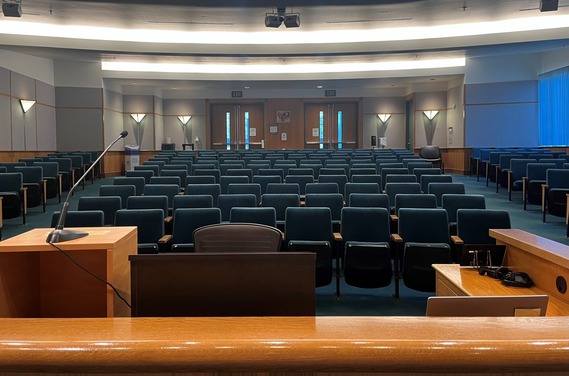 Community members can participate in a public hearing on the Comprehensive Plan update.
Since the start of the year, Council has been working to complete a lengthy and detailed review of the Whatcom County Comprehensive Plan, part of the once-per-decade update process required by the state. The Comprehensive Plan consists of 12 chapters and more than a thousand pages of goals and strategies intended to guide the county’s growth over the next 20 years, covering everything from housing to economic development to the environment.
Council has now reviewed the entirety of the plan, incorporating input from the countless county residents, advisory groups, and businesses who engaged in the process and provided feedback over the past six months so that the Comprehensive Plan is a true reflection of the community’s values and priorities for the future.
A public hearing and potential vote on the Comprehensive Plan will take place at the Council's regular evening meeting on July 14 at 6 p.m. Community members are welcome to participate in the public hearing in person from Council Chambers at 311 Grand Avenue in Bellingham or online via Zoom. If joining online, please make sure to register for a Zoom link by 4 p.m. to join the speaker queue.
Councilmembers expressed gratitude for all of the community members, businesses, and organizations that contributed their time, energy, and ideas to the Comprehensive Plan process.
“We’re so appreciative of everyone who emailed, called, or provided public comment on the Comprehensive Plan,” said Council Chair Kaylee Galloway. “Your feedback was essential in shaping this document and ensuring it provides the best possible vision for Whatcom County.”
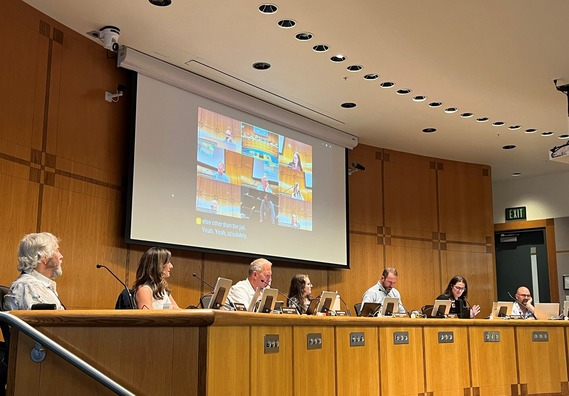 Councilmembers engaged in discussion following a presentation on initial programming for the new jail facility.
Council received a presentation on proposed programming for the new jail facility, one of the major capital components of the county’s Justice Project initiative, during their June 23 Criminal Justice and Public Safety Committee meeting.
County voters approved a sales tax increase in November 2023 to fund costs associated with a new county jail, behavioral care center, and other projects prioritized in the Justice Project Implementation Plan such as community-based behavioral health treatment, supportive housing, re-entry support programs, expansion of incarceration reduction programs, and other public health, safety and criminal justice facilities and services.
Work is underway on a number of the incarceration prevention and reduction projects called for in the plan. However, increasing construction costs due to inflation and lower-than-expected sales tax revenues are creating uncertainty and putting pressure on the key capital projects.
In May, Council approved Resolution 2026-018 by a vote of 5-2 providing direction, establishing priorities, and affirming values for planning and construction of the new Whatcom County jail and behavioral care center. Councilmembers Ben Elenbaas and Mark Stremler cast the dissenting votes against the resolution.
The resolution followed a motion by Council in late April setting a preliminary budget cap of $205 million for the jail and $34 million for the behavioral care center, including $14 million in state and grant funds.
Councilmember Barry Buchanan, a long-time member of the Incarceration Prevention and Reduction Task Force, brought the resolution forward, in part, to acknowledge changes to the financial landscape which make it necessary to renegotiate the interlocal agreement that coordinates project funding commitments with the Whatcom County cities.
Councilmembers Elizabeth Boyle, Jessica Rienstra, and Jon Scanlon collaborated on edits to the draft resolution informed by input from the county’s partners and community members.
Boyle stressed that, even though the county and cities are facing challenging financial circumstances, they are not giving up on commitments to fund community services. “We all have a promise to take better care of each other, and that includes ample funding for services,” she said.
During their presentation on the 23rd, the project team provided a high-level overview of plans for the new jail facility, which will have an operating capacity of approximately 410 compared to around 300 at the current jail, though the total footprint of the building has been reduced to about 150,000 square feet down from 227,000 due to budget constraints.
To align with the Council's emphasis on behavioral health care and re-entry services, the project team incorporated dedicated acute behavioral health housing with safety cells, calming rooms, dayrooms, and clinician space into the facility design. Other enhancements over the current facility include a medical and detox unit with supervised detox capacity and a fresh air court, and increased space for mental health screening and interview functions during intake.
The project team will share estimated operating costs and additional planning items in July. Council is anticipated to vote on approval of proposed jail programming before their August recess. Programming for the behavioral care center is expected in November or December of this year.
|