Adult Recovery Court was the first therapeutic court here, and the program has grown. Family Recovery Court started 18 years ago, and an assisted outpatient treatment program recently started for individuals with severe mental health concerns.
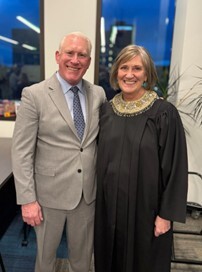
Judge Moore took over leadership of therapeutic courts on January 1, 2026, from longtime colleague Judge Joseph Wilson. Moore served as back-up recovery court judge for two years, and the judges gradually transitioned responsibilities.
“It’s about trust and relationships,” Moore said. “I was sensitive to the fact that people had built a trust relationship with Judge Wilson. I always appreciated the work he’s done with the therapeutic courts. It’s just an honor to follow through on this program.”
Moore, of Everett, was appointed Snohomish County Superior Court Judge by former Gov. Jay Inslee in 2021. She started her career as a prosecutor and worked with the regional drug task force. She later practiced law at the private firm Brewe Layman, where her clients included parents striving to stay sober and be a positive part of their kids’ lives. Her experiences as a prosecutor and in family law helped prepare her for recovery court.
“Without the accountability piece, I don’t believe there’s recovery. Accountability doesn’t have to be punitive. It can be instructive,” Moore said. “This is an evidence-based program, and the evidence shows it works. If people can commit to the program and follow the steps, their chances are really good.”
It takes a skilled and dedicated team, she said. There’s involvement from court staff, prosecutors, public defenders, judges, treatment providers, medical staff, community organizations, the participants and their loved ones.
People can’t just sign up for recovery court. They must be referred. Moore and her team are working to establish more entry points. Adult Recovery Court has capacity for up to 125 people, with 55 in the program as of March. Family Recovery Court can serve up to 55 children and their parents, with 16 spots filled. The new assisted outpatient treatment (AOT) program has eight of 15 spots filled, and a February announcement from the U.S. Department of Health and Human Services included potential new AOT funding.
Each therapeutic court has hearings once a week. Supporting work happens every day, such as tracking progress, ensuring drug testing, and connecting people to counseling and support.
“All the evidence and programming drills down to the ‘why?’ Why do they use this substance?” Moore said.
There’s real change when someone finds their “why?” and begins retooling their brain to manage without substance use. Judge Moore has seen it in the courtroom. She’s also lived it with her own family. Her sister spent 10 years in federal prison for what began as using and escalated to dealing.
“I lived through that with my parents and her children,” Moore said. “I’m grateful and honored to say that she’s been out of custody for almost 15 years and she is healthy and happy. We rebuilt our relationship, so I know families can reconcile.”
Judge Moore’s daughter also grew up alongside the daughter of Debbie Warfield, who helped start the annual Overdose Awareness Day vigil, “A Night To Remember, A Time To Act.” Warfield is one of two moms who lost their adult sons to overdose and now honor their memories by increasing awareness and support for others.
“I admire the courage of those moms to put themselves out there to destigmatize and give people pathways,” Moore said.
Moore has lived in the area for 32 years and has two grown children as well as two grandchildren. She loves being a grandma. In her down time, Moore enjoys gardening and reading.
She studied at the University of Idaho and earned her law degree from Seattle University. Moore is on the Therapeutic Courts Committee, the Family Law Committee, and the Criminal Law and Rules Committee for the Superior Court Judges’ Association.
Her job is demanding but rewarding.
“At the end of the day, if I’ve impacted one person’s life for the better, that’s the reward,” she said.
|