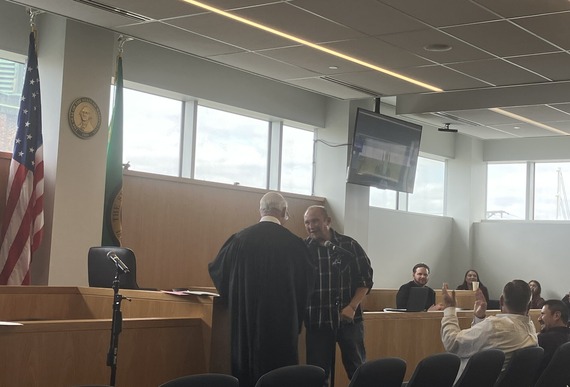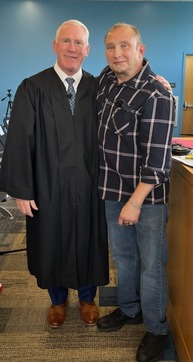
“I have never seen a transformation like this,” Judge Wilson told Michael on June 13, the day he graduated Adult Recovery Court. “I have never seen someone work so hard.”
Michael, 54, has come a long way from the man in a 2023 booking photo who looked “like tales from the crypt” and didn’t much care whether he lived or died. He had a record, a no-contact order against him involving his ex, and children he hadn’t seen in too long. He went by the nickname Machete. He was trouble.
Now, he’s an involved dad who works full-time at Judd and Black and watches the house and cat while the kids are camping. He lives in clean-and-sober housing and sees family nearly every day. He carries his own supply of Tylenol so he never has to ask someone else for a pill, even for a headache.
He has a down-to-earth way of telling his story and doesn’t dodge the rough parts. When he says, “If I can do it, anyone can,” he means it.
For about six years, Michael was homeless and addicted to drugs. He started using marijuana and meth before he became homeless. The heroin came later, then fentanyl.
At one point, while high, he called the only phone number he knew by heart. It was for his ex. In contacting her, he violated the order.
He was offered the chance at Recovery Court but didn’t take it seriously enough.
“I had no one. I didn’t really care,” he said. “I died on the streets already once.”
He did an initial 28-day program and stayed sober for two weeks. Then he got news that a young man who was like a son to him had died. He remembers going to the store to get a coffee and instead walking right past it to the park where he knew he could get something much stronger. After two weeks of hard-won sobriety, he began to spiral again.
In April 2023, he was at a park with fentanyl pills and powder on a piece of foil, unaware of his surroundings even though he usually paid attention. From the gazebo, he could see who was approaching and recognize police before they reached him. That day, though, he didn’t care when the officer approached. Not about getting caught, and not about surviving the next hit. With fentanyl, the equivalent of fewer than 10 grains of salt can be fatal for an adult. There was enough on his foil that he heard it hit the ground and bounce when he dropped it.
“That day, that cop saved my life because I was really trying to end it,” he said.
He was offered another chance at Recovery Court. He learned that his ex had asked for the second chance on his behalf. She believed he was worth helping and that, he said, is what convinced him to help himself.
“They tell you that you gotta love yourself before you can get clean. No. You need someone to care about you so you know you’re worth it,” Michael said. “A lot of these guys, they think no one cares. The system doesn’t care … It took me a minute to feel like I was worth it.”
He’s the father of seven, ranging in age from 9 to 36 years old. His oldest understand some of Michael’s journey, but it’s harder for the younger kids. It will take time to rebuild trust.
“My kids come first now, always,” he said. “They didn’t for a while. Now they do. Always.”
Reclaiming his life hasn’t been easy. Suboxone (a medication to treat opioid use disorder) helped with the physical toll, but the hardest effort was the work he needed to do on himself. It took support, time, faith, and honest self-reflection. He relied on the no-nonsense approach of a judge who didn’t think he would make it, challenging Michael from Day 1 to prove him wrong. He relied on his counselor, who kept him in a treatment program longer than planned to make sure he didn’t backslide after his mom died last June. He relied on volunteers, court staff, friends and family – his “strong front line.”
Sitting in a quiet conference room in the Snohomish County Courthouse, only hours to go until graduation, Michael paused to think about what he would tell himself if he could go back a couple of years.
“I’ve been asked that question. I always would come up with some bull**** answer. But now?” He thought about it a minute more. “Now, I would tell myself, ‘Don’t give up. Things do get better’ … If you really want to be clean and sober, you can do it. You take it one step at a time. It’s not 24 hours at a time. It’s a minute at a time for some of us. Thirty seconds at a time.”
At his graduation, friends were sprinkled throughout the audience. His family filled much of the front row, and one of his children presented him with his certificate.
He celebrated what his one-day, one-minute, thirty-seconds at a time had added up to: 787 days sober and a new start.
|