|

President Biden announced new actions to protect Americans and help communities and hospitals battle Omicron. Included in the new actions are:
Increased Support for Hospitals
Deploying Additional Medical Personnel
- Mobilizing an additional 1,000 troops to deploy to COVID-burdened hospitals
- Deploying federal medical personnel available to states immediately
Expanding Hospital Capacity
- Activating FEMA response teams to help states and hospitals add capacity now
- Providing ongoing support to states to help hospitals create and license more beds
- Deploying hundreds of ambulances and emergency medical teams to transport patients to open beds in key states
Providing Critical Supplies
- Pre-positioning critical supplies from the Strategic National Stockpile
- Deploying ventilators to states in need
Robust Access to Free Testing
- Standing up new federal testing sites
- Distributing free, rapid tests to Americans (via mail starting in Jan. 2022)
- Utilizing the Defense Production Act to further accelerate production
Expanding Capacity to Get Shots in Arms
- Standing up new pop-up vaccination clinics
- Deploying additional vaccinators across 12 states, Tribes and territories
- Allowing flexibility to surge pharmacy teams
- Continuing to scale pharmacy capacity
Read the full fact sheet here.
|
|
|
|
Good news, Snohomish County! 75% of residents ages 5 and up have protected themselves with at least one dose of COVID vaccine. Don’t forget- if you are due (or overdue) for your second dose, make sure you take care of it ASAP. In other good news, case rates are once again on a downward trend. Keep up the great work!

|
|
|
The Omicron variant of the virus that causes COVID-19 has now been detected in Snohomish County.
The Washington State Department of Health last week reported at least one such case in Snohomish County detected by sequencing of lab results. Additional details about the case are not available.
The presence of Omicron does not change the prevention measures in place but is a cue that people should maintain precautions to reduce the spread of COVID and the likelihood of severe illness.
“This shouldn’t come as a surprise given recent detection throughout the Puget Sound region,” said Snohomish Health District Health Officer Dr. Chris Spitters. “It serves as a reminder to complete vaccination, get a booster as soon as possible once eligible, continue masking in public, maximize ventilation of indoor spaces, and keep up with all other public health measures. Based upon observations elsewhere, Omicron seems likely to displace Delta over the coming month or two as the dominant strain.”
COVID is not the only illness that can spread easily this time of year. Influenza, or flu, tends to circulate more often in winter. Both state and national surveillance systems for influenza have detected increased influenza cases over the past several weeks. So, along with COVID vaccines and boosters, it is important to get your annual flu shot as soon as possible if you have not done so already. As with COVID, stay home if you feel ill with any flu-like symptoms, pursue testing, and avoid close contact with others to reduce the spread.
|
|
|
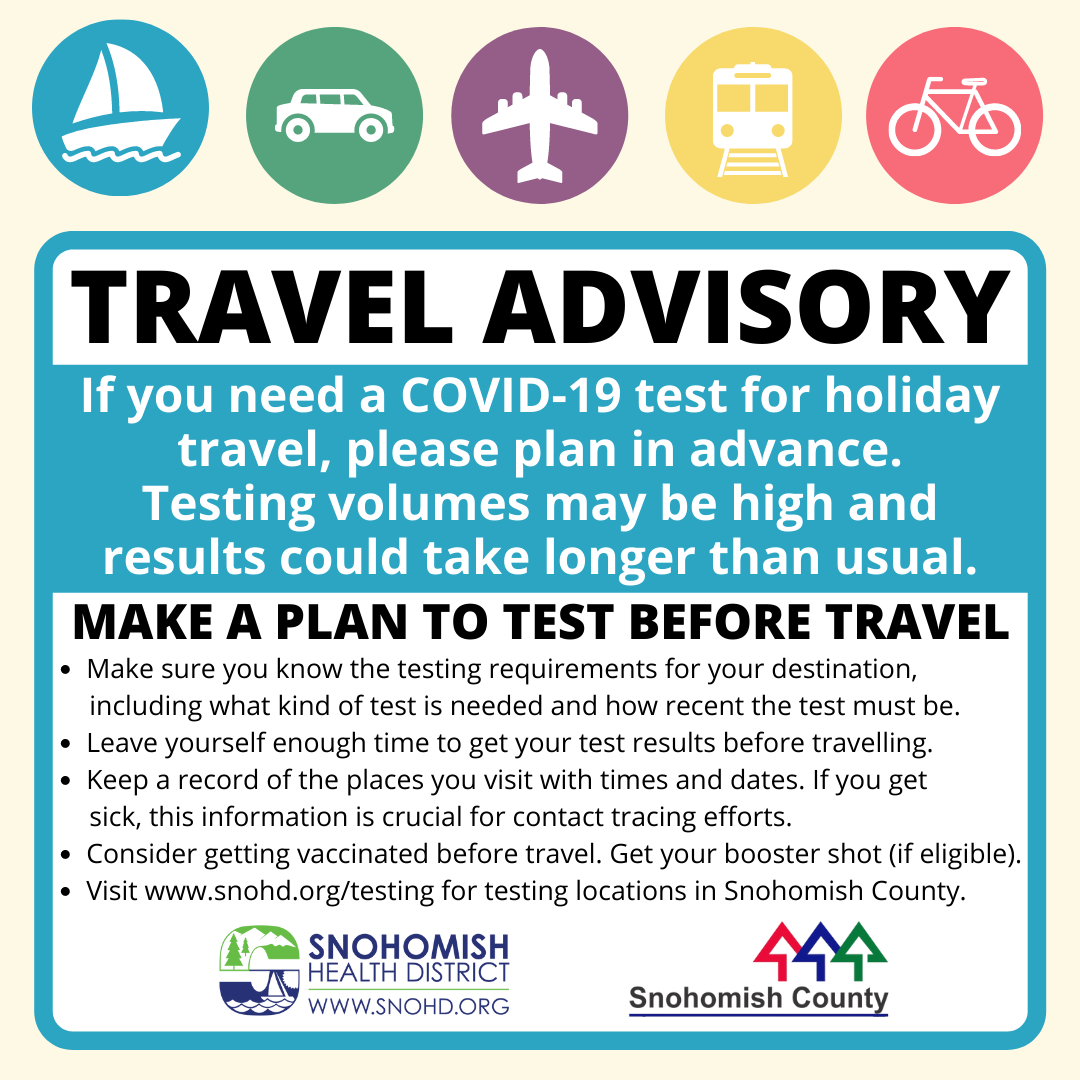
If you are planning to travel or gather with others from outside of your household, plan ahead for needs such as testing or proof of vaccination. Many destinations or activities may require you to provide a negative COVID test and/or your COVID vaccination record. For those who have misplaced their COVID vaccination card, proof of vaccination can be downloaded from https://myirmobile.com/washington-sign-in.
For testing, please be aware that there may be high volumes and some testing providers have closures during the holidays, so it is helpful to book an appointment in advance and consider the timeline for your trip or activity. A quick turnaround cannot be guaranteed, and lab results may take 1-3 days. After you get tested, wait to travel until you receive a negative result, and do not travel if you test positive or have any symptoms. More information is available at www.snohd.org/testing.
Other traveling and gathering reminders:
- Stay home and do not have people over if you have any symptoms of illness
- Follow all travel guidelines, including masking, frequent handwashing, and distancing as much as possible
- Keep gatherings small and hold them in well-ventilated areas
|
|

The Snohomish Health District is consolidating existing monthly COVID reporting into a single report containing the high points and key data. Rather than separate reports for race/ethnicity data, hospitalizations and outbreaks, and vaccination rates, these are now rolled into one detailed monthly document.
Reports can be found at www.snohd.org/casecounts under the “Snapshots and Reports” button. Case counts and case rate information will continue to be updated weekly under the “Local Case Counts” button. Monthly heat maps of case rates and vaccine coverage still will be produced, but cumulative heat maps will no longer be updated.
Additional data can be found and broken out at the county level using the Washington State Department of Health data dashboard.
|
|
|
|
The Washington State Department of Health (DOH) is recommending people 18 and older choose to receive an mRNA COVID-19 vaccine (Pfizer-BioNTech or Moderna) instead of the single-shot Johnson & Johnson (J&J) vaccine. This update follows guidance and recommendations from the Centers for Disease Control and Prevention’s Advisory Committee on Immunization Practices (ACIP) and the Western States Scientific Safety Review Workgroup. Individuals who wish to receive the J&J vaccine are encouraged to reach out to their health care provider to discuss their options as J&J will still be available across the state.
The preferential recommendation follows new data presented to the ACIP about thrombosis and thrombocytopenia syndrome, or TTS. TTS is a rare but serious condition involving blood clots and a low blood platelet count seen in some people who received the J&J vaccine. However, the risk is rare. Nationwide, 54 cases of TTS, including nine confirmed deaths, have been reported, which is a fraction of a percent of the 14 million doses of J&J given overall. While TTS has been seen in both men and women, the most at-risk group is women 30 through 49. People who received the J&J vaccine who develop severe headache, abdominal pain, leg pain, or shortness of breath within three weeks after vaccination should contact their health care provider.
Of the more than 11.4 million doses of COVID-19 vaccine given out across Washington, about 436,000 doses have been the J&J vaccine, which equals about 4%. According to data reported to the Vaccine Adverse Event Reporting System (VAERS) through Nov. 30, there have been six possible cases of TTS following J&J vaccinations in Washington, including one death.
“Public health and safety are, and will always be, our top priorities, which is why we are adopting this new guidance,” said Umair A. Shah, MD, MPH, Secretary of Health. “Today, more than 5 million Washingtonians are fully vaccinated, which means they are protecting themselves from serious illness, hospitalization, and death. I continue to encourage everyone to get vaccinated and, with this news, boosted with an mRNA vaccine as soon as possible.”
“With this recommendation, COVID-19 vaccines based on mRNA are preferred over J&J vaccine, but J&J continues to be an option for those who aren’t able to receive mRNA vaccine,” said Dr. Tao Sheng Kwan-Gett, Chief Science Officer. “With new variants like omicron on the scene, it’s important for people to get vaccinated and boosted to increase their protection against COVID-19, especially the elderly, children, and adults with chronic conditions. Vaccines save lives.”
Those with questions or concerns are encouraged to talk to their trusted health care provider or visit DOH’s COVID-19 Vaccine Frequently Asked Questions page. Everyone 5 and older is currently eligible for the COVID-19 vaccine. The ACIP recommends everyone 16 and older receive a booster dose of mRNA vaccine two months after the first dose of J&J or six months after completing the Pfizer or Moderna vaccine series. mRNA booster doses after an initial dose of J&J have been shown to be effective. To find vaccine locations near you visit Vaccine Locator, Vaccines.gov, or call the state’s COVID-19 hotline at 833-VAX-HELP. Language assistance is available.
|
|
|
El Departamento de Salud del Estado de Washington (DOH, por su sigla en inglés) está recomendando a las personas mayores de 18 años que opten por recibir la vacuna contra la COVID-19 de ARNm (Pfizer-BioNTech o Moderna) en lugar de la vacuna de una sola dosis de Johnson & Johnson (J&J). Esta actualización se implementó según las pautas y recomendaciones del Comité de Asesoramiento sobre Prácticas de Inmunización (ACIP, por su sigla en inglés) de los Centros para el Control y la Prevención de Enfermedades y del Grupo de Trabajo de Revisión de Seguridad Científica de los Estados del Oeste. Se recomienda a las personas que deseen recibir la vacuna de J&J que se pongan en contacto con su proveedor de atención médica para discutir sus opciones, ya que la vacuna de J&J seguirá estando disponible en todo el estado.
En Washington, de acuerdo con el Sistema de Vigilancia de Eventos Adversos de las Vacunas (VAERS, por su sigla en inglés), hasta el 30 de noviembre, hubo seis posibles casos de síndrome de trombosis con trombocitopenia (STT) después de la aplicación de vacunas de J&J, incluida una muerte.
"La salud pública y la seguridad son, y siempre serán, nuestras principales prioridades, y es por eso que estamos adoptando esta nueva pauta", declaró Umair A. Shah, MD, MPH, secretario de Salud. "Hoy en día, más de 5 millones de habitantes de Washington están totalmente vacunados, lo que significa que se están protegiendo de la forma grave de la enfermedad, de la hospitalización y de la muerte. Sigo alentando a todo el mundo a que se vacune y, con esta noticia, se refuerce con una vacuna de ARNm lo antes posible".
"Con esta recomendación, las vacunas contra la COVID-19 de ARNm son preferibles ante la vacuna de J&J, pero esta sigue siendo una opción para quienes no puedan recibir la vacuna de ARNm", expresó el Dr. Tao Sheng Kwan-Gett, jefe oficial de Ciencias. "Con la aparición de nuevas variantes como la ómicron, es importante que la gente se vacune y refuerce su vacunación para aumentar su protección contra la COVID-19, especialmente los ancianos, los niños y los adultos con enfermedades crónicas. La vacuna salva vidas".
Se recomienda a las personas que tengan preguntas o dudas que hablen con su proveedor de atención médica de confianza o que visiten la página de preguntas frecuentes sobre la vacuna contra la COVID-19 del DOH. Actualmente, todas las personas mayores de 5 años pueden vacunarse contra la COVID-19. El ACIP recomienda que todas las personas mayores de 16 años reciban una dosis de refuerzo de la vacuna de ARNm dos meses después de la primera dosis de la vacuna de J&J o seis meses después de completar la serie de vacunas de Pfizer o Moderna. Las dosis de refuerzo de ARNm después de una dosis inicial de la vacuna de J&J han demostrado ser eficaces. Para encontrar los centros de vacunación más cercanos, consulte el localizador de vacunas o Vaccines.gov. La recomendación preferente es consecuencia de los nuevos datos presentados al ACIP sobre el síndrome de trombosis con trombocitopenia (STT). El STT es una afección rara pero grave que implica la formación de coágulos de sangre y un bajo recuento de plaquetas en la sangre, y se observa en algunas personas que recibieron la vacuna de J&J. Sin embargo, el riesgo es poco frecuente. En todo el país se han notificado 54 casos de STT, incluidas nueve muertes confirmadas, lo que supone una fracción del porcentaje de los 14 millones de dosis de J&J administradas en total. Aunque el STT se ha observado tanto en hombres como en mujeres, el grupo de mayor riesgo es el de las mujeres de 30 a 49 años. Quienes hayan recibido la vacuna de J&J y presenten dolor de cabeza intenso, dolor abdominal, dolor en la pierna o dificultad para respirar en las 3 semanas posteriores a la vacunación deben comunicarse con su proveedor de atención médica.
De acuerdo con los datos, de los más de 11.4 millones de dosis de la vacuna contra la COVID-19 distribuidas en todo Washington, unas 436,000 dosis han sido de la vacuna de J&J, lo que equivale a un 4 %.
Puede llamar a la línea directa dedicada a la COVID-19 del estado, 833-VAX-HELP. Se ofrece asistencia lingüística.
|
|
|
The U.S. Food and Drug Administration today issued an emergency use authorization (EUA) for Pfizer’s Paxlovid for the treatment of mild-to-moderate COVID-19 in adults and pediatric patients (12 years of age and older) who are at high risk for progression to severe COVID-19, including hospitalization or death. Paxlovid is available by prescription only and should be initiated as soon as possible after diagnosis of COVID-19 and within five days of symptom onset. Paxlovid is not authorized for the pre-exposure or post-exposure prevention of COVID-19 or for initiation of treatment in those requiring hospitalization due to severe or critical COVID-19. Paxlovid is not a substitute for vaccination in individuals for whom COVID-19 vaccination and a booster dose are recommended.
Paxlovid is the first at home treatment authorized for COVID-19.
Read the full release.
|
|
|
Vaccination appointments are available for those 12+ at the Ash Way Park & Ride site. It is typically open Wednesdays through Fridays from 9 a.m. to 4 p.m., but will be closed December 23-26.
The testing schedule for next week is as follows:
- Testing at the Everett site located at 3715 Oakes Avenue is open Monday through Thursday from 9 a.m. to 4 p.m.
- The Ash Way Park & Ride location at 16327 Ash Way in Lynnwood is typically open for testing Saturdays and Sundays from 9 a.m. to 4 p.m., but will be closed December 23-26.
Appointments for testing are available at www.snohd.org/testing and vaccine appointments at www.snohd.org/drivethru.
Those without internet access, needing language assistance, or requiring additional support in scheduling can reach the Health District’s call center at 425.339.5278 to schedule a testing or vaccine appointment. Callers after hours or on holidays or weekends can leave a message, which will be returned on the next business day.
|
|

If your organization puts on a community event and is looking for resources to share, the Snohomish Health District can help. The Health District has staff and volunteers who can host a booth or table at events. These could include health or resource fairs, back-to-school fairs, community festivals, and other similar events. You can request a booth or table at your event by filling out the short online form at www.snohd.org/eventrequest.
While we can’t guarantee availability for every request, we attend as many as possible. We welcome the invites and are eager to interact with people in the community. Please submit your request at least two weeks prior to the event, and someone will contact you to confirm whether a team is available. Our teams can provide health information and answer questions, as well as gather feedback on public health needs around Snohomish County. Topics that can be covered include: immunizations, environmental health, maternal and child health, opioid and overdose prevention, tobacco and vaping prevention and quit resources, and more. The request form allows you to specify areas of interest for your event.
If you are unable to use the request form or have questions, please contact communications@snohd.org.
|
|
|
|
Cumulative from Jan. 2020 to present.

|
|
|
ESSENTIAL LINKS AND PHONE NUMBERS FOR UP-TO-DATE INFORMATION
|
|
|
|
|