|
|
The number of COVID-19 cases in Snohomish County continues to drop, but transmission remains high, and the healthcare system continues to be under siege, a virtual press conference was told Tuesday.
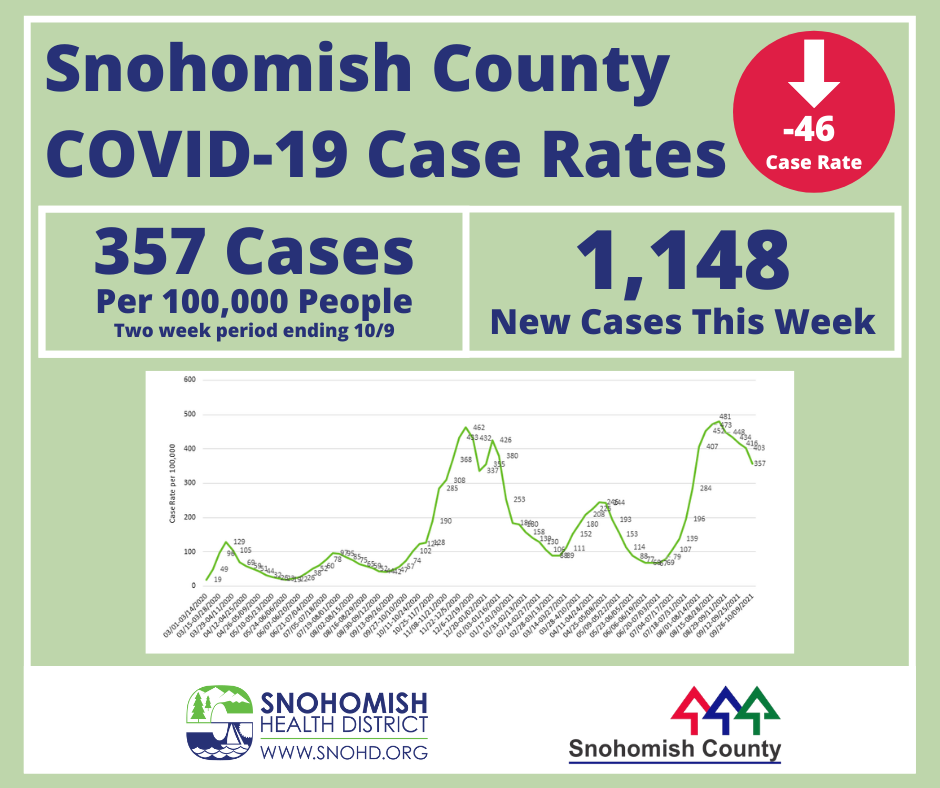
The 14-day COVID case rate has dropped from roughly 400 to 357 new cases per 100,000, said Dr. Chris Spitters, Health Officer with the Snohomish Health District.
“The trajectory is great,” Dr. Spitters said. “Let's hope it's sustained. Let's all do everything we can to continue it, but to also keep in mind that we're still at a very high level of transmission and that all of the common-sense prevention measures – especially masking and social distancing – are still indicated.”
Even though the number of patients hospitalized for treatment of COVID has declined by roughly a third compared to recent weeks, the healthcare system remains “under siege,” he said.
Snohomish County Executive Dave Somers briefed reporters on his plan for helping the community recover from the pandemic. It was approved by the County Council last week.
The recovery effort is funded by the American Rescue Plan Act. The county received about $80 million from that source this year and anticipates similar support in 2022.
Executive Somers detailed how the money will be spent to support economic recovery while also addressing public health challenges, improving access to affordable childcare, and ensuring people are fed and have shelter.
“All of these investments really are going to help those in need and are intended to, and focused on them, to ensure we are doing all we can to help our community recover from the pandemic,” Executive Somers said. “A lot of businesses and families have suffered through this and we’ve got a lot of work to do to recover and gain some stability in our communities.”
Watch a video of the full briefing: https://youtu.be/s6209nSeR6c
|
|
|
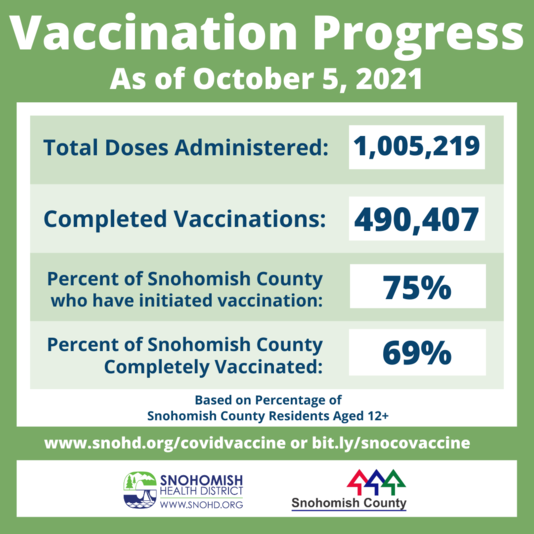
We hit two big milestones here in Snohomish County this month. The one millionth dose of COVID vaccine was administered recently and we have reached 75% of eligible residents 12 and up having had at least one dose. With more than 489,000 residents fully vaccinated and another 42,000 partially vaccinated, Snohomish County has one of the highest vaccination rates in the state.
More than 13,300 doses were administered during the one-week period ending October 5. That’s more than one dose a minute for a full seven days. Every five minutes, three more people here became fully vaccinated, the data show.
“More people initiated COVID vaccination last week than in any week since mid-June,” noted Dr. Chris Spitters, Health Officer for the Snohomish Health District. “Let’s keep that increasing trend of participation going!”
Some of this increase may also be the result of people seeking their Pfizer boosters. The Centers for Disease Control and Prevention and state Department of Health have recommended that the following individuals should receive a booster dose of the Pfizer vaccine at least six months after they completed their vaccine series:
- People 65 years of age and older,
- People 18 years of age and older living in a long-term care setting, and
- People 50 – 64 years of age with underlying medical conditions or those at increased risk of social inequities.
Additionally, the following individuals who completed a Pfizer vaccine series at least six months ago may receive a Pfizer booster dose:
|
|
|
Health officials are urging everyone eligible to get both their flu and COVID vaccines now. Area hospitals continue to face ongoing staffing shortages in acute and long-term care settings, which will be further stressed by what is expected to be a potentially severe flu season, along with updated modeling that projects another increase in COVID cases in December.

Flu activity was kept low last season because of vaccination, social distancing, masking, school closures and limited travel. Now that pandemic restrictions are lifting, flu has a much higher chance of spreading. We can all do our part to prevent illness and hospitalizations by getting vaccinated and continuing to practice all the standard COVID prevention measures throughout the coming months.
“We are in a very different situation than we were last fall and winter,” said Dr. Chris Spitters, Health Officer for the Snohomish Health District. “Last year’s absence of flu transmission in the community likely won’t be the case this year. While the timing and magnitude of the upcoming flu season is uncertain, Snohomish County residents can take steps today to minimize the impact locally. First and foremost, get vaccinated.”
A yearly flu vaccine is recommended for everyone aged six-months and older, including pregnant and nursing people. For protection of healthcare system capacity, it is particularly important for healthcare workers, adults 65 years of age and older, and others with underlying medical conditions to get vaccinated. If you are 65 or older, talk to your provider about flu vaccine and other important vaccines for your age group.
Flu and COVID-19 vaccines can both be received in the same day, or even the same visit for convenience. You may visit your local doctor’s office, pharmacy or clinic event in your area. See www.vaccinefinder.org or call the Help Me Grow Washington hotline at 1-800-322-2588 (language assistance available) to find a flu vaccine location near you.
In Washington, all children under 19 can get flu vaccines and other recommended vaccines at no cost. The provider may charge an administration fee to give the vaccine. You can ask them to waive this fee if you cannot afford it. Most insurance plans, including Medicare part B, cover the cost of flu vaccine for adults.
See the full press release for more information.
|
|
|
|
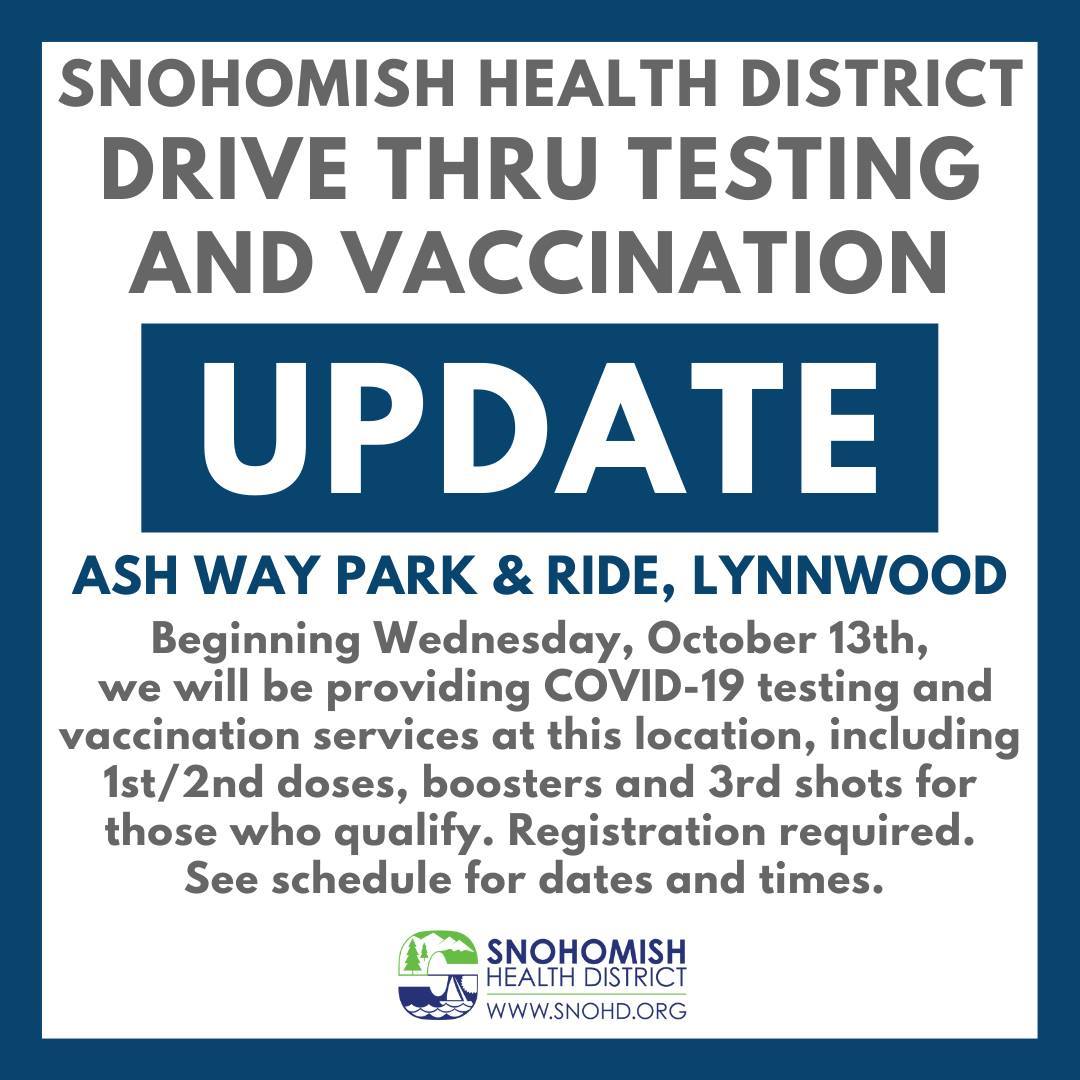
Starting today, the Ash Way Park & Ride site will be a combination COVID testing and vaccination site. The site will be offering vaccinations only on Wednesdays and Thursdays from 9 a.m. to 4 p.m. The site will be testing only on Fridays, Saturdays, and Sundays from 9 a.m. to 4 p.m. Vaccines offered will be primarily Pfizer. Moderna and Johnson & Johnson will be available as supplies allow. First, second, third, and booster doses will be available. Appointments are required for both vaccine and testing services. Registration for is available online at www.snohd.org/drivethru or by calling 425-339-5278 weekdays from 8:30 a.m. to 4:30 p.m.
Another vaccine and testing location will be coming online soon, with details to be announced once finalized.
In addition to the Ash Way Park & Ride dual site, testing will continue to be offered at the Everett site located at 3715 Oakes Avenue. That location is open from 9 a.m. to 4 p.m. Monday through Friday. Note that both the Everett and Ash Way locations close for one hour at 12 p.m. to allow for lunch breaks and shift changes.
A calendar with community COVID-19 vaccine clinics offered by the Health District is also available at www.snohd.org/calendar.aspx?CID=31. Vaccines at these community-based clinics are provided at no cost to patients, regardless of insurance status.
|
|
|
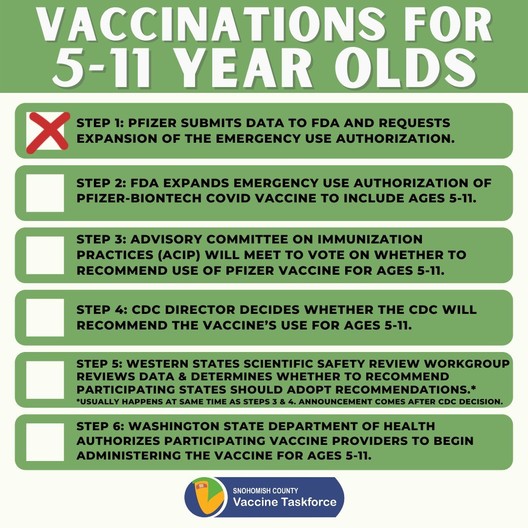
The anticipated expansion of Pfizer’s emergency use authorization for its COVID-19 vaccine to include youth that are 5–11 years of age is moving forward. As a reminder, there are multiple steps in the process before providers can begin administering the vaccines to this age group. The FDA and CDC are meeting in the coming weeks to discuss the issue. Still, it is possible that COVID-19 vaccines for these ages could become available sometime in November. The FDA scheduled an advisory committee meeting on Oct. 26 to inform the agency’s decision-making. In the meantime, please encourage children to wash their hands often, wear a mask when needed, and please keep them home when they are sick.
Learn more.
|
|
|
Gov. Jay Inslee released a statement Monday after publication of a state Office of Financial Management report that shows more than 90% of state government workers are now vaccinated against the virus that causes COVID-19. The OFM report shows vaccination rates for workers across state departments. The vaccinations were required ahead of an Oct. 18 deadline from the governor.

“We all can be extremely encouraged with the progress we have made in vaccinating public servants in response to this pandemic,” Inslee said. “As today’s numbers released by the Office of Financial Management show, tens of thousands more public servants residing in communities across our state are now vaccinated, putting themselves and the people they interact with at much lower risk from this virus. The first numbers gathered showed around 49 percent, now we are over 90 percent. The numbers show this strategy to increase vaccinations has been a great success.
“These high vaccination rates will continue to increase, and union-negotiated impacts will give more time to reconsider their choices as they take unpaid leave. I am so thankful for a state workforce that has chosen the right and best path for themselves, their families and communities and the residents they serve. These actions have saved lives, prevented hospitalizations and protected the health of vulnerable populations and the unvaccinated, like young children.”
See the governor's full statement for more information.
|
|
|
|
New research confirms hospitalization risk higher with four COVID-19 variants – People in Washington state infected with Alpha, Beta, Gamma, and Delta variants have a higher risk of hospitalization compared to those infected with non-variant versions of SARS-CoV-2, according to new research from the Washington State Department of Health (DOH), in collaboration with Fred Hutchinson Cancer Research Center, Institute for Disease Modeling at the Bill & Melinda Gates Foundation, and and UW Medicine Virology Lab. The variants Gamma and Beta have the highest estimated risk for hospitalization.

Additional research was conducted to examine the risk of hospitalization among people infected with these variants who were vaccinated and those who were unvaccinated. Overall, they found that people infected with Alpha, Beta, Gamma or Delta variants who were vaccinated had a lower risk of hospitalization.
Nuevas investigaciones confirman que el riesgo de hospitalización es mayor con cuatro variantes de la COVID-19 – En el estado de Washington, los contagiados con las variantes alfa, beta, gamma y delta corren un mayor riesgo de hospitalización en comparación con aquellos contagiados con SARS-CoV-2, según una nueva investigación (solo en inglés) llevada a cabo por el Departamento de Salud del Estado de Washington (DOH, por su sigla en inglés) en colaboración con el Centro de Investigación del Cáncer Fred Hutchinson, el Instituto de Modelado de Enfermedades de la fundación Bill y Melinda Gates y el laboratorio de Virología de la Facultad de Medicina de la Universidad de Washington. Las variantes gama y beta suponen el mayor riesgo estimado de hospitalización.
Se realizaron investigaciones adicionales para evaluar el riesgo de hospitalización entre los contagiados con estas variantes que estaban vacunados y los que no estaban vacunados. En general, se descubrió que los contagiados con las variantes alfa, beta, gama y delta que estaban vacunados corrían un menor riesgo de hospitalización. Cuando los investigadores evaluaron las variantes por separado, el mismo patrón de menor riesgo de hospitalización para las personas vacunadas se observó en los contagiados con las variantes alfa, gama y delta. La variante beta se excluyó de este análisis debido a la baja cantidad de contagios de esta variante.
|
|
|
|
The state Department of Health has published the second installment of its two-part series exploring the Food and Drug Administration (FDA) full approval of Pfizer’s vaccine against the virus that causes COVID-19.
What does it mean when a vaccine gets ‘FDA Approval?’ While FDA approval is the gold standard for proving a product is safe and effective, the process itself usually doesn’t get much attention. This gives way for rumors to spread on and offline. In an earlier post, we discussed some of the myths circulating about FDA approval of the Pfizer vaccine. In this part, we’re taking a behind-the-scenes look at the approval process. Read more.
¿Qué significado tiene cuando una vacuna contra el covid-19 recibe la ‘aprobación de la FDA’? Ha pasado ya más de un mes desde que la Administración de alimentos y medicamentos, la FDA, dio la aprobación total de la vacuna Pfizer COVID-19 para mayores de 16 años, con el nombre de Comirnaty. Esta aprobación de la FDA ha sido un gran logro en la lucha contra el COVID-19. Esto ha tenido un gran impacto en la vacunación en un mayor número de personas en los Estados Unidos. En una publicación anterior, hablamos de algunos de los mitos que circulan sobre la aprobación de la vacuna Pfizer por parte de la FDA. En este blog, vamos a echar un vistazo más profundo sobre el proceso de aprobación. Leer más
|
|
|
|
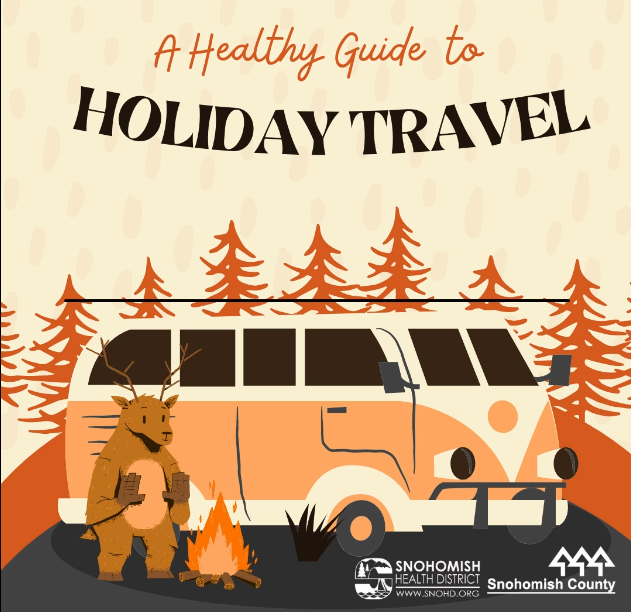
Traveling for the holidays? Look to the CDC travel guidelines to prepare for your trip. The CDC recommends delaying travel until you are fully vaccinated.
For more information, see the full CDC guidelines.
Facebook
Twitter
|
|
|
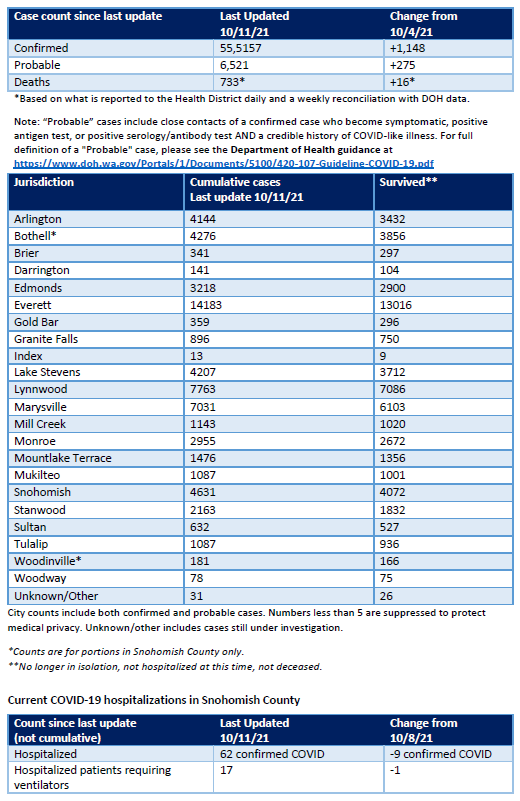
Cumulative from January 2020 to present.
|
|
|
ESSENTIAL LINKS AND PHONE NUMBERS FOR UP-TO-DATE INFORMATION
|
|
|
|
|