|
|
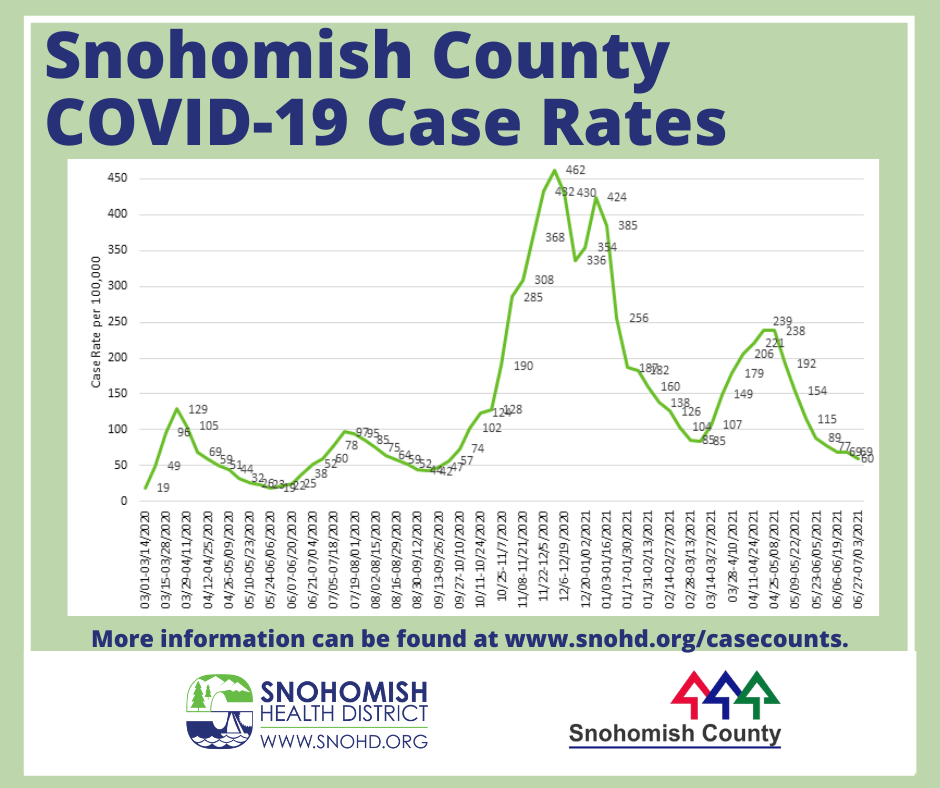
After hitting a two-week plateau, the COVID case rate in Snohomish County dropped from 69 to 60 new cases per 100,000 population. With more activities open, we need to stay focused and keep cases down. Vax up, wash your hands, stay home if sick, and keep a mask handy – depending on where you go, you’ll need it.
|
|
|
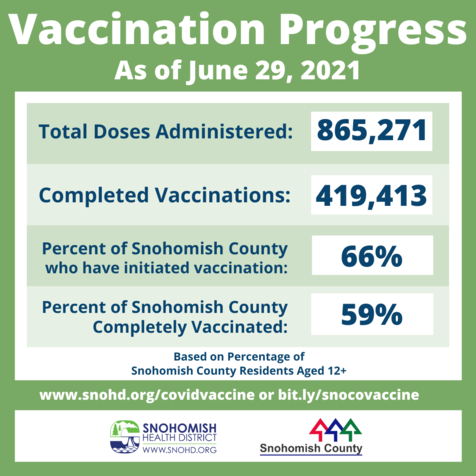
The latest data show that another 10,400 people in Snohomish County completed COVID-19 vaccination by the end of June, and roughly 4,100 more had their first shot. Nearly 6 in every 10 people in the county, ages 12 and up, are now fully vaccinated. http://bit.ly/snocovaccine
|
|
|
Mass vaccination sites here are closing after six months and more than 318,000 doses of COVID-19 vaccine administered.
Vaccination against COVID-19 remains vital. Vaccine supply has stabilized, demand is down, and other providers such as clinics or pharmacies are in a position to keep up with the need for vaccinating those who still have not received their first or second doses. A list of resources to help find COVID vaccine is included at the end of this press release.
All but one of the mass vaccination sites operated by the Snohomish County Vaccine Taskforce were demobilized as of June 30.

The remaining site at Ash Way Park & Ride in Lynnwood is finishing second doses of the Pfizer COVID vaccine during the month of July. After July 10, that site will be second-dose only and is scheduled to close by the start of August.
The first mass vaccination site opened Jan. 6, 2021. By April 21, seven mass vaccination sites were set up around Snohomish County: Angel Of The Winds Arena in Everett, Arlington Airport, Ash Way Park & Ride in Lynnwood, Boeing Everett Activity Center, Boom City in Tulalip, Edmonds College, and Evergreen State Fairgrounds in Monroe.
By the beginning of May, demand for COVID vaccine was decreasing. The mass vaccination sites have been gradually winding down as the availability of vaccine from other providers has improved. About 409,000 people in Snohomish County are fully vaccinated and 850,681 total doses have been administered by all providers in the county.
The vaccine taskforce has been a collaboration among public health, emergency management, law enforcement, fire and emergency medical services, human services, transit, public works, and other partners throughout Snohomish County.
A total of 1,777 staff and volunteers from 25 agencies have worked at least 55,828 hours on vaccine taskforce efforts. Information on staffing and hours still is being processed and the taskforce estimates that, once that is added, more than 63,000 total hours will have been recorded on the mass vaccination work as of June 28.
Along with the vaccination sites, mobile teams with the taskforce also have provided community-based clinics and visits to homebound individuals. The Snohomish Health District is taking over coordination of the remaining community-based clinics. Meanwhile, the demand for homebound vaccinations has decreased and the taskforce is no longer providing home visits for COVID vaccination. Pharmacies or other providers may offer homebound vaccination.
See the full press release for more information.
|
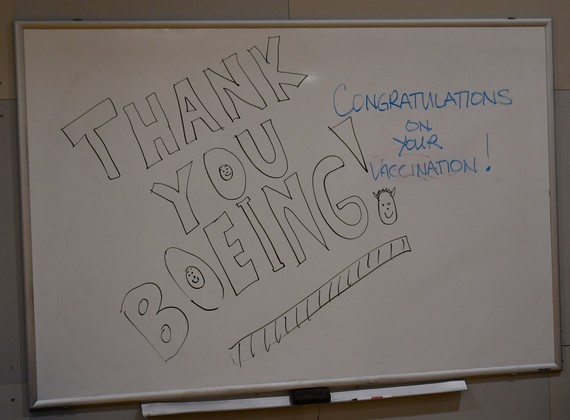 Messages left at the mass vaccination site hosted by Boeing.
|
|
|
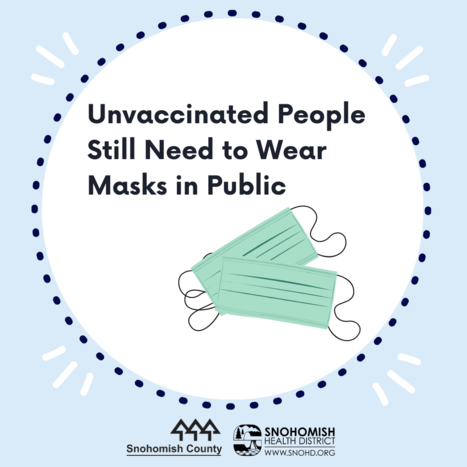
All people, regardless of vaccination status, are still required to wear masks in certain places, such as public transportation, schools and health care settings. In most other settings, people who are fully vaccinated do not need to wear a mask.
However, the Secretary of Health’s mask order has been amended to say that no one is required to wear a mask outdoors. People who are unvaccinated are strongly encouraged to wear a mask in crowded outdoor settings, such as at sporting events, fairs, parades, concerts, and similar settings where it’s harder to maintain physical distance. No one is required to wear a mask during outdoor sports practice or competition, while swimming or when engaged in water sports and recreation.
People who are not fully vaccinated must wear a mask when in indoor public settings, as well as during indoor sports practices and competitions. There will be some limited exceptions that will be designated by the Washington State Department of Health (DOH). Details and future updates will be through the Governor’s Office and DOH websites.
The settings in which all people, including people who are fully vaccinated, are required to wear masks include:
- child care facilities, camps, K-12 schools, and other youth settings where children are present or expected to be present;
- health care settings, in accordance with CDC health care infection prevention and control recommendations;
- correctional facilities in areas where incarcerated individuals are present or expected to be present;
- homeless shelters in areas where individuals being served are present or expected to be present; and
- public transportation and transportation hubs, including airports, bus or ferry terminals, train and subway stations. Note that the Health District supports transportation agencies excluding or disembarking riders who decline to wear a mask.
See the full press release for more information.
|
|
|
Due to COVID-19, vaccines seem to be on everyone’s mind these days. Along with COVID-19 vaccine questions, you may also be wondering: “What vaccines have I already had? Which vaccines do I still need to get? How can I find out if my kids have all their vaccinations for school?”

Another pressing question might be, “What do I do if I lose my COVID-19 vaccination card?”
There’s good news — most of your vaccine questions can be answered easily with the help of an online portal. Washington State offers an authorized service called MyIR Mobile which allows you to safely access your and your family’s immunization records online. It’s free, it’s official, and it’s secure. Once registered, you can access all of your vaccination records — including your COVID-19 vaccine records.
See the full press release for more information.
|
|
|
|
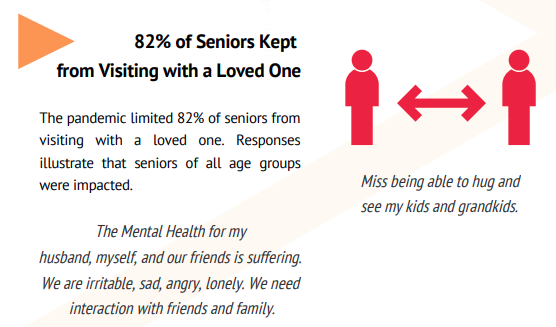
Snohomish County Human Service's Aging and Disability Services this month published results of its survey of residents 55 and older to better understand the unique difficulties seniors have faced here during the COVID crisis. The survey measured critical areas around health and wellbeing, technical abilities, financial impacts, kinship care, risk of infection, and emergency preparedness. A total of 3,480 surveys were completed, in print and online. The results will be used to help inform future planning to assist seniors.
Read the full report for more information.
|
|
|
Early results from the COVID-19 Student Survey of about 65,000 middle and high school students in Washington show many of them reported feeling sad or depressed most days during the pandemic, the Washington State Health Care Authority reports. But the majority of students in each grade also reported a high degree of resilience, saying they were optimistic about the future.

Statewide reports for participating middle and high schools can be found at csswashington.org.
Students in grades 6–12 from 330 schools in 35 of 39 counties took part in the survey, which was administered in March 2021. Students at dozens of middle schools and high schools in Snohomish County participated.
Some key findings:
- Some students reported concerns about the financial impacts of COVID-19 on their families.
- Of those surveyed, 58 percent of high school students and 45 percent of middle school students reported feeling sad or depressed on most days during the past year.
- Remote learning was challenging. Nearly 70 percent of middle and high school students said they felt it was harder to do their schoolwork this year than it was last school year.
- The survey results also show resilience among many students: More than 90 percent of participating students in each grade were at least slightly hopeful, and nearly 60 percent of all responding students reported feeling optimistic or hopeful about the future.
See the full press release for more information.
|
|
|
|
Gov. Jay Inslee last week issued an extension of the utility moratorium proclamation, which will now expire on September 30, 2021. This will be the final extension of the proclamation and the extension will align with the end date of the tenancy preservation bridge (21-09) to give Washingtonians struggling with housing payments time to prepare and seek assistance before both proclamations expire.

"Utilities and housing are inextricably linked," Inslee said. "Our priority is to keep Washingtonians safe and housed, and give them a glide path to long-term stability."
The Office of the Governor will work closely with utilities on how they can continue to support customers once the moratorium expires. Utilities are encouraged to:
- Continue to make good faith efforts to reach customers with past-due accounts, including partnering with community organizations, and provide information about their various assistance options.
- Help customers identify utility, local, state and federal financial assistance programs they may be eligible for.
- Offer extended payment plans of 12 months or longer.
- Waive disconnection, reconnection, site visit and late fees accrued during the disconnection moratorium, if customers sign up for payment assistance.
- Refrain from reporting overdue accounts to credit bureaus or placing liens on customers with overdue accounts for at least 180 days.
See the full press release for more information.
|
|
|
|
Small business owners and nonprofits across Washington can start applying today for low interest loans of up to $150,000 through the newly-launched Small Business Flex Fund. The Fund is a public-private partnership aimed at helping small businesses and nonprofits – particularly those in low-income communities – recover and grow as communities across the state reopen for business.
Gov. Jay Inslee in November 2020 approved a foundational investment of $30 million for the state Department of Commerce to create a recovery loan program. Commerce is partnering with several financial institutions and community-based organizations to lend $100 million or more to small businesses and nonprofits with fewer than 50 employees and annual revenues of less than $3 million.

Qualifying businesses and nonprofits can apply for loans up to $150,000. Loans are available in 60- or 72-month loan terms at interest rates between 3-4.5%.
“Reopening our economy is an incredible milestone and we want to ensure that our smallest businesses and nonprofits have equitable access to flexible financial support to get back on their feet,” said Inslee. “The Small Business Flex Fund will not only aid in our businesses’ recovery from the pandemic, but it will allow them to plan ahead, grow and thrive. And this is a tool that will remain available over many years, to bolster our smallest businesses and nonprofit organizations in times of economic hardship.”
“The COVID-19 pandemic shone a bright light on many of the historic inequities and barriers facing different communities. One of those barriers is access to working capital for small businesses and nonprofits trying to develop and grow, especially those in low-income areas and led by women and people of color,” said Lisa Brown, Director of the Washington State Department of Commerce.
The Fund works with and through local Community Development Financial Institutions (CDFIs), which serve under resourced communities and underbanked businesses the Small Business Flex Fund aims to help.
See the full press release for more information.
|
|
|

This state’s latest bimonthly morbidity and mortality report for COVID-19 was released last week. It provides an overview of confirmed or probable COVID case rates, hospitalizations, and deaths by race and ethnicity across Washington. Read the full report for more information.
Below are some key findings:
|
- Confirmed or probable case rates for Native Hawaiian and Other Pacific Islander and Hispanic populations are approximately 3.5 times higher than case rates for Asian and white populations.
- Confirmed or probable case rates for Black populations are approximately two times higher than case rates among Asian and white populations.
- Native Hawaiian and Other Pacific Islander populations have death rates among confirmed or probable COVID-19 cases that are six times higher than white populations.
- American Indian/Alaska Native and Hispanic populations have death rates among confirmed or probable COVID-19 cases that are three times higher than white populations.
- Black populations have death rates among confirmed or probable COVID-19 cases that are about twice as high as white populations.
| Race |
Cases |
Case rates per 100,000 |
Deaths |
Death rates per 100,000 |
| All races |
450,849 |
5888.7 |
5,908 |
77.2 |
| Hispanic |
74,938 |
7944 |
712 |
214.3 |
| White |
131,236 |
2597.7 |
4,122 |
63.1 |
| Asian |
15,942 |
2169.9 |
450 |
91.9 |
| Black |
14,601 |
4648 |
201 |
116.4 |
| Native Hawaiian/Pacific Islander |
4,4647 |
8410.4 |
102 |
373.6 |
| American Indian/Alaska Native |
4,285 |
4477.1 |
133 |
198.8 |
|
|
|
The state Department of Health has prepared Coping with Grief and Loss During COVID-19, a resource that provides information (including signs), as well as tools for coping, and tips for supporting someone through grief and loss
 |
|
Research shows each COVID-19 death on average can affect up to nine grieving relatives, the state says. As of this week, the state has confirmed more than 5,900 COVID-19 deaths. More than 600 of those have been in Snohomish County.
In addition, death of a loved one is not the only cause of grief and loss. The COVID-19 pandemic has created multiple loss experiences for many, including job loss, diminished health, or the loss of our “normal” lives.
|
|
|
|
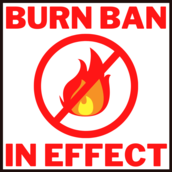
Snohomish County has been the focus of a burn ban since June 25. The same is now true statewide.
Gov. Jay Inslee on Tuesday declared a state of emergency due to increased risk of wildfires, and prohibited most outdoor and agricultural burning through September 30, 2021.
"Washington is facing a historic drought and we have already experienced record-breaking heat. We must be vigilant in our efforts to prevent wildfires, and the loss of life and destruction of land and property that comes with them,” Inslee said.
“We have seen a record-breaking number of fires for this early in the summer,” said Commissioner of Public Lands Hilary Franz. “Extreme drought conditions leave communities across our state at risk as fire danger continues to climb.”
The state burn-ban mirrors rules already in place in the county. Backyard grilling is OK. Small recreational fires in fire pits are allowed, but not encouraged. Other types of fires are prohibited.
See the full press release for more information.
|
|
|
|
Now that the state has reopened, you may find that some local retailers are choosing to keep some safety measures in place. This may include masks and physical distancing. Please be patient as our business community moves towards getting back to normal.
Meanwhile, state health officials have released updated guidance for workplaces, other than health-care settings. The guidance replaces the more sector-specific directions that were released earlier in the COVID crisis.
Facebook
Twitter
|
|
|
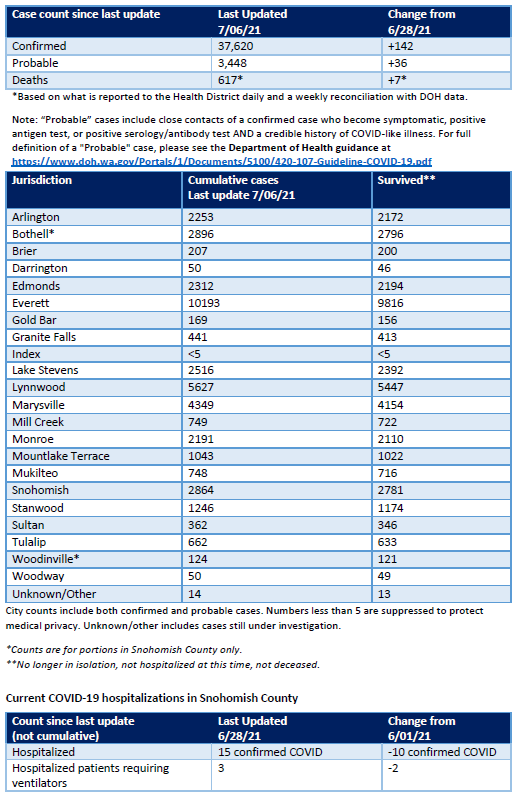
Cumulative from January 2020 through July 6, 2021.
|
|
|
|
ESSENTIAL LINKS AND PHONE NUMBERS FOR UP-TO-DATE INFORMATION
|
|
|
|
|