|
|
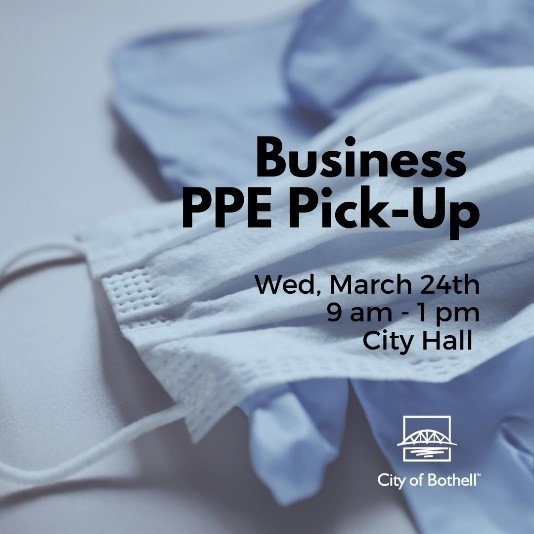
The move to Phase 3 means that restaurants, retail, fitness establishments and other indoor spaces can now operate at 50% capacity. To support the move of local businesses into this next phase, the City of Bothell has scheduled a PPE distribution event for Wed., March 24 from 9 a.m. – 1 p.m. at Bothell City Hall. During the event, the city will distribute face masks, hand sanitizers, and wall mounted dispensers to Bothell businesses. Businesses should bring a copy of its business license or a business card.
Questions? Contact Jeanie Ashe, jeanie.ashe@bothellwa.gov, (425) 806-6149.
|
|

Uncertain conditions resulting from the COVID-19 pandemic in 2020 caused the county to pause its 2020-2021 Lodging Tax Small Fund Grant cycle last June. The 2020 grant cycle would have funded projects in 2021. After evaluating the feasibility of a compressed schedule, the county has decided to cancel the 2020-2021 grant cycle. Consideration for the 2021-2022 cycle that is set to open this summer for projects occurring in 2022 is under review.
“We know our tourism industry has been severely impacted by the COVID-19 pandemic,” said Snohomish County Council and LTAC Chair Stephanie Wright. “While economic conditions are improving, applicant project planning and execution timelines in 2021 largely remain uncertain due to the pandemic. We intend to open the grant application cycle as soon as we can be more certain about successful project implementation.
The Snohomish County Parks, Recreation and Tourism Division will provide additional information about the potential future opening of a Lodging Tax Small Fund Grant cycle later in 2021 for 2022 projects once further determinations are made.
The Snohomish County Annual Lodging Tax Small Fund Grant may be used for marketing and promotion of visitor-related events, projects and activities which draw tourists to stay overnight in the county, and strongly align with the new 2018-2022 Snohomish County Strategic Tourism Plan.
|
|
|
|
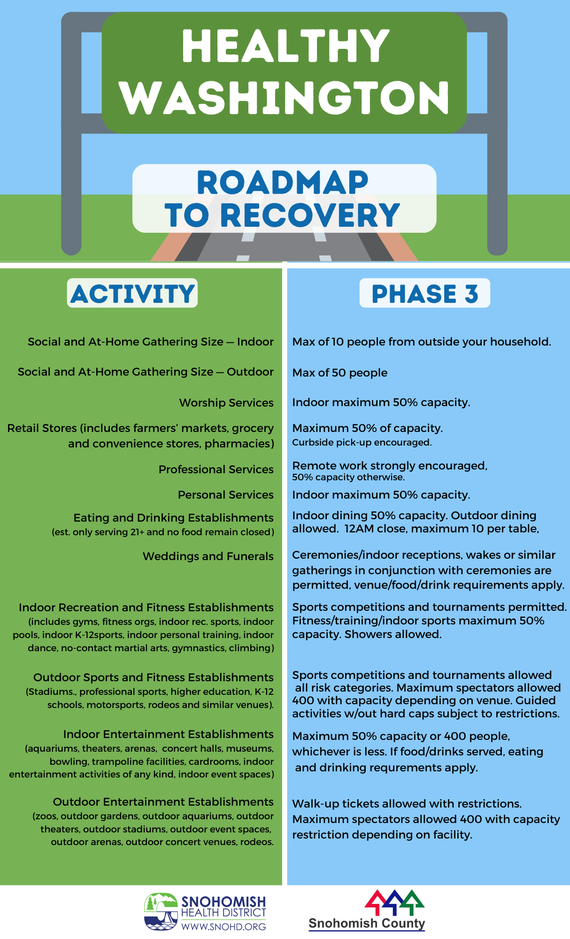
Washington State’s “Roadmap to Recovery” has moved into Phase 3. To help keep us headed in the right direction, we still need to follow the three W’s: Wear a mask. Wash your hands. Watch your distance. For more specifics on the new guidance, please go here: www.bit.ly/WAPhase3Info
|
|
|
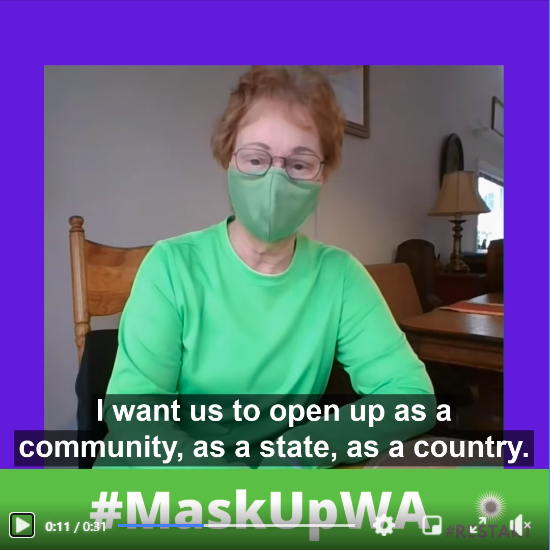
Warm Beach resident Cass Owens wears a mask to keep her friends and neighbors safe. She also wears one to help us open up as a community, as a state, as a country. #MaskUpWA #MaskMonday
Facebook
Twitter
|
|
|
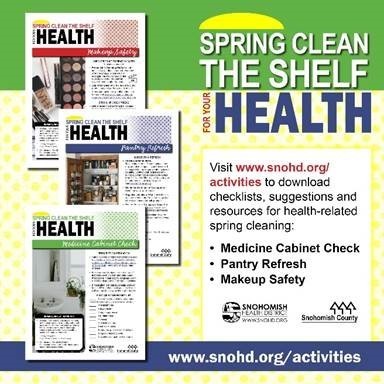
Spring is just around the corner. Get a head start on your cleaning goals by checking out these handy guides to decluttering your spaces. Download at www.snohd.org/576/Spring-Cleaning
|
|

UW Bothell recently posted a story on its website about the efforts of the Snohomish Health District to partner with current students to stop the spread of COVID-19 by creating safety messages tailored to young adults.
Emily Oomen — an alumna and current COVID-19 coordinator for the Snohomish Health District wanted to set up a social media challenge to complement the Mask Up Washington campaign — and a partnership between SHD and UW Bothell was formed.
Oomen and Heather Thomas, SHD’s public and government affairs manager, worked with the students to develop the social media messages.
“I was confident the students would provide valuable insight and come up with effective campaign ideas for reaching young adults, who are the group most likely to spread the virus,” Oomen said.
Read the full article by Elisabeth Schnebele.
|
|
|
Over the last year, the state Department of Commerce has connected small businesses with more than $125 million in grants to address the economic outfall of COVID-19. This effort continues with a new round of grant opportunities. The application portal is scheduled to open March 29.
Working Washington Round 4 offers grant relief funds to small for-profit businesses, especially those that were required to close due to public health and safety measures.
Priorities for funding are:
- Businesses required to close.
- Businesses with lost revenue as a result of closure.
- Businesses with added expenses to maintain safe operations.
- Equitable distribution of grant funds across the state and to businesses owned and operated by historically disadvantaged individuals.
Frequently asked questions are posted online, as is information about eligibility and required documentation
|
|
|

Insurance Commissioner Mike Kreidler has extended two emergency orders. His order requiring health insurers to waive copays and deductibles for any consumer requiring testing for coronavirus (COVID-19) and his order protecting consumers from receiving surprise bills for lab fees related to medically necessary diagnostic testing for COVID-19 are both extended until April 18, 2021.
Kreidler's order waiving cost-sharing applies to all state-regulated health insurance plans and short-term, limited-duration medical plans. The order on surprise billing applies to both in-state and out-of-state laboratories when a provider orders diagnostic testing for COVID-19.
Also, insurers must continue:
- Allowing a one-time early refill for prescription drugs.
- Suspending any prior authorization requirement for treatment or testing of COVID-19.
- In addition, if an insurer does not have enough medical providers in its network to provide testing or treatment for COVID-19, it must allow enrollees to be treated by another provider within a reasonable distance at no additional cost.
Read the full release.
|
|
|

The U.S. Small Business Administration has launched a splash page for the Shuttered Venue Operators Grant (SVOG) application portal in anticipation of opening applications for the much-anticipated critical economic relief program on Thursday, April 8, 2021.
“Help is here for venue operators hit hard by the COVID-19 pandemic. The SBA has worked diligently to build the Shuttered Venue Operators Grant program from the ground up to assist and address the diverse eligibility requirements of each type of applicant and we will open for applications on April 8,” SBA Administrator Isabella Casillas Guzman said. “The SBA knows these venues are critical to America's economy and understands how hard they've been impacted, as they were among the first to shutter. This vital economic aid will provide a much-needed lifeline for live venues, museums, movie theatres and many more.”
Prior to the official SVOG application opening, the SBA will host a national informational webinar to highlight the application process for potential eligible entities from 2:30 to 4 p.m. ET on Tuesday, March 30, 2021. Those interested in participating can register here.
The SVOG program was established by the Economic Aid to Hard Hit Small Businesses, Nonprofits and Venues Act, which appropriated $15 billion for it. The American Rescue Plan Act, signed into law by President Joe Biden on March 11, 2021, appropriated an additional $1.25 billion, bringing the program funding to a total of $16.25 billion, with more than $16 billion allocated for grants.
To ensure eligible venues do not miss a window to receive assistance through the Paycheck Protection Program, the American Rescue Plan Act also amended the SVOG program so entities that apply for a PPP loan after Dec. 27, 2020, can also apply for an SVOG, with the eligible entity’s SVOG to be reduced by the PPP loan amount. The PPP loan applications have been updated to reflect this.
As the SBA builds and prepares to open the program, the dedicated SBA website, www.sba.gov/svogrant, which includes frequently asked questions, video tutorials and other SVOG details, is the best source for information for those looking to apply for a grant. To prepare in advance of the SVOG application portal opening on April 8, potential applicants should get registered in the federal government’s System for Award Management (SAM.gov), as this is required for an entity to receive an SVOG, and reference the preliminary application checklist and eligibility requirements.
|
|
|
|
The Internal Revenue Service announced that the next batch of Economic Impact Payments will be issued to taxpayers this week, with many of these coming by paper check or prepaid debit card.
For taxpayers receiving direct deposit, this batch of payments began processing on Friday and will have an official pay date of Wednesday, March 24, with some people seeing these in their accounts earlier, potentially as provisional or pending deposits. A large number of this latest batch of payments will also be mailed, so taxpayers who do not receive a direct deposit by March 24 should watch the mail carefully in the coming weeks for a paper check or a prepaid debit card, known as an Economic Impact Payment Card, or EIP Card.
No action is needed by most people to obtain this round of Economic Impact Payments (EIPs). People can check the Get My Payment tool on IRS.gov on to see if the their payment has been scheduled.
“The IRS continues to send the third round of stimulus payments in record time,” said IRS Commissioner Chuck Rettig. “Since this new set of payments will include more mailed payments, we urge people to carefully watch their mail for a check or debit card in the coming weeks.”
Following enactment of the American Rescue Plan Act on March 11, the IRS moved quickly to start delivering the third round of Economic Impact Payments. The IRS initiated the first batch of the $1,400 stimulus payments, mostly by direct deposit, on March 12.
March 22 marks the second batch of payments, with additional payments anticipated on a weekly basis going forward. The vast majority of taxpayers receiving EIPs will receive it by direct deposit. In addition, the IRS and the Bureau of the Fiscal Service leveraged data in their systems to convert many payments to direct deposits that otherwise would have been sent as paper checks or debit cards. This accelerated the disbursement of these payments by weeks.
Watch the mail for paper checks, EIP Cards
Taxpayers should note that the form of payment for the third EIP may be different than earlier stimulus payments. More people are receiving direct deposits, while those receiving them in the mail may get either a paper check or an EIP Card – which may be different than how they received their previous stimulus payments. IRS and the Treasury Department urge eligible people who have not received a direct deposit to watch their mail carefully during this period.
Paper checks will arrive by mail in an envelope from the U.S. Department of the Treasury. For those taxpayers who received their tax refund by mail, this paper check will look similar, but will be labeled as an “Economic Impact Payment.”
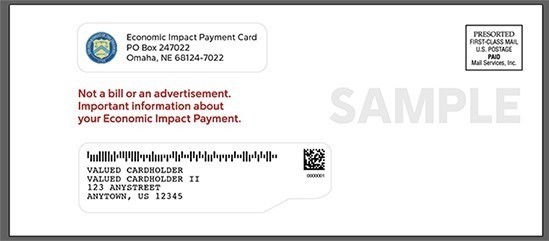
The EIP Card will come in a white envelope prominently displaying the seal of the U.S. Department of the Treasury. The card has the Visa name on the front and the issuing bank, MetaBank, N.A. on the back. Information included with the card will explain that this is an Economic Impact Payment. Each mailing will include instructions on how to securely activate and use the card. It is important to note that none of the EIP cards issued for any of the three rounds is reloadable; recipients will receive a separate card and will not be able to reload funds onto an existing card. EIP Cards are safe, convenient, and secure. EIP Card recipients can make purchases online or in stores anywhere Visa Debit Cards are accepted. They can get cash from domestic in-network ATMs, transfer funds to a personal bank account, and obtain a replacement EIP Card if needed without incurring any fees. They can also check their card balance online, through a mobile app, or by phone without incurring fees. The EIP Card provides consumer protections against fraud, loss, and other errors. The EIP Card is sponsored by the Bureau of the Fiscal Service and is issued by Treasury's financial agent, MetaBank, N.A. The IRS does not determine who receives a prepaid debit card.
More information about these cards is available at EIPcard.com.
Read the full release.
|
|

The Treasury Department and Internal Revenue Service on Wednesday announced that the federal income tax filing due date for individuals for the 2020 tax year will be automatically extended from April 15, 2021, to May 17, 2021.
"This continues to be a tough time for many people, and the IRS wants to continue to do everything possible to help taxpayers navigate the unusual circumstances related to the pandemic, while also working on important tax administration responsibilities," said IRS Commissioner Chuck Rettig. "Even with the new deadline, we urge taxpayers to consider filing as soon as possible, especially those who are owed refunds. Filing electronically with direct deposit is the quickest way to get refunds, and it can help some taxpayers more quickly receive any remaining stimulus payments they may be entitled to."
Individual taxpayers do not need to file any forms or call the IRS to qualify for this automatic federal tax filing and payment relief. Individual taxpayers who need additional time to file beyond the May 17 deadline can request a filing extension until Oct. 15
Read the full release.
|
|
|
|
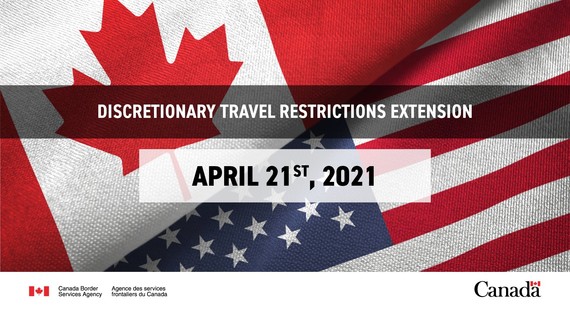
Canada continues to strongly advise its residents to cancel or postpone non-essential travel outside the country. Its restrictions remain in effect through April 21.
“Now is not the time to travel,” the government says on its driving to Canada requirement checklist. “People who travel, regardless of citizenship, will need to follow testing and quarantine requirements to keep Canadians safe, particularly given the new COVID-19 variants in Canada and around the world.”
|
|
|
Avoid nonessential travel this spring break by having a staycation. You don't have to go far to have fun. Let's make this the last spring break you have to mask up by being COVID-safe.
Need some ideas on what to do during your staycation? Watch the video on Facebook or Twitter.
#NotForeverJustForNow
|
|
|
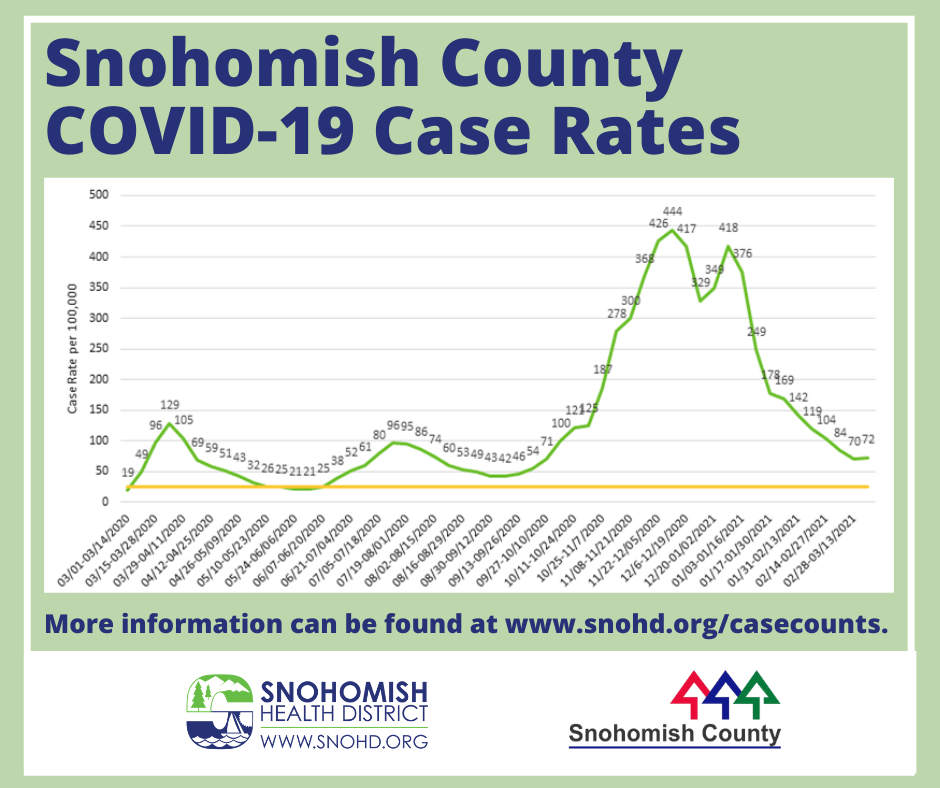
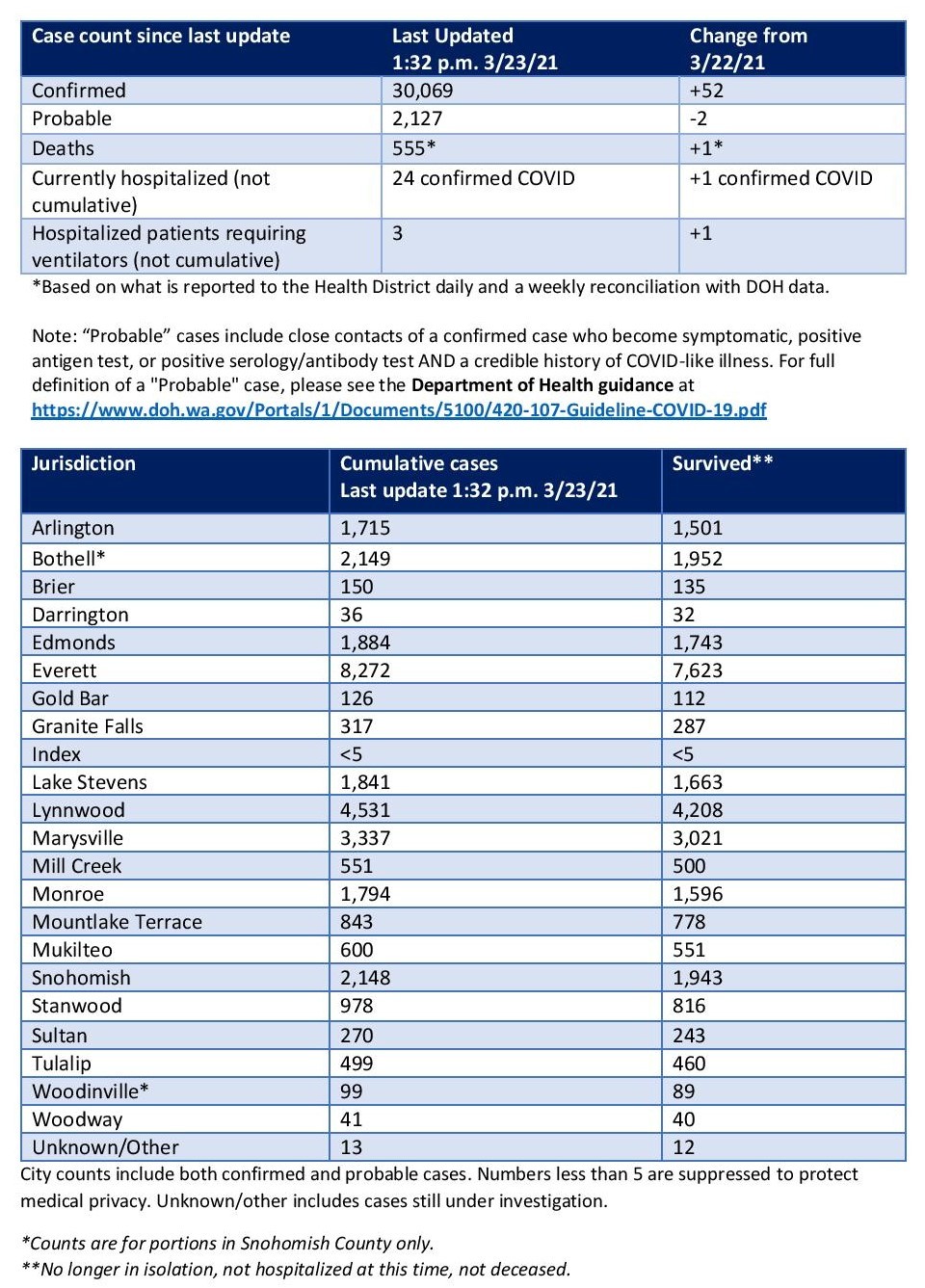
Cumulative from January 2020 through March 23, 2021.
|
|
|
ESSENTIAL LINKS AND PHONE NUMBERS FOR UP-TO-DATE INFORMATION
|
|
|
|
|