|
|
Snohomish County Executive Dave Somers and Health Officer Dr. Chris Spitters provided updates Tuesday on the community’s response to COVID-19.
Executive Somers told a virtual press conference that he is thankful for partnerships during the COVID crisis, including the solid working relationship with the Snohomish County Council. The executive said he is grateful for the council’s decision Monday to continue funding a variety of pandemic-fighting programs, including:
- $1 million to continue support for small businesses who have already applied to the Relief, Recovery, Resiliency Program.
- $1.5 million for continued support to the Nourishing Neighborhoods program, which is bringing locally grown produce and other food to 15 locations in the county where regular access to food has been a challenge during the pandemic.
- $1.5 million for emergency child care for essential workers.
- $2.5 million for programs managed by Human Services, including funds to support seniors, enhanced 2-1-1 services, community outreach services, and motel vouchers for individuals experiencing homelessness.
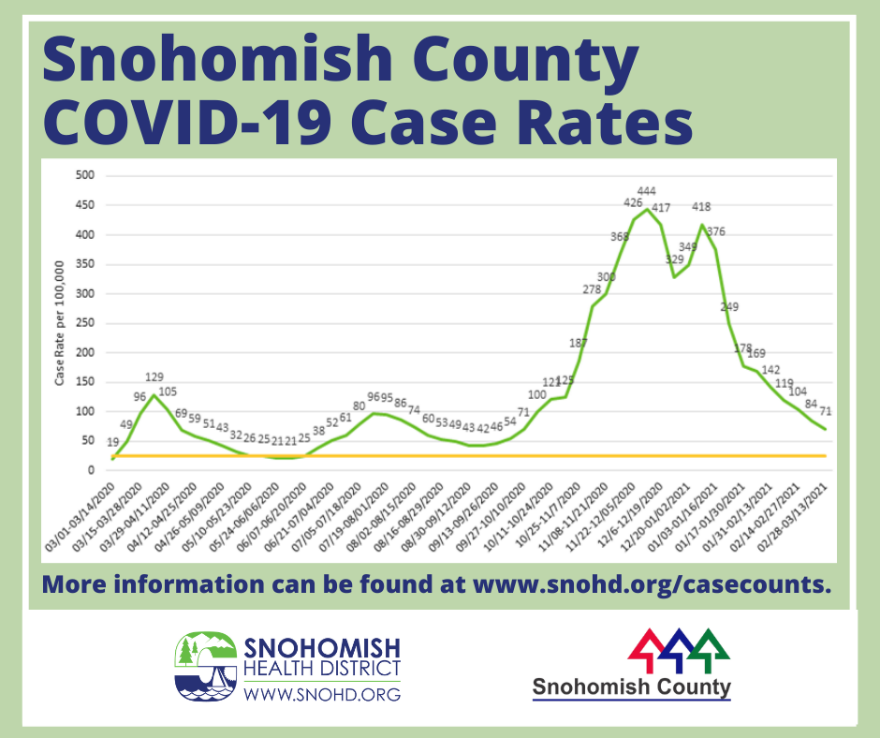
Dr. Spitters said declining COVID case rates are encouraging, and evidence that prevention measures are having the desired effect. He noted that even as more students are returning to in-person instruction in the county, there has not been a spike in outbreaks. He said that is “a good signal that the parents, the student, the staff and the faculty are engaging in those prevention measures that have been shown here and elsewhere to interrupt and limit spread of COVID in the school community.”
He urged people to continue the hard work.
“You are preventing hospitalizations and deaths while also buying time for us to roll out vaccination to everyone in the county ultimately who wants to get it,” Spitters said.
Vaccination efforts continue to be hampered by limited supply, the press conference was told. By mid week, a total of roughly 300,000 people in the county will have become eligible for vaccination since the program began in December. About half of that population so far has received at least a first dose of vaccine.
The Snohomish County Vaccine Taskforce and other providers here this week received about 15,000 doses of vaccine. That means there are up to 15 people competing for each vaccination appointment.
Spitters said providing vaccinations will take time, but everyone will get their turn.
Gov. Jay Inslee last week announced an update to his pandemic recovery plan, and all counties will be moving to a less-restrictive Phase 3.
Somers said that is good news for the community, but it comes with some risk.
“We are anxious to move on, pushing the vaccines out as fast as we can, and asking people to stay safe,” he said. “It is not over. It is not time to let up our guard.”
Watch it here: https://youtu.be/4Z2mRuMHPwc
Or read the transcript: https://www.snohd.org/DocumentCenter/View/7011/March-16-Media-Availability
|
|
|
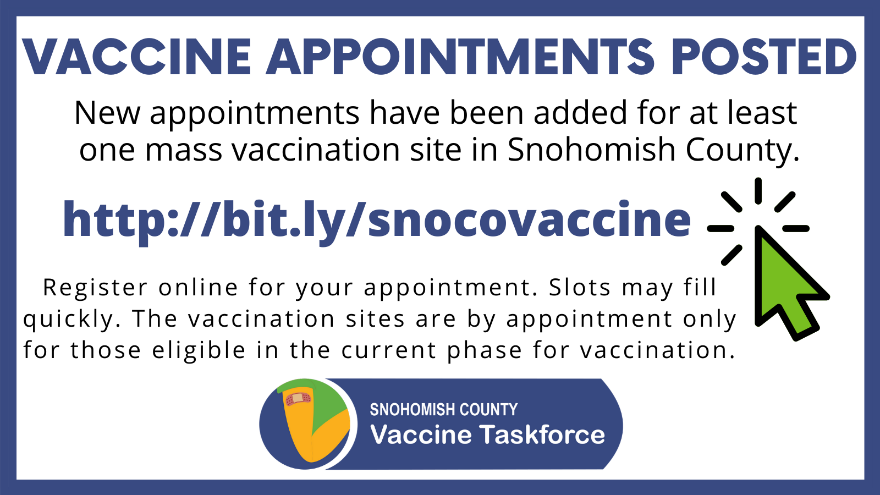
The Snohomish County Vaccine Taskforce will be posting on social media when appointments have been posted for at least one of the mass vaccination sites. Follow Snohomish Health District and Snohomish County Department of Emergency Management to be sure these posts will appear in your Facebook or Twitter newsfeed.
Keep in mind that these are only for people in the current phase for vaccination, and patients should bring proof of eligibility. Not sure if you are eligible, or need verification? Check www.findyourphasewa.org.
Registration links and info on the brand of vaccine administered at each site are available online at http://bit.ly/snocovaccine.
When are appointments posted?
- Appointments for the sites at Edmonds College and Boeing Everett Activity Center, when doses are available, will open for a week at a time, typically posting over the weekend or early in the week (Monday or Tuesday).
- Appointments for the sites in Arlington, Monroe and Angel Of The Winds Arena in Everett, when doses are available, will open for one or two days at a time, posting around 2 p.m.
|
|
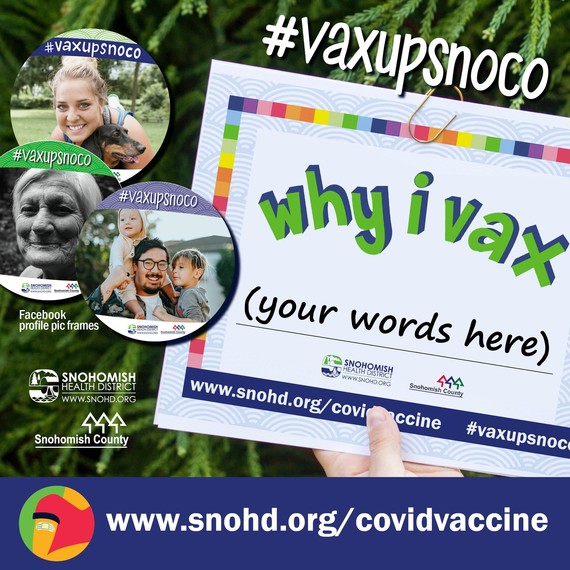
Have you gotten your COVID vaccine, or do you plan to get your COVID vaccine? Share your reasons with your community using #vaxupsnoco.
|
|
|
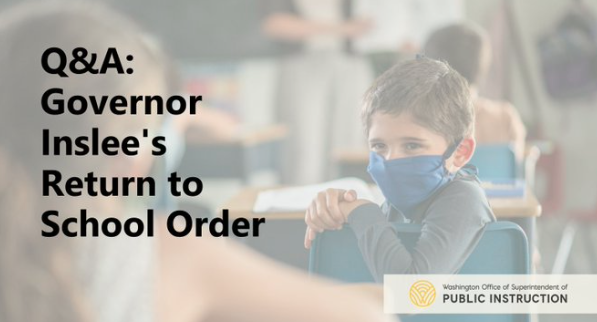
Gov. Jay Inslee on Monday signed an emergency proclamation related to protecting the mental and behavioral health of children and youth in Washington during the COVID-19 crisis. The governor will require all public K–12 schools in Washington to provide each student with the opportunity to learn in-person at their school, for no fewer than two days per week, by April 19, 2021.
“This has been a long year for our state’s students and their families. They have lived with fear and uncertainty,” Inslee said during a press conference Friday. “The youth mental health crisis has become significantly worse during the COVID-19 pandemic, and it is time to provide an in-person learning option to help students that need it.”
The state Office of Superintendent of Public Instruction has prepared a Q&A detailing what the new rules mean for schools in Washington, and addressing safety, timing and options.
|
|
|
The vaccine is an important part of ending the COVID-19 pandemic. If you’re eligible in Phase 1A or Phase 1B- Tier 1, you should get yours now! (Think: 65 or older; high-risk health care; educators and staff for pre-K through 12th grade; childcare providers.)
And if you have Apple Health (or Medicaid), you might even be able to get a ride there. Transportation barriers shouldn’t keep you from getting protected from COVID-19.
The Washington State Health Care Authority (HCA) offers help with transportation for non-emergency health care appointments. Non-emergency visits are routine check-ups or other visits that don’t need treatment right away. Vaccine visits are non-emergency, so the HCA can help people get to a COVID-19 vaccine site. This is free for those with Apple Health who have no other way to get to appointments.
You are eligible for transportation help if:
- You have a current ProviderOne services card (the Apple Health ID card)
- You have no other way to get to your health care appointment
- The health care visit is covered by your Apple Health program. Visit the Apple Health website for more information about covered services.
See the full blog post for more information.

|
|
|
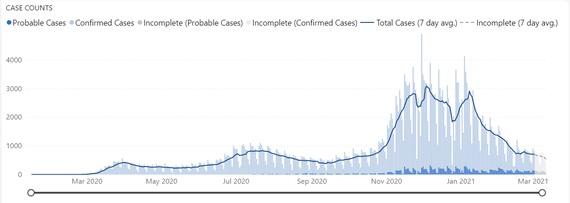
The state Department of Health late last week released the latest statewide situation report on COVID-19. A key concern: a possible fourth wave infection.
"When you look at our data, there is a pattern of several waves of COVID-19 activity followed by a return to baseline level. The baseline we reached after our second wave in summer 2020 was higher than the level after our first wave. Now, following the third wave that began last fall, cases have flattened out at higher baseline level than ever before," said Acting State Health Officer Scott Lindquist, MD, MPH. "I'm concerned about what this means for the future and a possibility of a fourth wave of activity, along with the increases we are seeing in variants of the virus. As we continue working to accelerate vaccination so we can protect more people, it's critical that we all maintain the precautions we’ve been taking to stop the spread of the virus."
Report findings include:
-
Case counts have increased slightly in western Washington and plateaued in eastern Washington as of late February. Case counts are still relatively high across the state—around the same level we were seeing last October when the third wave of disease activity was ramping up. Plateauing or increasing at these high levels is concerning.
-
Most counties have seen declines in case counts since the first week of January, but cases have flattened in several counties and are starting to increase again in others. Six of 39 counties had rates above 200 new cases per 100,000 people over the two-week period ending on Feb. 25. No counties had rates above 500 new cases per 100,000 people.
-
Cases are increasing among younger adults aged 20-29 and 30-39. This has previously been an early warning sign of larger surges in the general population. Case counts in other age groups were declining, but have now flattened. As more people who are 60 and older get vaccinated, we expect to see a more rapid decline in cases in this population.
-
We are seeing sharp declines in hospital admission rates among people 70 and older, possibly because those groups are among the first to get vaccinated. Admissions have declined at different rates depending on the age group. Overall, hospital admissions have flattened in eastern Washington and continue to decline in western Washington.
-
COVID-19 transmission is continuing at about the same level after declines through January and February. The best estimate of the reproductive number (how many new people each COVID-19 patient will infect) in the state on Feb. 19 was 0.96. The goal is to maintain a reproductive number well below one — meaning COVID-19 transmission is declining — for a substantial amount of time.
-
The estimated prevalence (percentage of people with active COVID-19 infections) began to plateau in early February after declines in January. High prevalence means there are a lot of people with infections who may need health care and could be spreading the virus to others. The best model-based prevalence estimate as of Feb. 19 was 0.11%.
|
|

The Internal Revenue Service has announced that the third round of COVID-19 Economic Impact Payments will begin reaching Americans this week.
Following approval of the American Rescue Plan Act, the first batch of payments will be sent by direct deposit, which some recipients will start receiving as early as this weekend, and with more receiving this coming week.
No action is needed by most taxpayers; the payments will be automatic and, in many cases, similar to how people received the first and second round of Economic Impact Payments in 2020. People can check the “Get My Payment” tool on IRS.gov to see the payment status of the third stimulus payment.
“Even though the tax season is in full swing, IRS employees again worked around the clock to quickly deliver help to millions of Americans struggling to cope with this historic pandemic,” said IRS Commissioner Chuck Rettig. “The payments will be delivered automatically to taxpayers even as the IRS continues delivering regular tax refunds.”
The third round of stimulus payments, those authorized by the 2021 American Rescue Plan Act, differs from the earlier payments in several respects:
- The third stimulus payment will be larger for most people. Most families will get $1,400 per person, including all dependents claimed on their tax return. Typically, this means a single person with no dependents will get $1,400, while a family of four (married couple with two dependents) will get $5,600.
- Unlike the first two payments, the third stimulus payment is not restricted to children under 17. Eligible families will get a payment based on all of their qualifying dependents claimed on their return, including older relatives like college students, adults with disabilities, parents and grandparents.
See the full press release for more details. IRS also has published an FAQ about the payments.
|
|
|
|
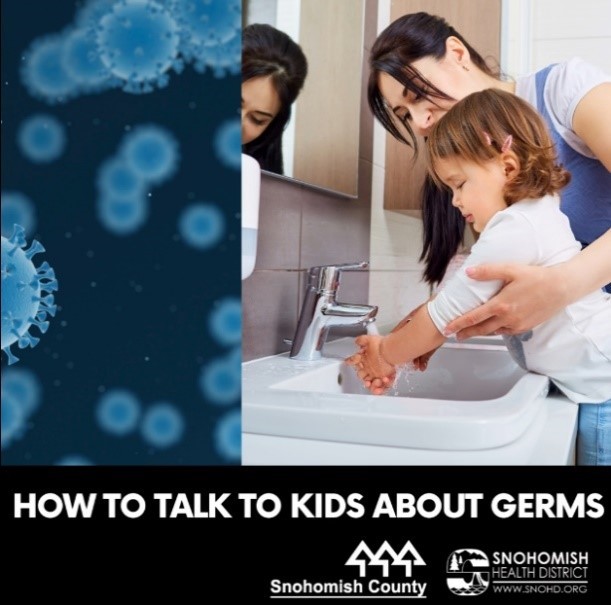
Education is a powerful COVID-fighting tool. Teaching kids what germs are can significantly help them practice good hygiene and COVID-safe behaviors. No matter the age be #AllIn
Facebook
Twitter
|
|

The American Rescue Plan Act dramatically expands access to free and low-cost health insurance for more than 200,000 people who get their health insurance through Washington’s Healthplanfinder, our state's Exchange.
“Despite the progress made under the Affordable Care Act, we know that too many families have struggled to afford critical health coverage, especially during the COVID-19 pandemic,” said Insurance Commissioner Mike Kreidler. “The American Rescue Plan Act makes good on a promise to provide more affordable coverage to so many in need. More importantly, we know it will save lives.”
Of the more than 224,000 people who selected a plan during the last open enrollment, 62% qualified for a subsidy to help with premium costs. Subsidies are available to people based on their income. In the past, subsides have been limited to people earning between 100% and 400% of the federal poverty level ($26,200 to $104,800 annual income for a family of four).
The American Rescue Plan Act reduces the percentage of income that people must pay toward their health coverage and removes for two years the cap on income to qualify for premium subsidies. The measures increase subsidies and the number of people who qualify for financial help.
With removal of the income cap, individuals who earn more than $51,040 and families who earn more than $104,800 will not be required to spend more than 8.5% of their income on health insurance premiums. Others with lower incomes will see their premiums reduced; a family of four earning between $26,200 and $39,300 would not pay any premiums. Before, they had to spend between 2% and 4.14% of their income on premiums.
See the full press release for more information.
|
|
|
|
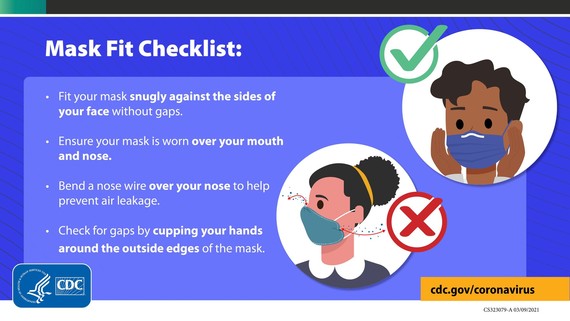
The Centers for Disease Control and Prevention recommends taking steps to make sure your mask fits correctly. Masks work best when everyone wears them, but not all masks provide the same protection. When choosing a mask, look at how well it fits, how well it filters the air, and how many layers it has.
Two important ways to make sure your mask works:
- Make sure your mask fits snugly against your face. Gaps can let air with respiratory droplets leak in and out around the edges of the mask
- Pick a mask with layers to keep your respiratory droplets in and others’ out. A mask with layers will stop more respiratory droplets getting inside your mask or escaping from your mask if you are sick.
See the full list of CDC mask tips for more suggestions on mask fit and function.
|
|
|
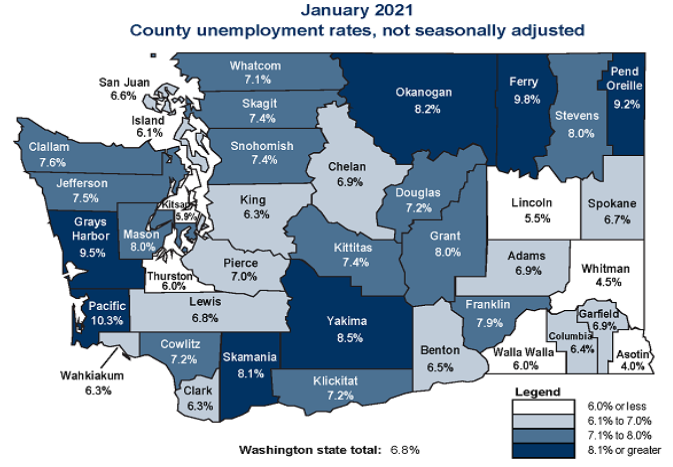
The unemployment rate in Snohomish County was 7.4% in January, the state Employment Security Department reported Tuesday. That was up from the 6.7% logged in December.
Statewide, the economy increased by 4,400 jobs in January and the unemployment rate dropped to 6%.
Read the full release.
|
|

The state Department of Health wants to support the safe reopening of buildings that may have been closed for an extended period of time due to COVID-19 related restrictions. Low, or no water use in vacant or underused buildings increases the risk to plumbing systems and the potential for Legionella.
Legionella bacteria occur naturally in the environment, usually in water. Legionella can cause a type of pneumonia called Legionnaires’ disease, and a flu-like illness without pneumonia called Pontiac Fever. People are exposed by breathing tiny water droplets contaminated with Legionella from water fixtures such as showers, hot tubs, and decorative fountains. Building users may be at higher risk of exposure because of stagnant water conditions during the COVID-19 related shutdown and when full use resumes.
“Just as closing so many of our commercial buildings and schools has been necessary for the health of the public, we need to make sure we are re-opening our buildings and schools in a way that also keeps people safe and healthy,” says Lauren Jenks, Assistant Secretary for Environmental Public Health.
See the full press release for more information.
|
|
|
|
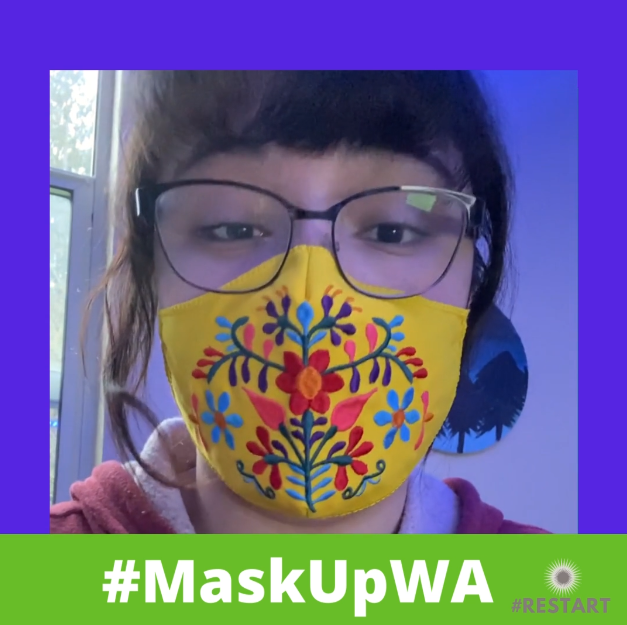
Saint Patrick's Day is Wednesday. There is no four-leaf clover that will protect you from COVID, but wearing a mask can help reduce your chance of getting sick. COVID-19 cases remain high in the community and public health experts are asking that you not let your guard down now.
#MaskUpWA

|
|
|
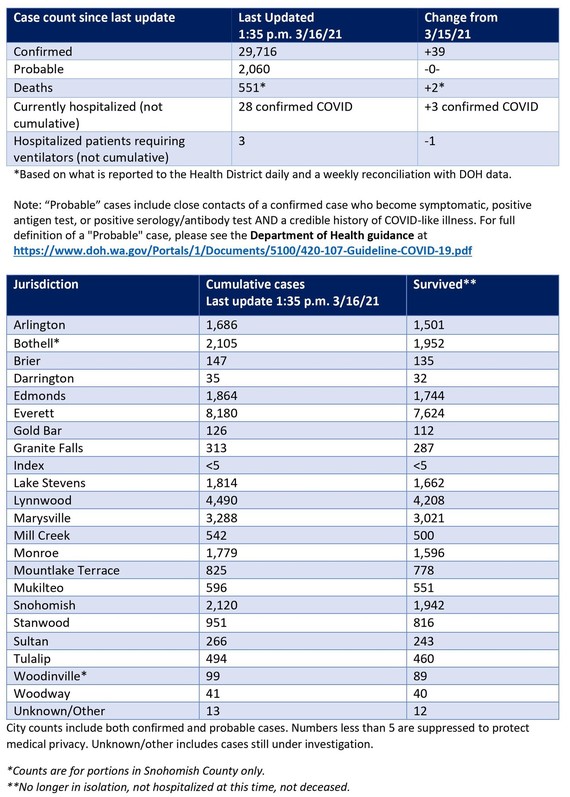
Cumulative from Jan. 2020 through March 16, 2021
|
|
|
ESSENTIAL LINKS AND PHONE NUMBERS FOR UP-TO-DATE INFORMATION
|
|
|
|
|