|
|
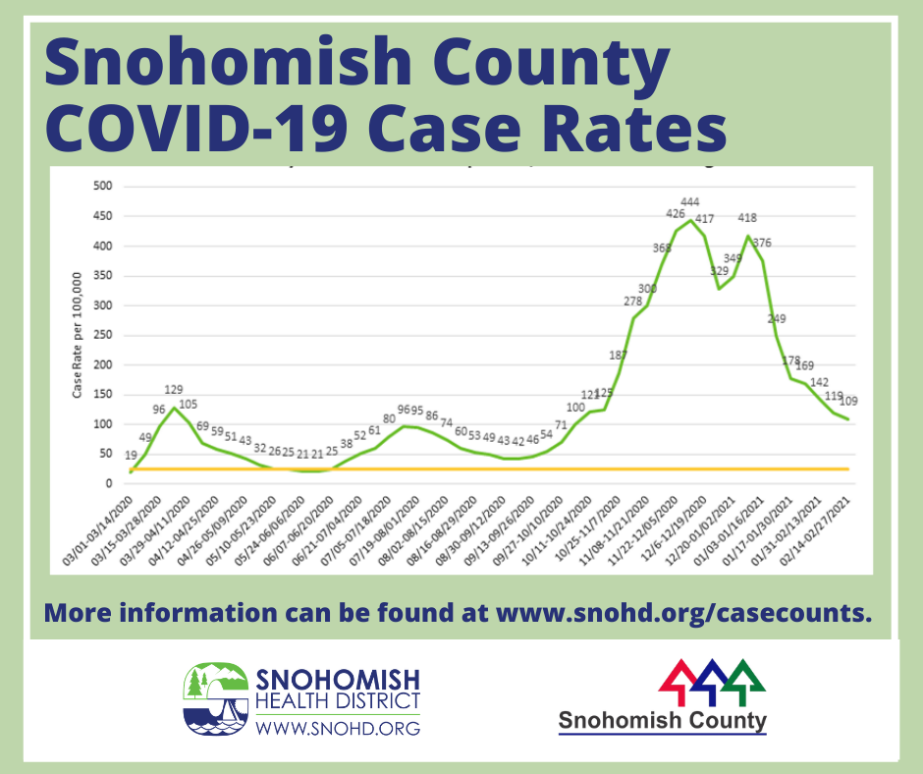
Snohomish County has seen another slight decrease in COVID case rates, to 109 per 100,000. Let’s make sure we don’t lose that momentum. We don’t want to plateau near 100 cases per 100,000. Wear your mask, watch your distance and wash your hands to help keep driving the case rate down.
|
|
|
Snohomish County Council Chair Stephanie Wright and Vice Chair Megan Dunn will be co-hosting a regional town hall meeting regarding COVID-19 vaccines and distribution from 4:30-5:30 p.m., Tuesday, March 2.
Opening remarks will be made by Executive Dave Somers. Panelists include Dr. Chris Spitters and Shawn Fredrick from the Snohomish Health District, Jason Biermann from Snohomish County Department of Emergency Management, and Rochelle Lubbers from the Tulalip Tribes.
The event is free and anyone is welcome to join via Zoom at http://bit.ly/SnoCoTownHall. The event will be recorded and available to watch at a later date.

|
|
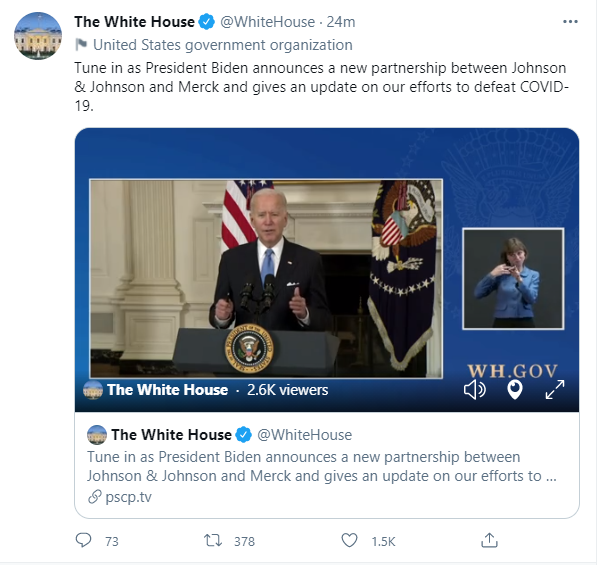
President Joe Biden today announced during a televised news conference a collaboration between Johnson & Johnson, Merck, and the federal government to ramp up vaccine production under the Defense Production Act.
As a result, the President said the U.S. should have enough vaccines for every American by the end of May – two months earlier than expected.
He also announced plans to stand up numerous mass vaccination sites and to make a priority out of vaccinating teachers, child care workers and others as part of an effort to resume K-12 education within the first 100 days of taking office.
|
|
|
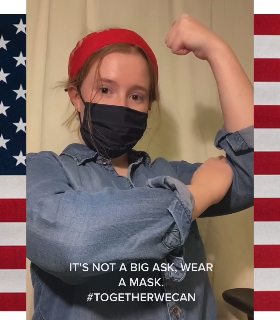
Rosie the Riveter here to tell you that we can fight COVID by continuing to mask up! Our hard work is paying off. #WeCanDoIt #MaskUpWA
Post made by University of Washington Bothell student Caitlin.
Facebook
Twitter
|
|
|
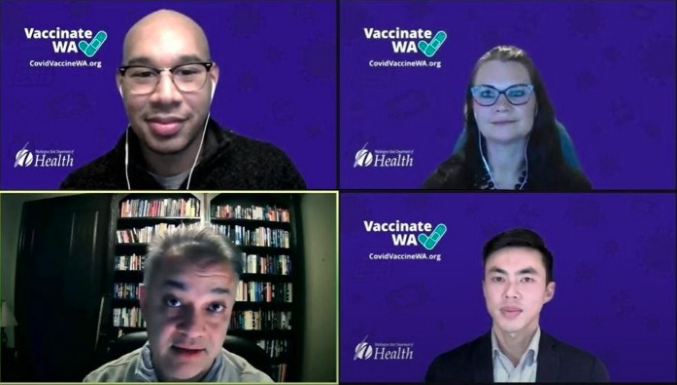
On Feb. 18, some of Washington’s top public health experts teamed up to answer about COVID vaccines and their distribution. The live event included a special Q&A session. It went beyond the media headlines to provide a deeper look into this unprecedented vaccine rollout.
The team included DOH’s Secretary of Health, Dr. Umair A. Shah, and COVID-19 Vaccine Director SheAnne Allen. Each have pivotal roles in managing Washington’s vaccine rollout. They were joined by Dr. Christopher Chen, who serves as Medical Director-Medicaid at the Washington state Health Care Authority (HCA). Dr. Chen and his agency help patients access the vaccine. Louis Shackelford moderated the special event. Louis serves as the External Relations Program Manager for COVID-19 Prevention Network and HIV Vaccine Trials Network at Fred Hutch.
The full webinar can be viewed for free in English or Spanish.
|
|
|
As of Feb. 22, more than 1,411,453 doses of vaccine have been given across the state, which is more than 75% of the 1,821,705 doses that have been delivered to our providers and long-term care programs, the state Department of Health reported. Washington is currently averaging 25,346 vaccine doses given each day. The state hit a new record Feb. 11, administering 44,872 doses in a single day – close to the goal of 45,000 people per day. This information can be found on the DOH data dashboard under the vaccines tab, which is updated three times per week.
Washington’s three-week allocation forecast from the federal government continues to increase. This information allows a multi-week strategy that helps with consistency and predictability. The forecast is subject to change as vaccine availability from the federal government may change.
- Week of February 28: 279,800 total doses (156,640 first doses, 123,160 second doses)
- Week of March 7: 285,200 total doses (156,640 first doses, 128,560 second doses)
- Week of March 14: 313,280 total doses (156,640 first doses, 156,640 second doses)
See the full press release for more information.
|
|

The state Department of Health has begun publishing a weekly SARS-CoV-2 sequencing and variant report today. The report summarizes genome sequencing coverage of Washington SARS-CoV-2 specimens from multiple laboratories across the US and our state. The goal of the report is to provide a statewide view of sequencing capacity and data, including breakouts by county and demographics. Comparing the sequences of viruses allows us to better understand viral transmission and the introduction of new strains, also called variants, to our state.
This report will be posted to the DOH dashboard and will be updated every Thursday.
“Sequencing SARS-CoV-2 cases provides critical information to help inform the public health response to the ongoing pandemic. By combining sequencing data with data from case and contact investigations, we can better detect outbreaks, identify and track new and emerging variants, and determine the effectiveness of public health control measures,” said DOH epidemiologist Hanna Oltean.
See the full press release for more information.
|
|
|
|
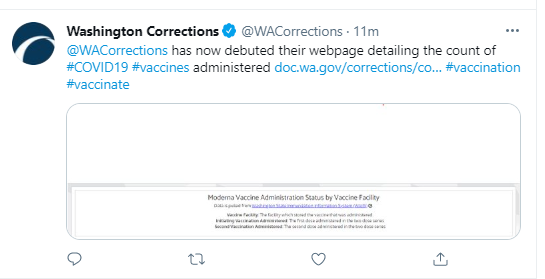
Department of Corrections has now debuted their webpage detailing the count of COVID-19 vaccinations administered. The site shares information on the total number of doses administered, the number of doses administered by facility, and the number of doses administered to staff and to those incarcerated.
|
|

Sno-Isle Libraries is currently offering limited in-building services at select Sno-Isle libraries. Community libraries offering in-building services include Brier, Camano Island, Coupeville, Darrington, Freeland, Lynnwood, Marysville, and Snohomish.
To enter a participating Sno-Isle Libraries library, customers must:
- Wear a face covering that covers both the nose and mouth
- Maintain social distancing
- Limit their visit to 30 minutes
- Maintain customer occupancy limits
Specific services available will vary at each community library. Please review the information below for more information.
Contact-free services are available at all Sno-Isle Libraries. These services include holds pick up, remote printing pickup, laptop checkout, and more.
As the in-building services will vary at each location, please see the list at https://www.sno-isle.org/in-building-services/
|
|
|
|
Gov. Jay Inslee on Feb 24 updated a proclamation in response to the continuing COVID-19 pandemic. The update extends the COVID-related commercial truck driver hour waiver to May 31, 2021 in alignment with federal waivers.
Read the full proclamation here.
|
|

The Food and Drug Administration on Thursday approved storing Pfizer BioNTech’s COVID-19 vaccine at standard freezer temperatures, helping ease storage requirements that could make delivery of the vaccine easier.
Pfizer Inc. submitted data to the FDA to demonstrate that their COVID-19 vaccine remains stable after storage of the undiluted vials for up to two weeks at standard freezer temperature.
The Pfizer vaccine had previously been required to be stored in ultra-cold freezers, which posed a challenge for distribution of the vaccine in places like rural areas that do not have widespread ultra-cold storage capabilities. The new move will allow the vaccine to be stored at “conventional temperatures commonly found in pharmaceutical freezers for a period of up to two weeks.”
“This alternative temperature for transportation and storage of the undiluted vials is significant and allows the vials to be transported and stored under more flexible conditions,” said Peter Marks, M.D., Ph.D., director of the FDA’s Center for Biologics Evaluation and Research.
Read the full release.
|
|
|

On the heels of the Federal Drug Administration's Emergency Use Authorization issuance on Saturday, the Centers for Disease Control and Prevention Director Rochelle P. Walensky, MD, MPH, on Sunday signed the CDC’s official recommendation that endorses the safety and effectiveness of the Johnson & Johnson COVID-19. This action clears the way for the J&J single dose vaccine to be administered across the country.
The J&J vaccine is the third safe, effective COVID-19 to receive EUA and the CDC’s official recommendation for use and comes at a pivotal time. CDC’s latest data suggest that declines in COVID-19 cases may be leveling off at still very high numbers.
“I know that many Americans look forward to rolling up their sleeves with confidence as soon as a COVID-19 vaccine is available to them” Walensky said. “Having different types of vaccines available for use, especially ones with different dosing recommendations and storage and handling requirements, can offer more options and flexibility for the public, jurisdictions and vaccine providers.”
Read the media statement.
|
|
|
|
One year ago today, Snohomish County marked its first COVID-19 death. We’ve now lost more than 500 people. Thank you for all you’ve done over many months to help keep that number from being higher. #InItTogether
Facebook
Twitter

|
|
|
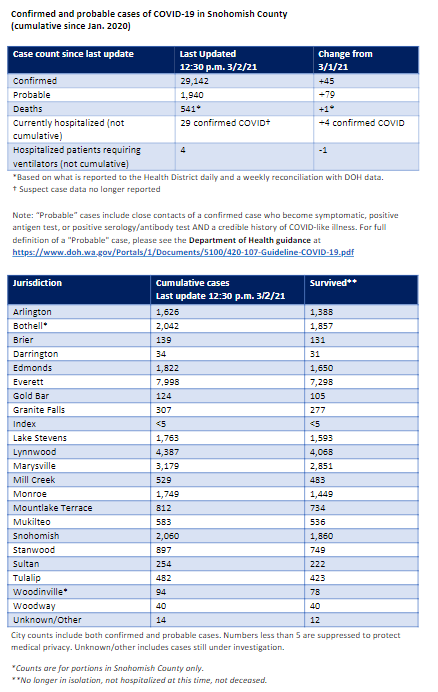
Cumulative from Jan. 2020 through Mar. 2, 2021
|
|
|
ESSENTIAL LINKS AND PHONE NUMBERS FOR UP-TO-DATE INFORMATION
|
|
|
|
|