|
Photo of the Month
 Tulips in the Skagit Valley // Photo by Karen DuBose, Skagit County Pollution Identification and Correction Coordinator

We hope you enjoyed this year's tulips as much as we have!
Tulip season is a great reminder of the many wonderful things our local farmers produce— and how important it is to respect their fields.
Spring tulips, summer berries, fall pumpkins, and winter birds make the Skagit Valley a year-round agrotourism site for locals and visitors alike.
This means a lot of foot and car traffic around fields where farmers work and grow their crops. Whether you're a local or a visitor, it's important that you keep your car on public roads and keep your feet on public land unless invited.
Even if a field looks like it's just grass or soil, it's still most likely private property. Different crops have different seasons, so not every field is in use all year long. But even in the off season, farmers pay attention to the health of their land— and appreciate you respecting their property.
With so many people visiting Skagit Valley, it's also especially important that you pack out all your trash— including poop!
Always scoop dog poop up in a bag and keep it with you until you can throw it away in a trash can. Have a plan for when and where you and your family will take bathroom breaks. There aren't many public restrooms in the valley! If you have young children, keep a trash bag in your car so you can take dirty diapers home.
|
|
|
|
We’ve paid the Pacific Northwest “rain tax,” and beautiful sunny days have returned! The Mount Vernon WSU AgWeatherNet station recorded 1.7 inches of rain, which is about 1 inch less than what we normally see. The average temperature was also slightly above normal, coming in at 49.8°F, about 1°F warmer than usual.
We’re starting to see a seasonal shift at many of our sites. Most of our lowland streams now have lower flows and warmer water temperatures. However, the Skagit River is doing the opposite, with moderately increasing flows and cooler temperatures from snowmelt. These changing conditions can influence water quality in different ways across the basin. Bacteria levels remained relatively low throughout April. The few bacteria hotspots were concentrated around Edison, including Edison Slough and the north and south Edison drainages.
With more sunny days ahead, it’s a great time to get out and enjoy Skagit County’s waters. A few simple actions like disposing of pet waste, packing out trash, and keeping pollutants out of the water can help keep these waters healthy throughout the season.
Interested in more? Check out our water quality map for our most recent sample results!
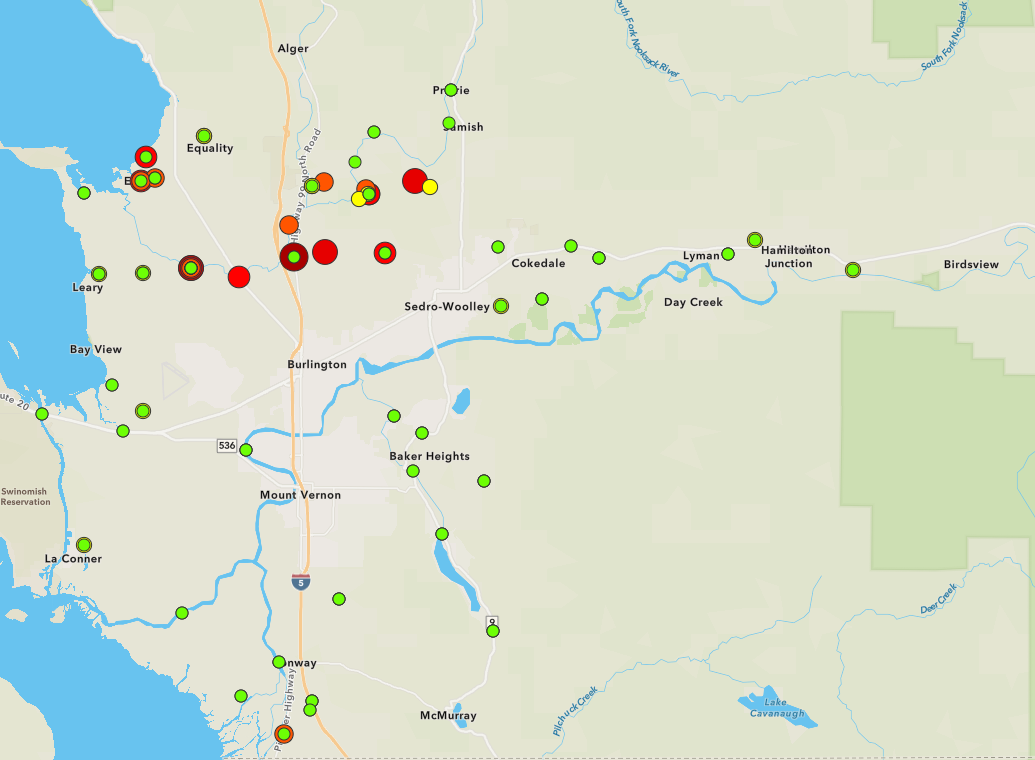 April's water quality results. Red dots represent sites with high levels of fecal bacteria, yellow represents sites with moderate levels of fecal bacteria, and green dots represent sites with low fecal bacteria levels. Click on the map to go to the online water quality map, where you can explore sites in Skagit, Whatcom, and Snohomish Counties.
|
|
Home Tip of the Month
Taking the RV out this summer? Here’s what you need to know about emptying your gray water and black water tanks!
What are gray water and black water?
Other than the fresh water you’ll use for drinking and showering, most RVs have two water tanks: One for gray water and one black water.
The gray water tank holds wastewater from sinks and showers—dirty dishwater and bathwater.
The black water tank holds water and waste flushed down the toilet. Some RVs only have a black water tank. In these cases, shower and sink water go to the same tank as toilet water.
What do I do with gray water and black water?
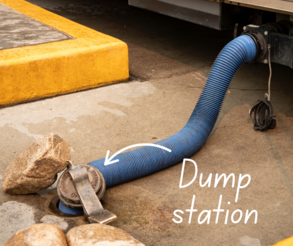
Although they are usually held in different tanks, gray water and black water should always be emptied in the same place: A designated dump station. Though some areas around the U.S. allow gray water to be dumped on the ground, it is illegal in Skagit County.
Most campsites have designated, well-marked dump stations, and there are others around the county as well.
The dumping process is easy, but there are some important steps to remember:
- Wear gloves.
- Make sure you have a sewer hose that can securely attach to your tank opening and that is long enough to reach the dump station.
- Use a hill or sewer hose support to make sure gravity is helping your waste flow out of your RV and into the dump station.
- Use a rock or something heavy to keep the hose in place.
- Dump black water first, then let the gray water rinse out the sewer hose.
- Close up your tanks completely when you’re done dumping.
- Clean out your sewer hose with a garden hose after dumping. Keep the end of the sewer hose in the dump station while cleaning it.
You should dump your black water tank when it’s about two-thirds full, which will be every 3 to 5 days depending on how many people are using the RV and how big the tank is.
Where can I dump in Skagit County?
There are several dump sites throughout Skagit County that are free or low cost for dumping. Free and by donation sites include:
A quick internet search of campgrounds in the area you plan to travel to can help you locate more dump sites.
It is important to note that free dump stations at campgrounds are typically intended for use by those camping there.
|
Can I dump at home?
The short answer is: Maybe.
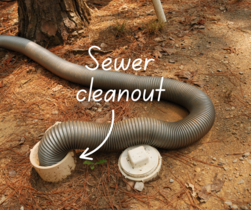
Some sewer districts allow you to dump your RV wastewater into your sewer cleanout if you have access to it. Make sure to call your jurisdiction’s sewage department to confirm whether or not this is legal in your area.
If you're on septic, connecting your RV to your system risks overloading it. Septic systems have a limited capacity and aren't built to handle a lot of material at once. Plus, common RV black water tank additives can harm your septic system and stop it from working properly. Unless you have a system specifically set up for connecting your RV, we'd highly recommend another method.
I can’t move my RV at home. What should I do?
If you can’t move your RV and can’t connect it at home, there are a variety of mobile services that can come to you to pump your RV.
|
|
|
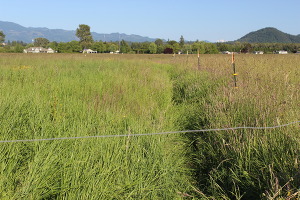
You may think of your animals as natural pasture mowers, but did you know it's important to go in and cut your grass after they graze?
Here are a few of the benefits mowing after grazing has for your pasture and animals.
Mowing can...
Stimulate grass growth.
Mowing your grass to a uniform height between 6 to 8 inches helps keep it growing. This will keep you in a constant supply of fresh, nutritious forage. Fresh growth has more nutritious value than older grass, so this constant pasture refresh will keep your animals healthy and happy!
Knock back weeds.
Tall weeds can shade out grass and other good forage. Keeping a uniform height can help your grass get ahead and outcompete weeds.
Controlling weeds is important because many, including poison hemlock (our Noxious Weed of the Month), are poisonous to livestock.
Fertilize your field.
If you leave behind grass clippings after you mow, you'll be adding natural fertilizer to your field! The nutrients in the cut grass will return to the soil, feeding your growing forage.
Harrow manure.
Mowing your pasture after animals have grazed will help spread out manure piles. This means the nutrients in the manure has a better chance of feeding your grass, rather than being carried away by rain.
Looking for more pasture care tips? Check out the Skagit Conservation District farm page!
|
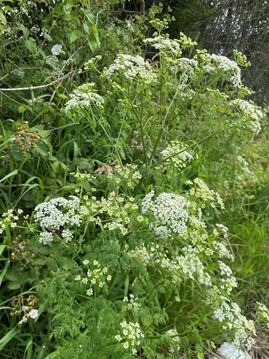
We've talked about this weed before and we'll talk about it again! Poison hemlock, also known as carrot-fern, fool's-parsley or spotted hemlock, is extremely deadly to both humans and livestock. It is often mistaken for Queen Anne's lace and other wild carrot species, making it especially dangerous. Now is the best time to form a control plan to eliminate this plant from your property. Here's what you need to know:
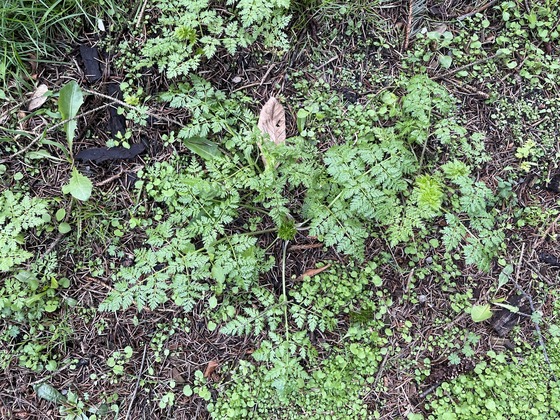
Description: Poison hemlock starts out in its first year as a small rosette of leaves close to the ground. In its second year it grows flowering stems. These stems can grow up to 12 feet tall and have small white flowers in umbrella shaped clusters about 4 to 8 inches across. Its leaves are green, small and look like finely divided fern fronds.
One thing that sets poison hemlock apart from its look-alikes are the purple spots and lack of hair on its stems. However, you should be careful handling any plant that looks like poison hemlock.
Toxicity: Based on its name, it won't come as a surprise that poison hemlock is very toxic to both humans and animals. Even when dried, all parts of the plant are poisonous.
Control: Poison hemlock can be pulled up by hand, but you'll want to wear gloves and long sleeves to protect your skin from irritation. All parts of the plant should be bagged and put in the garbage, not the compost. After pulling up the plants, a layer of sheet mulch can discourage any seedlings from growing back. Still, be sure to monitor the area carefully for new sprouts.
Overgrazed pastures with bare spots are at risk of being invaded by poison hemlock, so be sure to keep grasses at least 3 inches tall and seed bare spots.
Herbicide may be an effective tool for large infestations. For more information or help in identifying and controlling poison hemlock, reach out to our Noxious Weed Coordinator, Evan Emrick, at (360)-707-1502, evane@co.skagit.wa.us
Learn more about poison hemlock from the Washington State Noxious Weed Control Board.
|
|
|
Program News
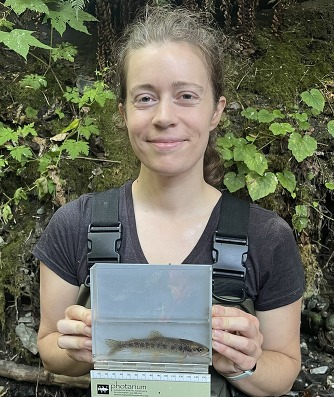
Halee Sexton, our new Source Control Inspector
We have another staff member taking on a new role here in the Natural Resources Division!
Halee Sexton, who served as our intern for over a year, is now the Source Control Inspector for our Stormwater Program!
Halee's new role will have her working with local business owners to help them keep our water clean.
|
Classes and Events
Master Gardener Plant Fair, May 9, 8 AM to 2 PM, Skagit County Fairgrounds: Visit the WSU Master Gardeners Plant Fair to find quality garden plants, locally-grown and chosen for success in our Skagit Valley environment. Free admission and parking, plant clinic, dozens of vendors, food, and fun!
Noxious Weeds with Evan Emrick, May 13, 5 PM to 6:30 PM, Skagit Valley College, Angst Hall #125: What's the problem with weeds? What is a noxious weed? What can we do about weeds? Hear the answers to these and other questions from Skagit County Noxious Weed Coordinator, Evan Emrick. Hosted by Skagit Conservation District
Composting Demonstration and Discovery Garden tour, May 30, 12 PM to 2 PM, WSU Discovery Gardens, 16602 WA-536, Mount Vernon: Skagit Master Gardener and Master Composter, Herta Kurp will give a demonstration on composting, followed by a tour of the Skagit Master Gardener display garden and WA Native Plant Society display garden. Bring a picnic lunch to enjoy after the tour. The garden is open to the public until dusk
Stormwater Systems Maintenance workshop, June 4, 5:30 PM to 7:30 PM, Skagit Port Commissioners Hearing Room, 15400 Airport Dr, Burlington: Private properties are responsible for maintaining their stormwater facilities. Join Skagit Conservation District to learn about stormwater regulations and system maintenance from Jason Quigley, Skagit County's Stormwater Coordinator, and Reilly Russell from TRICO Companies.
Volunteer Opportunities
Skagit Land Trust work parties, May 8 & 22, June 12: Volunteer with Skagit Land Trust to remove invasives, plant native shrubs and trees, and maintain important work tools! You can also learn about volunteering through community engagement and community science on the Skagit Land Trust website.
Utopia fieldtrips, throughout May: Skagit Land Trust is seeking a few enthusiastic environmental educators and volunteers to support kids in some fun outdoor learning experiences at our Utopia Conservation Area this May! Their education team will be hosting seven student field trips for second-graders from Sedro-Woolley schools and one Mount Vernon School.
Bowman Bay Stewardship, June 9, 10 AM to 12 PM: Join Northwest Straits Foundation for a volunteer work party at Bowman Bay! Spend the morning supporting the ongoing restoration through weeding, spreading mulch, and tending to native vegetation to create a resilient nearshore habitat.
Salish Sea School Volunteer Opportunities: Whether you’re helping with educational programs, community events, marine conservation projects, or daily operations, your time and talents directly support a thriving Salish Sea where people and nature flourish.
|
|
Contact Us
For questions or more details, please contact Karen DuBose at kdubose@co.skagit.wa.us or 360-416-1460.
This project has been funded wholly or in part by the United States Environmental Protection Agency under assistance agreement PC01J18001-0 to the Washington Department of Health. The contents of this document do not necessarily reflect the views and policies of the Environmental Protection Agency, nor does mention of trade names or commercial products constitute endorsement or recommendation for use.
|
|
|
|
|