 Earth Month in Full Bloom
Skagit County is our home—fertile farmland, clean air and water, fields of world-renowned flowers, and a river with all five species of Pacific salmon. We have so much to be thankful for, and Earth Month is a great time to take care of it. Whether you learn something new, talk with others, spend time outside, or make small changes at home, every action helps keep our communities and natural places healthy for people, wildlife, and the children who will lead our future generations.
Here are a few ideas to help you care and connect with our special corner of Earth this month:
Expand your knowledge & perspective
Connect with & inspire others
- Talk with a young person in your life about how they’re feeling about environmental issues and what they’re noticing in their own community.
- Share what you’re learning with friends or coworkers to spark conversation.
- Join a local club or group focused on conservation or zero waste.
Engage outdoors, intentionally
Take small, meaningful actions at home
Amplify your voice
- Advocate for local environmental policies—even sending a supportive email counts.
- Share tips or experiences on social media to encourage others to act.
- Write to your local representatives about sustainability initiatives.
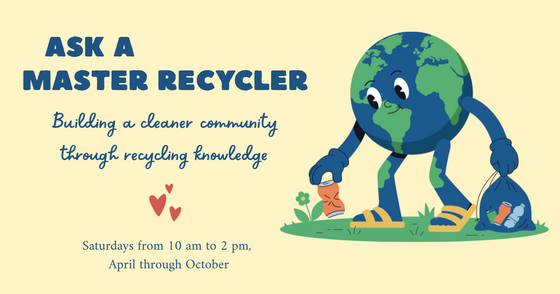
Ask a Master Recycler – Starting Saturdays in April
Get your recycling questions answered
Skagit County Master Composter Recyclers will be available one Saturday each month from April through October, 10 a.m. to 2 p.m., at the Skagit County Transfer & Recycling Center (14104 Ovenell Rd, Mount Vernon). Stationed in the recycling area staff shed, they’ll answer residents’ questions while you drop off materials at the free recycling drop-off area. Stop by to pick up helpful tips, learn what belongs in your recycling bin, and make your recycling routine easier and more effective!
Upcoming Dates to Ask a Master Recycler:
-
Saturday, April 18
-
Saturday, May 30
-
Saturday, June 13
Reduction, Reuse & Repair Tip of the Month
Small actions that reduce waste, with ideas for reusing and repairing along the way.
Start here: Don't Buy It.
The more we buy, the more waste we create—and global garbage is growing faster than the human population, projected to outpace it more than twofold by 2050 (World Bank, 2018). Before making a purchase, write it on a wish list and wait: giving yourself time to reflect can prevent impulse buying. You can also thrift first, borrow, refill, or repair what you already own. Small steps like these keep items in use longer and reduce the burden on waste systems.
Here are three things to stop buying now. Pick one this month, and see if you can make it a habit.
 |
|
Plastic coffee cups
Stop hiding behind the “But I needed this coffee” excuse! Grab a reusable mug—or skip the single-use cup. Keep one in your car, and you’ll be ready for any caffeine craving. Most coffee shops don’t mind giving it a rinse, and some will even reward you with a small discount for doing your part. Remember: as long as we keep buying single-use cups, they’ll keep making them. Cut single-use plastic at the source—swap it out whenever simple alternatives are available.
|
 |
|
Plastic and/or paper bags
Plastic bags now cost 12 cents each at the store, so bring a reusable cloth bag or grocery tote every time you shop to skip the charge. Forgot your bag? Keep a few near your front door and return them to your car after unpacking so they’re ready next time. If you don’t have a bag, use store boxes if available, or carry your groceries back to your vehicle and unload them at home. Do this a few times, and you’ll train your brain to remember—soon, forgetting your bags will be a thing of the past!
|
 |
|
Water bottles
A 2024 study published in the Proceedings of the National Academy of Sciences (Qian et al., 2024) found that a single liter of bottled water can contain about 240,000 plastic particles, including microplastics and nanoplastics—often leaching from the bottle itself.
These findings are also highlighted in The Plastic Detox, a new documentary available on Netflix.
Choosing reusable water options can help reduce exposure to these contaminants while also cutting down on plastic waste.
|
Simple tips to help you recycle the right way and stay informed about upcoming changes.
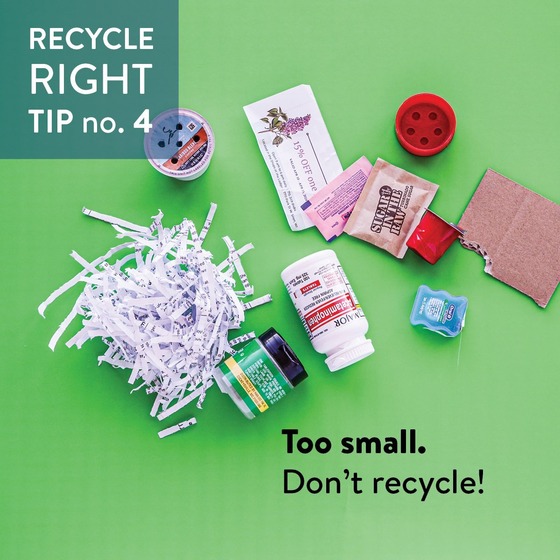
Size Matters: What’s Too Small for Your Recycling Bin
In Skagit County, small items can’t always be recycled in your curbside bin with Waste Management (WM). Anything smaller than 2–3 inches—about the size of a credit card or palm are too small to be recycled, as they fall through sorting machinery and become trash or contamination. Examples include plastic bottle caps, plastic straws, K-Cups, tiny paper scraps, shredded paper, and small foil balls.
Tips to recycle the right way:
-
Follow the 3-inch rule: If it’s smaller than 3 inches, throw it away.
-
Remove lids: Loose caps often get lost. Taking them off helps ensure containers are empty and keeps caps out of the recycling bin
-
Drop-off options: Some small items, such as scrap aluminum and metals, can be recycled at Skagit County Transfer Sites.
Keeping tiny items out of your bin helps machines run smoothly and makes recycling work better for everyone.
Organics Tip of the Month
A quick guide to new organics rules, with tips for everyday composting.
This is the first in a four-part newsletter series breaking down Washington’s Organics Management Law (HB 1799) and what it means for residents of Skagit County and across Washington State.
You may have already heard a bit about this law—some parts have been rolling out in Washington over the past few years, and more changes are still unfolding. In fact, many pieces are already in effect today, including statewide climate targets and expanding requirements for businesses and local governments. At its core, the law is about something simple: keeping food scraps and yard waste out of the landfill and putting them to better use instead.
You’ll often hear this called “organics diversion,” but it really just means separating food and yard waste so it doesn’t end up in the trash.
So why is that such a big deal? Here are the key reasons:
-
It cuts climate pollution: When food and yard waste are buried in landfills, they break down and produce methane, a powerful greenhouse gas.
-
It supports state climate goals: Washington has already set binding targets to significantly reduce landfill organics as part of its broader effort to cut greenhouse gas emissions.
-
It helps reduce food waste: The law is already driving systems to recover edible food so it can be redirected to people instead of being thrown away.
-
It builds healthier soils: Organics can be turned into compost that improves soil, holds water better, and supports local growing systems.
-
It’s already in motion: Many parts of the law are active today, including statewide targets, business requirements, and infrastructure planning—while broader residential rollout continues in phases over the coming years.
-
It creates a more useful system: Rather than being treated as trash, organic materials are reused and returned to the system as a resource.
Overall, it’s a shift toward treating food and yard waste as something valuable—not just something to throw away.
A curated mix of what we’re loving, learning, and paying attention to.
A Netflix documentary that looks at how everyday plastic use might be affecting our health, especially hormones and fertility. It follows scientists and real people as they try cutting back on plastics to see if it makes a difference.
A clear, accessible guide to how plastic has become a global environmental and health crisis, and what we can do about it. Written in partnership with Beyond Plastics, it explains how plastic pollution affects ecosystems, climate, and human health—while also highlighting practical steps and policy changes to reduce plastic use and push for systemic change.
A Grist article explaining why Starbucks’ “recyclable” plastic cups often still end up in landfills. It breaks down the gap between what’s labeled recyclable and what actually gets recycled in practice.
Pierce County’s Earth Matters Series offers free virtual and in‑person classes on home composting, waste reduction, and sustainable living. Highlights include Composting Made Easy, and Talking Trash sessions, which provide practical tips for reducing waste at home. Led by environmental education staff and local experts, the series equips participants with the tools and knowledge to build greener habits and a more sustainable lifestyle. Register online to participate virtually.
A free, short-form video series from the 5 Gyres Institute that breaks down how plastic is made, used, and discarded—and what happens after it enters the environment. Through clear, accessible lessons, it connects everyday consumption to larger systems and highlights practical pathways toward reducing plastic pollution.
Upcoming Events
Earth Day Highlights
Join us for a very special Earth Day Coffee Club with the Salish Sea School! We'll meet at Washington Park for a brief conversation about the history of Earth Day and then spend the rest of the morning cleaning up Sunset Beach - finishing with a cozy morning campfire! Open to all 18 years and up. Please bring your own mug.
Get a Free Tree on Earth Day, April 22, Skagit Valley Food Coop, 202 South 1st St, Mount Vernon
Every year, the Co-op celebrates Earth Day with a Free Tree giveaway. Come get a free tree from Bellingham-based Fourth Corner Nurseries! We know you want to plant an entire forest, but one tree per customer, please.
Varieties this year include:
Red Elderberry (Sambucus racemosa)
Golden Currant (Ribes aureum)
Flowering Dogwood (Cornus florida)
If you bring in your own reusable shopping bag for your Co-op shopping trip, the Coop will give you TWO Tokens for Tomorrow instead of one, to donate to a local non-profit organization: Skagit PFLAG, Skagit Legal Aid, Northwest Immigrant Rights Project, and Concrete Dress It Forward.
Book Club: Earth Day, April 22, 4 pm to 5 pm, Museum of Northwest Art (MoNA) 121 1st St, La Conner
Please join us for this exciting collaboration between MoNA & La Conner Swinomish Library!
For a fresh twist on the classic book club model, Richard Vendiola from the La Conner Swinomish Library has selected several books related to the theme of nature, beauty and climate change. Join us at MoNA to have a discussion celebrating Earth day, connecting to the book of your choice, meet fellow book-lovers, and have light refreshments surrounded by art!
Help Eco-Restore get our community-focused medicinal and pollinator gardens into the ground while learning skills for your own backyard. We’ll be out there rain or shine, so dress for the weather and bring your favorite gardening gloves! All tools provided. Learn professional planting techniques and Pruning 101 tips. Work alongside fellow plant lovers at our beautiful new Childs Creek site. Earth Day gifts for all volunteers + exciting raffle drawings!
Anacortes Earth Day, April 24 & 25, downtown "Old Town" Anacortes
Come to downtown Anacortes and take part in two days of joy, beauty, and education as we honor and celebrate our natural environment. The event includes the Luminary Light Parade, the Procession of the Species, the Sustainable Fashion Show, and activity/ educational booths. All activities are free and everyone is welcome!
Earth Day at Edgewater Park, April 25, 9 am to 1 pm, Edgewater Park, 600 Behrens Millett Rd, Mount Vernon
Join Skagit Fisheries and Mount Vernon Parks and Enrichment Services for a fun and meaningful Earth Day Celebration at Edgewater Park! Hosted in partnership with Mount Vernon Parks and Recreation and the Skagit Fisheries Enhancement Group, this event is all about giving back to nature and connecting with our local environment. As part of our work party 9am-noon we’ll plant some trees, remove invasive English ivy. At our Earth Day Fair learn what local resource agencies and organizations are doing to help Mother Earth. We hope you can join us!
Celebrate Earth Day with the Skagit Land Trust at Utopia Conservation Area. Volunteers will help remove invasive Himalayan blackberry from restoration areas and along walking paths, followed by an optional walk to the Skagit River.
Expect a short walk (up to 1/3 mile) to the work site and hands-on removal involving bending, digging, and cutting—come prepared for a bit of a workout.
Bring household garbage, recycling, yard waste, and other acceptable items to Mount Vernon’s free Spring Clean‑Up day for city residents. Hosted by the City of Mount Vernon Solid Waste Division, this event helps you responsibly dispose of clutter and common household items at no cost.
City residents can bring household garbage, furniture, and yard waste to the Anacortes's free Residential Clean-Up day. Appliances are accepted for a fee, and certain items like TVs, tires, propane tanks, and construction debris are not allowed. Verification of residence is required—please bring two forms of ID. Plan to arrive early; gates close promptly at noon.
Shred-a-Thon, April 18, 9 am to 1 pm, Walgreens, 909 17th St, Anacortes
Join us to safely dispose of your unwanted documents while supporting a great cause! Bring your papers for secure shredding. This fundraising event supports families in need through Anacortes Family Center programs. Suggested donation: $20 per box. All proceeds benefit Anacortes Family Center.
Soils with Toby Rodgers, April 30, 6 pm to 7:30 pm, Skagit Valley College, Angst Hall, Room 125
Toby Rodgers will introduce the different soil types found in Skagit County and how to identify and understand them. Learn how soils function, how to keep them healthy, and how to protect this vital resource. Bring your questions and “get the dirt” on soils! Hosted by the Skagit Conservation District.
Visit the WSU Master Gardeners Plant Fair to find quality garden plants, locally-grown and chosen for success in our Skagit Valley environment. Free admission and parking, plant clinic, dozens of vendors, food, and fun!
Mending Circle, May 12, 4 pm to 6 pm, La Conner Swinomish Library, 520 Morris Street, La Conner
Bring your project, share skills, stitch together. A drop in space to: - Work on your own sewing, needle art, or mending projects - Get help, ideas, and advice from fellow sewists. Chat, share skills, and enjoy creative company. Join us at the La Conner Swinomish Library every second Tuesday of the month. This is a free community group; no library card is required.
Join Habitat for Humanity for an amazing evening with games, a silent and a live auction, a full runway show featuring local trashion designers and our famous "Brown Bag" contest. All proceeds support local affordable homeownership in Whatcom County and promote sustainable, creative reuses of trash in our community.
Recycling Facility Tours, May 29, WM Cascade Recycling Center, Woodinville
Interested in learning more about our state-of-the-art recycling facilities? Request to attend an upcoming recycling facility tour in person or virtually! WM hosts free tours throughout the year.
Skagit Master Gardener and Master Composter, Herta Kurp will give a demonstration on composting, followed by a tour of the Skagit Master Gardener display garden and WA Native Plant Society display garden. Bring a picnic lunch to enjoy after the tour. The garden is open to the public until dusk
Fix-It Days, May 30, 9 am to 2 pm, Anacortes Farmers Market, 611 R Ave, Anacortes
Help avoid throwing out and replacing broken items! Bring them in and the Transition Fidalgo repair team will evaluate and fix your item, if possible. Examples: appliances, tools, lamps, clothing, and more. When in doubt, bring it in and they’ll gladly assess. Donations to Transition Fidalgo community group for the repairs, are welcome.
World Bank Group. (2018). What a waste 2.0: A global snapshot of solid waste management to 2050. World Bank. https://www.worldbank.org/en/publication/what-a-waste
Qian, N., Gao, X., Lang, X., Deng, H., Bratu, T. M., Chen, Q., Stapleton, P., Yan, B., & Min, W. (2024). Rapid single-particle chemical imaging of nanoplastics by SRS microscopy. Proceedings of the National Academy of Sciences, 121(3), e2300582121. https://doi.org/10.1073/pnas.2300582121
|