Home Tip of the Month
Doing some spring cleaning in your shed, garage, or supply closet? Keep your eye out for materials with labels that say "Danger," "Warning," or "Caution." These materials have dangerous chemicals in them. When you’re getting rid of products with these labels, they can’t just go in the trash. Instead, you should take them to the Skagit County Household Hazardous Waste Facility, where you can safely dispose of them— for FREE!

Pest and plant killers, paint thinners, car and battery fluids, and some cleaning products are examples of hazardous waste. They contain chemicals that could be dangerous. When people throw these materials away in the regular trash, they can leak out and poison (and even kill) people, pets, and wildlife.
To help you deal with these dangerous chemicals properly, Skagit County has the Household Hazardous Waste Facility where we dispose of your hazardous waste for free!
The Household Hazardous Waste Facility can take up to 25 gallons of your home's hazardous waste each month. Make sure to keep all of your materials separate and clearly labeled when you bring them! Find more information on the facility and to see a full list of materials we accept on the Household Hazardous Waste Facility webpage.
If you have hazardous materials you're still using, make sure they are properly contained. Keep them in labeled, leak-free containers with lids. Keep all chemicals out of reach of children and animals. Even everyday household cleaning products can contain chemicals that will kill people and pets if swallowed.
Don't want to worry about hazardous waste? Here are some tips for reducing the chemicals in your home:
Find alternatives— See if you can use a non-toxic or less toxic product to solve your problem. There are often low- or no-chemical alternatives to common hazardous products. For example, vinegar and baking soda are commonly used natural cleaners.
Buy less— If a hazardous product is the only option for your project, buy only what you will use up in a reasonable amount of time. If you have leftovers you can't use, share them with neighbors and friends.
Avoid aerosols— Aerosol is used in many spray cans to propel the product out. The aerosol often runs out before the product, leaving leftover hazardous waste in the can. Cans with any hazardous waste in them need to be brought to the hazardous waste facility.
|
Farm Tip of the Month
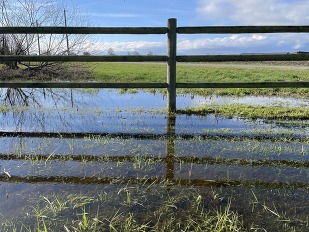
Happy spring, farmers! We’ve had a few sunny days, but the ground has some catching up to do.
Soils that are still saturated are not ready for grazing, manure spreading, or reseeding. Here’s why:
Grazing— Grazing on saturated soil can harm your grass. When soil is wet, it’s easier for animals to pull grass out at the root rather than biting it off partway down the stem. Grass can’t keep growing if it’s pulled all the way out.
Animals on wet pastures can also rip up and damage grass with their hooves causing stunted growth and mud. Additionally, pressure on wet soil causes the water to be squeezed out like a sponge, leaving behind compacted soil.
What to wait for before you put animals out to pasture:
- No standing water on pasture.
- Grass is 6 to 8 inches tall.
- Grass survives a “pull test”—Tug the grass until it either breaks or pulls up by the roots. If the grass pulls up by the roots, it is NOT ready to be grazed on.
Manure spreading— When your soil is saturated with water, there isn’t anywhere for manure, and the nutrients it holds, to soak in. The manure is more likely to flow off your field and into nearby waterways. Manure is full of bacteria, so it can make people, pets, and wildlife sick. Manure in the water can affect you and people downstream from you.
The process of spreading the manure can also harm your pasture. When soil is wet, your tractor can dig into your soil and damage your grass by ripping it up at the roots. You’re also at risk of getting stuck!
What to wait for before you spread manure:
- No standing water on pasture.
- “T-Sum” has been reached (this has already happened for this year).
- Visit the Whatcom Conservation District Application Risk Management page to access their Application Risk Management worksheet and map.
Reseeding— Reseeding muddy and damaged pastures can help you reestablish forage that will outcompete weeds and grow roots to break up compacted soils. Using equipment to reseed a pasture brings the same risks as spreading manure—damage to the grass and potential for rutting and getting stuck. Paying attention to your seed germination instructions is also important to ensure success.
- What to wait for before you reseed:
- No standing water on pasture.
- No animals on pasture to let the plants establish.
- Check your seed mix instructions and wait for the right time and moisture levels.
|
Did you do some egg hunting last weekend? Get egg-cited, because we have another spring “hunt” for you!
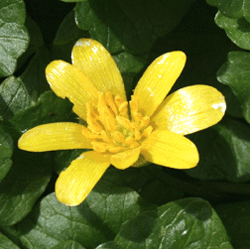
We’d like to invite you to the hunt for lesser celandine, a yellow-flowering noxious weed that typically pop up in early spring. Lesser celandine emerges in the understory, wetlands, streambanks, and roadsides before many of our native plants. Its early arrival gives it an advantage to establish itself and outcompete beneficial plants. Lesser celandine is on the Washington quarantine list, and it is illegal to buy, sell, or offer it for sale in the state.
While it may die back completely in June, a dense root system is left behind and can still stop native and non-invasive plants from growing. This makes finding lesser celandine early very important.
So… Let’s hop to searching!
Description: Lesser celandine a small plant that grows into a dense carpet of vegetation about 3 to 12 inches high. Solitary yellow flowers with 7-13 petals bloom at stem tips and form clusters of globular shaped fruit called achenes. The leaves are shiny, dark and kidney shaped with edges that can be smooth or have rounded teeth.
Plants can reproduce by movement of tuberous roots, bulbils on their stem, and by seed.
Toxicity: This weed is toxic to humans and livestock.
Control: Timing control efforts of this plant can be a challenge due to limited time the plant has growth above ground and how fast it can spread. Tubers and bulbils are easily dislodged and spread to new areas.
You can control small infestations by hand digging and removing all parts of the plant. Make sure to bag all plant parts and throw away – do not put this plant in compost!
Sheet mulching may be effective in smothering plants, but only if mulch layer is around 6 inches deep.
Herbicide may be an effective tool for large infestations. For more information or help in identifying and controlling lesser celandine, reach out to our Noxious Weed Coordinator, Evan Emrick, at (360)-707-1502, evane@co.skagit.wa.us
Look-alikes: Lesser celandine may be confused with some violet species because of similar size and leaf shape. However, when flowering, they are easily distinguishable. Lesser celandine’s vegetation also completely dies back in June, which is not the case for most violets.
Images courtesy of Washington State Noxious Weed Control Board. Learn more about lesser celandine at the Washington State Noxious Weed Control Board website.
|


Program News
Jamie Halpin, Stormwater Technician
We are SO excited to announce that Jamie Halpin, formerly our Source Control inspector, will be taking on the role of Stormwater Technician!
In her new position, Jamie will be inspecting and maintaining our stormwater system. Her work will help reduce neighborhood flooding, protect our water from pollution, and keep our stormwater system working as it should.
“I’m looking forward to exploring different stormwater treatment systems like detention ponds and bioswales,” she said. “I feel like there’s a lot of really cool and interesting treatment systems out there that are unique to every site.”
Jamie was born and raised in Skagit County in the Bow/Alger area. She has worked for the County for three years.
“My favorite part of working at the County is the people, for sure,” she said. “I’m very lucky to work in the Natural Resources Division with friendly, passionate people.”
Outside of work, Jamie spends a lot of her time cuddling and doting on her cat, Little Moo. She is also a Magic the Gathering player, an animal lover, and a cat-safe houseplant enthusiast.
2026 Stormwater Management Program Plan open for public comment April 15 through May 1
Skagit County’s 2026 Stormwater Management Program Plan draft is opening for public comment on April 15th until May 1st.
The Stormwater Management Program Plan describes what Skagit County will do to protect natural waterways from stormwater pollution (pollution that flows off roads, sidewalks, and other surfaces when it rains) in 2026.
Skagit County Natural Resources Division wants to encourage Skagit County residents to read and comment on the plan. Public input helps make sure that what the Stormwater Program is doing lines up with what county residents want and need. You can find the plan and information on how to comment online.
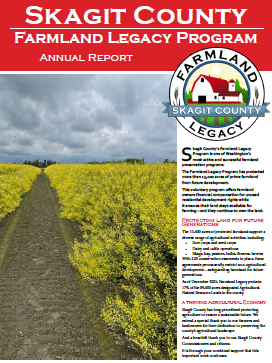
The Skagit Farmland Legacy Program 2025 Annual Report is out now!
Read all about how Skagit Farmland Legacy Program has protected farmland in 2025. The report includes stunning pictures of Skagit farmland and quotes from local landowners. Find the pdf of the report online.
|
 |
Classes and Events
NW Forest Landowner Assistance Workshop, April 11, 9 AM to 2 PM, Padilla Bay Interpretive Center: Join Skagit Conservation District to learn about Agency Assistance Programs for small forest landowners, current funding programs for forest management, and talk one on one with agency service foresters.
Anacortes Earth Day, April 24 & 25: Come to downtown Anacortes and take part in two days of joy, beauty, and education as we honor and celebrate our natural environment. The event includes the Luminary Light Parade, the Procession of the Species, the Sustainable Fashion Show, and activity/ educational booths. All activities are free and everyone is welcome!
Soils with Toby Rodgers, April 30, 6 PM to 7:30 PM, Skagit Valley College, Angst Hall #125: Toby Rodgers (Washington Society of Professional Soil Scientists) will talk about the different types of soils found in Skagit county. You will learn how to identify your soil types and how they function, how to protect your soil and keep it healthy, and more. Bring your questions and "get the dirt" on soils. Hosted by Skagit Conservation District.
Simon Acres Farm Tour, May 5, 5 PM to 7 PM, Sedro-Woolley, exact location provided when registered: Join Skagit Conservation District's free Farm Tour to hear from a local equine owner on how she worked with Skagit CD to improve her pasture and soil health, and improve chore efficiency! You will come home with the knowledge of how to take your own soil sample and a free waiver to submit it to Simply Soil Testing in Burlington.
Master Gardener Plant Fair, May 9, 8 AM to 2 PM, Skagit County Fairgrounds: Visit the WSU Master Gardeners Plant Fair to find quality garden plants, locally-grown and chosen for success in our Skagit Valley environment. Free admission and parking, plant clinic, dozens of vendors, food, and fun!
Noxious Weeds with Evan Emrick, May 13, 5 PM to 6:30 PM, Skagit Valley College, Angst Hall #125: What's the problem with weeds? What is a noxious weed? What can we do about weeds? Hear the answers to these and other questions from Skagit County Noxious Weed Coordinator, Evan Emrick. Hosted by Skagit Conservation District
Composting Demonstration and Discovery Garden tour, May 30, 12 PM to 2 PM, WSU Discovery Gardens, 16602 WA-536, Mount Vernon: Skagit Master Gardener and Master Composter, Herta Kurp will give a demonstration on composting, followed by a tour of the Skagit Master Gardener display garden and WA Native Plant Society display garden. Bring a picnic lunch to enjoy after the tour. The garden is open to the public until dusk
Stormwater Systems Maintenance workshop, June 4, 5:30 PM to 7:30 PM, Skagit Port Commissioners Hearing Room, 15400 Airport Dr, Burlington: Private properties are responsible for maintaining their stormwater facilities. Join Skagit Conservation District to learn about stormwater regulations and system maintenance from Jason Quigley, Skagit County's Stormwater Coordinator, and Reilly Russell from TRICO Companies.
Volunteer Opportunities
Skagit Fisheries Enhancement Group Earth Day work party, April 25, 9 AM to 1 PM, Edgewater Park: Join Skagit Fisheries and Mount Vernon Parks and Enrichment Services for a fun and meaningful Earth Day Celebration! Hosted in partnership with Mount Vernon Parks and Recreation and the Skagit Fisheries Enhancement Group, this event is all about giving back to nature and connecting with our local environment.
Skagit Land Trust work parties, April 22 and May 8 & 22: Volunteer with Skagit Land Trust to remove invasives, plant native shrubs and trees, and maintain important work tools!
Utopia fieldtrips, throughout May: Skagit Land Trust is seeking a few enthusiastic environmental educators and volunteers to support kids in some fun outdoor learning experiences at our Utopia Conservation Area this May! Their education team will be hosting seven student field trips for second-graders from Sedro-Woolley schools and one Mount Vernon School.
Bowman Bay Stewardship, June 9, 10 AM to 12 PM: Join Northwest Straits Foundation for a volunteer work party at Bowman Bay! Spend the morning supporting the ongoing restoration through weeding, spreading mulch, and tending to native vegetation to create a resilient nearshore habitat.
Salish Sea School Volunteer Opportunities: Whether you’re helping with educational programs, community events, marine conservation projects, or daily operations, your time and talents directly support a thriving Salish Sea where people and nature flourish.
|