|
Photo of the Month
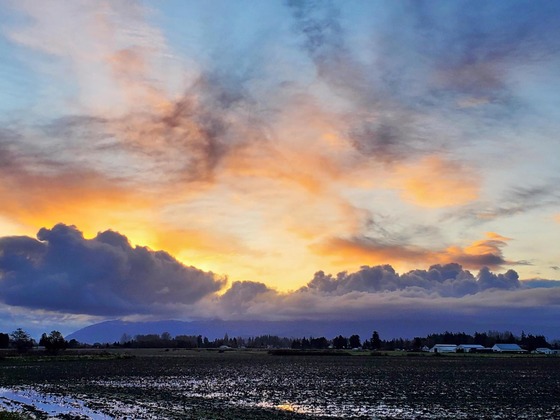 The Skagit sunrise, seen from the Thomas Road crossing of the Samish River. Photo by Karen DuBose.
Karen DuBose, our Pollution Identification and Correction Coordinator, caught this beautiful sunrise while doing early morning field work on Monday.
DuBose also captured a post-storm sample of the water in the Samish River. This sample showed us that the water is clean enough to reopen shellfish harvesting after recent rains.
Rainy weather means more pollution is washed into rivers, streams, and eventually the bay, where shellfish like clams and oysters are grown. Too much bacterial pollution in the bay makes shellfish dangerous to eat, so shellfish growers stop their harvesting.
Once the rain has passed, it’s our job to make sure the water is clean enough for shellfish growers to start harvesting again. We sample local waterways and send the samples to a lab to be tested for fecal coliform. If bacteria levels are low enough, harvesting reopens!
The bacterial pollution that rain washes into our waterways comes from unmanaged or improperly managed human, dog, and livestock waste. You can reduce pollution by:
- Getting your septic system inspected regularly
- Scooping and throwing dog poop away in the trash (even in then woods and on private property)
- Collect manure and cover it with a tarp or structure
- Packing out human and pet waste on hikes
Pollution in our waterways doesn’t just harm people growing and eating shellfish—it can make children, adults, pets, and wildlife who come in contact with the water sick, too.
|
|
|
Just when we thought spring might be here, the cold and precipitation arrived! While I think most of us are ready for spring, this additional snow is just what we need to maintain higher stream flows and cooler waters during the summer.
February was both warmer and drier than usual. The Mount Vernon WSU AgWeatherNet station had an average temperature of 42.9°F, which is about 1.9°F warmer than normal. The station recorded about 2.1” of rain, which is 0.7” less than average.
Bacteria levels across our long-term monitoring sites continued to be low. We found the highest bacteria levels at the Alice Bay drainage and the North Edison drainage; however, these were only moderately high. In February, only one sample, which came from the Alice Bay Drainage, had an E. coli result that was above Washington state water quality standards (320 MPN/100mL).
May the good water quality conditions continue with this chilly weather! Check out our most recent results on our Water Quality Map!
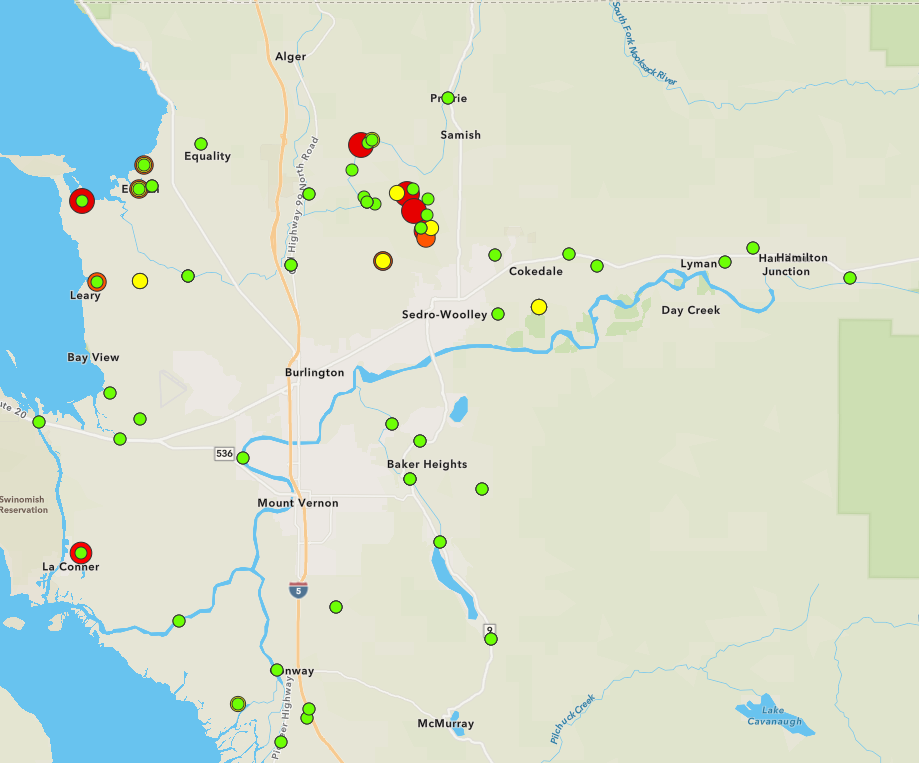 February's water quality results. Red dots represent sites with high levels of fecal bacteria, yellow represents sites with moderate levels of fecal bacteria, and green dots represent sites with low fecal bacteria levels. Click on the map to go to the online water quality map, where you can explore sites in Skagit, Whatcom, and Snohomish Counties.
|
|
Home Tip of the Month
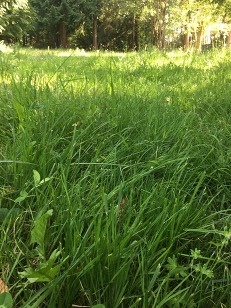
We're coming into spring, and we have some good news... You don't have to fertilize!
Fertilizer, though marketed as the path to a green lawn, is often an waste of time and money. Plus, it can create public health issues and pollute water.
The cost of fertilizing
If you don't know what your soil needs, fertilizer can be, quite literally, money down the drain.
Soil can only hold a certain amount of nutrients. Adding more is like watering a plant that's already sitting in a puddle! There's nowhere in the soil for the nutrients to go, and spring rains will wash them away quickly.
Because of this, the nutrients in fertilizer often end up in our water, where they can cause serious problems for human, animal, and environmental health.
|
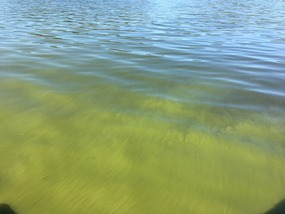
Algae blooms
The nutrients in fertilizer, especially phosphorus, feed algae blooms in our lakes and waterways. These algae blooms can sometimes be extremely toxic— they can sicken or even kill children, adults, and animals that play in or drink from the water.
Fertilizing in spring creates an extra risk of algae blooms because algae already grows faster in spring and summer when there is more sunlight.
What should you do?
The easiest way to save money and keep fertilizer out of our water is to skip fertilizing all together.
If you feel you must fertilize, here are some tips:
- Wait until fall to fertilize. This will reduce the risk of feeding algae blooms in lakes.
- Test your soil first. This will tell you what nutrients your soil actually needs. You can buy fertilizer that has these specific nutrients.
- Consider using grass clippings as fertilizer. They break down slowly and naturally, AND they're free!
- Use slow-release fertilizer, ideally with zero phosphorus.
- Use only as much fertilizer as the label instructs.
Above all, keep in mind that everything you put on or in the ground can be washed into your nearest stream, river, lake, or bay.
|
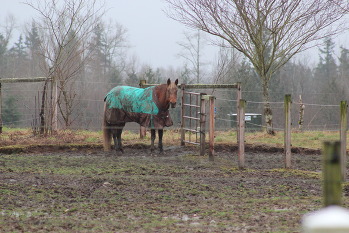
Farm Tip of the Month
Spring is sneaking up on us, and grass is getting ready to grow! Get a jump on the season by seeing what work may be needed in the coming months.
Prep for reseeding
Now is the time to buy forage seed to amend your sacrifice pasture or heavy use area, and specifically cover any worn out and muddy areas. When choosing seed, consider what mixes will compliment your animals nutrient needs, diversify forage, and be suitable for your soil.
Note: You'll have to wait until your pastures are drier and grass height is 6 inches tall before you can move your animals out of your sacrifice pasture and reseed! Grazing too early can damage the grass and stunt its growth.
Plan for next year
It's a good idea to take pictures of the areas that have gotten muddy. Knowing what's muddy now can help you plan for next year. You might want to make changes like:
- Fencing animals away from the places that get muddy.
- Changing your feeding area.
- Adding or changing footing material.
- Rerouting gutters or collecting roof runoff.
Effective manure spreading
Now is also a good time to think about soil amendments. If you're planning to spread manure, the Whatcom Conservation District ARM worksheet is a great resource! It will help you assess when to spread and how much manure to use.
|
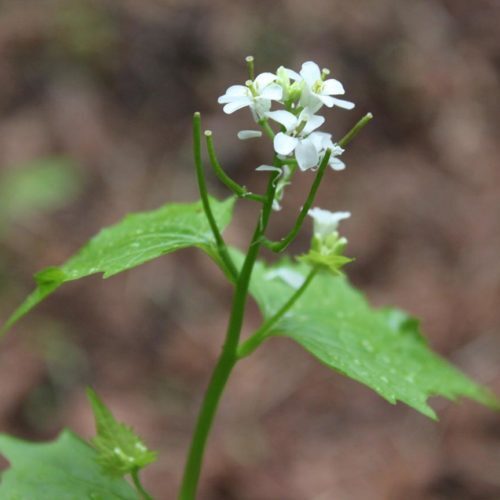
This plant may look like the cutest clover in the patch, but don’t be fooled! Garlic mustard is a Class A noxious weed in Skagit County. It is illegal to transport, buy, sell or distribute this plant.
Although this plant’s strong smell is sure to shamROCK your world, native plants and animals don’t eat garlic mustard. In fact, it actually reduces the amount of food around for our wildlife to eat. Garlic mustard releases chemicals into the soil that disrupt plant growth and soil fungi that are critical for tree development and survival.
Garlic mustard begins its growth in early spring and quickly outcompetes native species that are still dormant. It produces many seeds that can survive years in the soil before germinating, making early detection and control of this plant very important!
Description:
Garlic mustard is a low growing plant with an upright stem that ends in small white flowers. It gets its name from its garlicy smell, especially in the early spring.
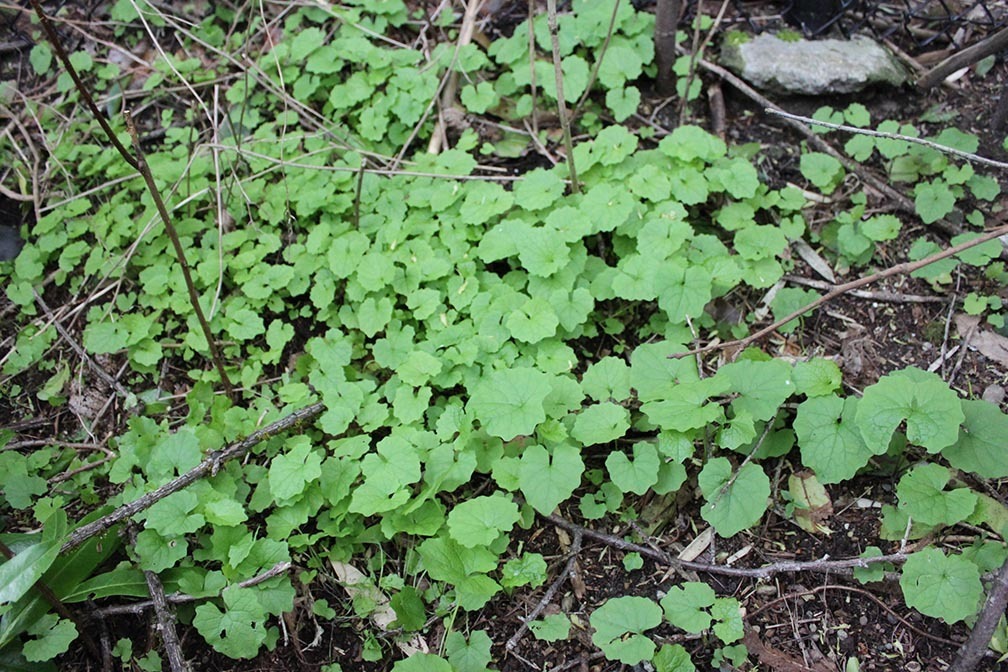
In its first year, garlic mustard has low growing leaves that are rounded to kidney shaped and scalloped on the edges. In its second year, the stem bolts up to 3 to 6 feet tall. Leaves along the stem become more triangular in shape and coarsely toothed.
Flowers have 4 petals, 4 sepals, and 6 stamen. Petals are white, about ¼ inch long and twice as long as the sepals.
Garlic mustard has long and slender seed pods that curve upwards. Seeds are dark brown to black, grooved and oblong in shape. Plants can produce as many as 8,000 seeds!
Toxicity:
Garlic mustard is edible to humans, but generally not eaten by local wildlife or insects.
Control:
Garlic mustard is a Class A noxious weed, so all patches must be eradicated (completely destroyed). It is essential to eradicate this plant before it goes to seed. Garlic mustard is quite difficult to get rid of once it’s established, so it’s important to find and identify infestations as early as possible.
Hand-pulling plants is a good control strategy, but make sure you remove the entire root.
Herbicide may be useful for large, dense infestations. For best control, apply in the spring or fall to seedlings and rosettes.
For questions about identification and control, please reach out to our Noxious Weed Coordinator, Evan Emrick, at (360)-707-1502, evane@co.skagit.wa.us. Learn more about identifying and controlling garlic mustard from the Washington State Noxious Weed Control Board.
Photos courtesy of the Washington State Noxious Weed Control Board.
|
|
|
Program News
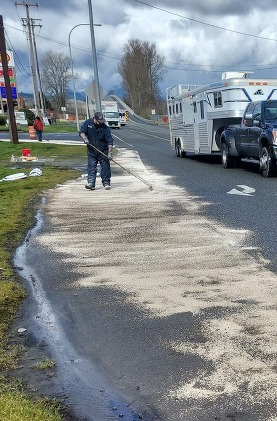
Stormwater staff cleans up local spill
Last week, Skagit County Stormwater and Operations staff spent over three hours cleaning up a gas spill near Cook Road and Old Highway 99. Our team used spill pads and cat litter (which is very absorbent) to soak up the gas, then cleaned up the spill materials to dispose of them.
This spill, which was likely from a leaky car, could have killed wildlife and polluted our waterways if it hadn’t been cleaned up.
A big thank you to the Shell gas station nearby that had spill materials at the ready! It’s important for businesses, especially ones that work with pollutants like fuel, to have spill materials and a plan for spills.
Agricultural Producer Survey
Skagit County’s Voluntary Stewardship Program (VSP) is looking for farmers to take our agricultural producer survey! This survey will help us understand how local farmers are managing soil health, nutrients, and habitat.
You can take the survey to share your stewardship today, whether or not you've worked with VSP!
|
Classes and Events
Skagit Conservation District Native Plant Sale: Skagit Conservation District's Annual Native Plant Sale is almost over, but there are still some plants left! Order online until Friday, March 13th at 4:00 PM. Orders must be picked up on Sunday March 15th between 9 AM and 1 PM.
WSU Pasture Management Series, March 16 & April 14, 6:30 PM to 8:30 PM, 11768 Westar Lane, Burlington: Join local pasture experts for a FREE two-evening workshop covering essential and advanced pasture management strategies. This series is ideal for both beginners and experienced producers and focused on practical, budget-friendly solutions that improve pasture productivity and protect our water resources.
Integrated Pest Management Workshop, March 19, 7:30 pm, Skagit Valley College: Join Skagit Conservation District in a FREE workshop to learn how to maintain a healthy landscape and prevent conditions that lead to pest infestations in a safe and sustainable way. Retired entomologist, Bob Gillespie will explain the conditions that lead to pest infestations and how to prevent or manage them in a safe and sustainable way.
Anacortes Earth Day, April 24 & 25: Come to downtown Anacortes and take part in two days of joy, beauty, and education as we honor and celebrate our natural environment. The event includes the Luminary Light Parade, the Procession of the Species, the Sustainable Fashion Show, and activity/ educational booths. All activities are free and everyone is welcome!
Master Gardener Plant Fair, May 9, 8 AM to 2 PM, Skagit County Fairgrounds: Visit the WSU Master Gardeners Plant Fair to find quality garden plants, locally-grown and chosen for success in our Skagit Valley environment. Free admission and parking, plant clinic, dozens of vendors, food, and fun!
Composting Demonstration and Discovery Garden tour, May 30, 12 PM to 2 PM, WSU Discovery Gardens, 16602 WA-536, Mount Vernon: Skagit Master Gardener and Master Composter, Herta Kurp will give a demonstration on composting, followed by a tour of the Skagit Master Gardener display garden and WA Native Plant Society display garden. Bring a picnic lunch to enjoy after the tour. The garden is open to the public until dusk
Stormwater Systems Maintenance workshop, June 4, 5:30 PM to 7:30 PM, Skagit Port Commissioners Hearing Room, 15400 Airport Dr, Burlington: Private properties are responsible for maintaining their stormwater facilities. Join Skagit Conservation District to learn about stormwater regulations and system maintenance from Jason Quigley, Skagit County's Stormwater Coordinator, and Reilly Russell from TRICO Companies.
Volunteer Opportunities
Skagit Fisheries Enhancement Group work parties, March 14, 21, & 28, and April 4 & 25: Join Skagit Fisheries Enhancement Group in planting and potting parties!
Skagit Land Trust work parties, March 21, April 1, and May 8: Volunteer with Skagit Land Trust to remove invasives, plant native shrubs and trees, and maintain important work tools!
Samish Indian Nation Department of Natural Resources Volunteer Training Day, March 31, 9 AM, Fidalgo Bay RV Park: Attend this volunteer training day with Samish Indian Nation’s Department of Natural Resources to learn how to perform beach seining, fish identification, and biometric data collection. With these skills, you can volunteer to support Samish Indian Nation in monthly beach seining events!
For more information or to RSVP, email Maddie at mzambo@samishtribe.nsn.us
Utopia fieldtrips, throughout May: Skagit Land Trust is seeking a few enthusiastic environmental educators and volunteers to support kids in some fun outdoor learning experiences at our Utopia Conservation Area this May! Their education team will be hosting seven student field trips for second-graders from Sedro-Woolley schools and one Mount Vernon School.
Salish Sea School Volunteer Opportunities: Whether you’re helping with educational programs, community events, marine conservation projects, or daily operations, your time and talents directly support a thriving Salish Sea where people and nature flourish.
|
|
Contact Us
For questions or more details, please contact Karen DuBose at kdubose@co.skagit.wa.us or 360-416-1460.
This project has been funded wholly or in part by the United States Environmental Protection Agency under assistance agreement PC01J18001-0 to the Washington Department of Health. The contents of this document do not necessarily reflect the views and policies of the Environmental Protection Agency, nor does mention of trade names or commercial products constitute endorsement or recommendation for use.
|
|
|
|
|