|
Photo of the Month
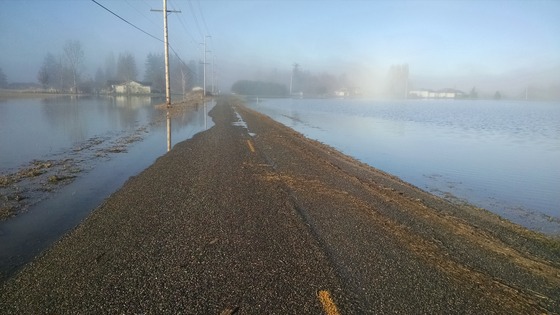 Flooding in January of 2015 surrounded and covered Sam Bell Road, as well as many other roads across the Skagit Valley.
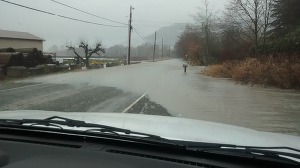
Skagit County is looking at some heavy rain in the forecast, and we will likely see flooding from the Skagit River over the next week.
Currently, NOAA's National Water Prediction Service is predicting that Skagit River near Concrete will reach major flood stage, with peak flows at 10 AM on Tuesday, December 9th and at 4 AM on Thursday, December 11th.
NOAA currently predicts that the Skagit River will also hit major flood stage near Mount Vernon. We're expecting peak flow 4 AM on Wednesday, December 10th and at 10 PM on Thursday, December 11th.
While flooding is very likely, the timing and intensity of the river peaks may change. Check in with the Skagit County River Hotline at (360) 416-1404 for updates on river levels, or look at NOAA's Skagit River gauges for current flow levels and up-to-date predictions:
Skagit River gauge near Concrete
Skagit River gauge near Mount Vernon
Here are a few tips to protect yourself and others during flooding:
-
Clear storm drains in your neighborhood. Storm drains allow rainwater to drain away out of streets and parking lots. Leaves and debris stop rainwater from draining. Keep your neighborhood storm drains clear to reduce flooding.
-
Stay out of flood waters. Flood waters pick up everything in their path, including debris and harmful bacteria.
-
Chlorinate or boil all water for drinking and food preparation if you are on a well.
-
Have a stocked first aid kit available in case of injury. Tend to injuries immediately.
- Be aware of electrical hazards.
-
Avoid Carbon Monoxide Poisoning. Use alternative sources of fuel for heating, cooking, and electricity.
-
Be Septic Smart. Your system may not function properly after a flood. Minimize water use until floodwaters completely recede and do not use if toilets and sinks do not drain properly.
For more information, please visit www.SkagitCounty.net/Flood. There, you can find resources including:
|
|
|
|
The holiday season is here, bringing festive lights, yummy treats, and plenty of rain! The Mount Vernon WSU AgWeatherNet station had a max-average temperatures in November around 53.3°F, which is about 3°F warmer than normal. Rainfall totaled 3.85 inches, about half an inch below typical levels for this time of year.
Routine sampling in November generally showed low bacteria levels. This often happens once winter rains have settled in. Stream flows rise and stay consistently higher, helping dilute bacteria already in the system. However, bacteria levels can spike during storms, when fast-moving runoff washes pollutants from roads, fields, yards, and pastures directly into nearby ditches and streams. Once the initial surge passes and flows stabilize, bacteria levels tend to drop again.
A few locations did still show elevated bacteria this month, including the South Edison Drainage, Edison Slough, and the Alice Bay Drainage.
Curious how things are looking as the wet season continues? Explore our Water Quality Map for the latest bacteria results!
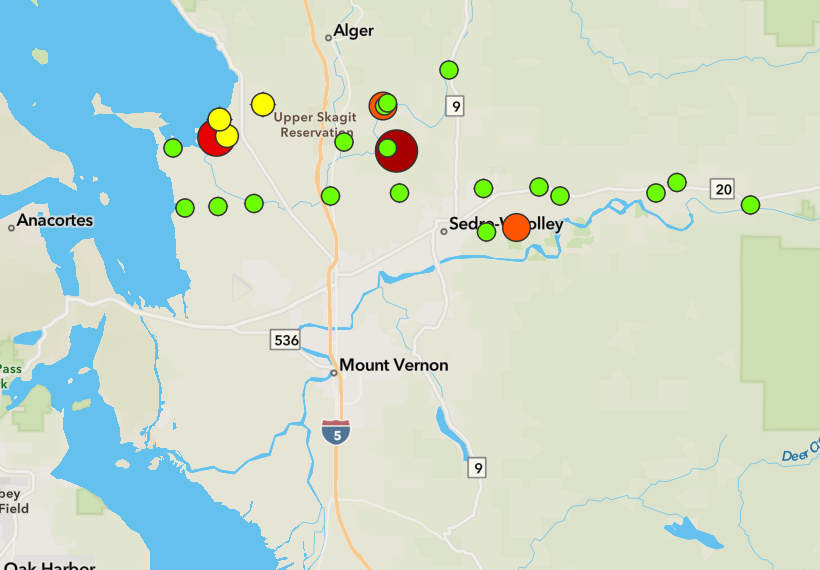 November's water quality results. Red dots represent sites with high levels of fecal bacteria, yellow represents sites with moderate levels of fecal bacteria, and green dots represent sites with low fecal bacteria levels. Click on the map to go to the online water quality map, where you can explore sites in Skagit, Whatcom, and Snohomish Counties.
|
|
Home Tip of the Month
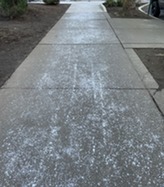
Winter weather will kick in soon, and after all this rain, that could mean icy roads and walkways! However, that doesn't just mean dumping salt on roads, driveways, and sidewalks.
Rain and meltwater wash deicing products like road salt into our waterways, where they can harm salmon and other wildlife. These products can also damage plants and lawns and irritate dogs' paws. Here are some tips for using deicing products this winter:
 Keep in mind that frosty mornings don't necessarily mean icy roads and walkways. Make sure you NEED deicer before you use it. Keep in mind that frosty mornings don't necessarily mean icy roads and walkways. Make sure you NEED deicer before you use it.
Take a look at the instructions on the bag when using deicer. Don't use any more than is suggested. Typically, you can cover about 10 sidewalk squares with a coffee mug worth of salt (12 oz).
Spread your salt evenly. Avoid leaving big patches, like in the picture above!
If the cold snap is over and your salt is still on the ground, or if you used a bit too much, sweep it up. Make sure that extra deicer ends up in the trash, not our water!
The best advice for those who use salt is read the instructions and use the smallest amount necessary to melt the snow. There's a difference between salts, though. Here are the options, from best to worst:
- Calcium chloride (CaCl): Only a small amount is necessary to effectively melt snow.
- Potassium chloride (KCl): You might need a little more than if you used calcium chloride, but this one is still a good option.
- Sodium chloride (NaCl, or rock salt): Please use as little as possible - the sodium in the runoff turns freshwater into salt water and can kill fish.
- Always avoid deicers containing magnesium or ammonia, as they will deteriorate your concrete. Ammonia is toxic to aquatic life.
|
|
|
Farm Tip of the Month
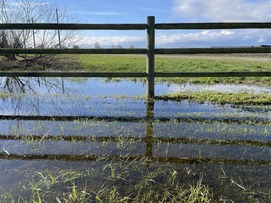
Did you know that 748 gallons of water runs off of an average-sized, 30x40 foot barn during a one-inch rainstorm? That makes for a LOT of mud and standing water around your barn!
What's wrong with mud and wet ground?
Animals that stand in mud and water can pick up hoof problems, resulting in more visits with the vet.
Plus, manure mixed with mud can more easily transfer bacteria and potential parasites to our waterways. This causes pollution and risks serious community health problems.
How can I stop mud from forming?
Installing or extending gutters and downspouts lets you to catch roof runoff and reroute it. This way, you can channel it away from your animals and manure storage area.
Where do I send the water?
There are several options for where to send the rainwater from your roof, including...
- Catchment containers- Catch rain water in tanks or large buckets for later use.
- Troughs- Channel rain water into troughs for your animals.
- Irrigation- Send water towards crops, gardens, or even a rain garden to water your plants.
Keep in mind the potential effects of where you're planning to reroute water, though. Will the new location create even more mud? Will it create flooding or pooling? Is it too close to your septic drain field? Make sure to consider possible consequences before rerouting large amounts of water.
If you're interested in rainwater harvesting on your farm, there are a wealth of resources available online. If you prefer the personal touch, the friendly farm planners at the Skagit Conservation District can help you map out a plan and offer great tips from other projects they've seen.
|
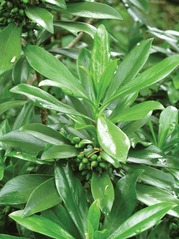
Spurge laurel, AKA Daphne or wood laurel, is a noxious weed that you'll notice all year long. It's evergreen, which means it doesn't drop its leaves in fall and winter.
Spurge laurel is on the quarantine list in Washington, meaning it's illegal to buy, sell, or transport. Part of what makes it such a troublesome weed is that it can quickly colonize large areas and take resources from native plants.
Here are the facts:
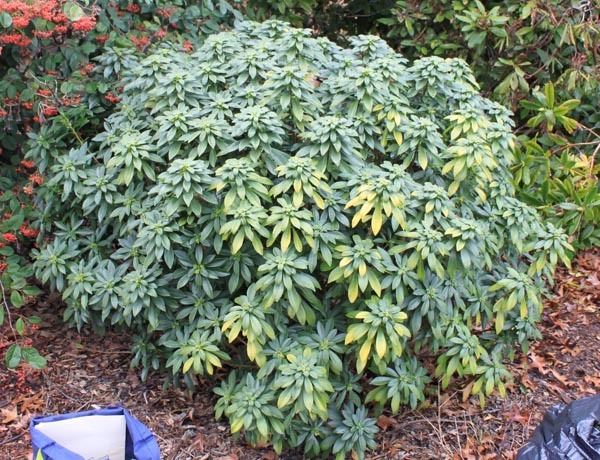
Description: Spurge laurel is a shrub (about 1.4 to 5 feet tall) with glossy, dark green leaves. Its leaves are oval shaped with smooth edges and pointed tips. They are duller and lighter in color on the underside. The leaves and the structure of the shrub can make it look like a rhododendron.
Spurge laurel has small, bright green flowers that grow at the base of the leaves. Its fruit starts out green, then becomes black as it matures, and looks like a black olive.
Toxicity: Every part of the plant is highly toxic to humans and livestock. Its sap can cause irritation to the skin.
Control: Spurge laurel can be pulled by hand when small or cut below the soil line when larger. Make sure to wear gloves when working with spurge laurel to avoid skin irritation from its sap!
A weed wrench is a great tool for pulling spurge laurel. Skagit County Noxious Weeds has a weed wrench available for loan to those dealing with noxious weeds on their properties. Please reach out to our Noxious Weed Coordinator, Evan Emrick, at (360) 707-1502 evane@co.skagit.wa.us for information on the tool loan program.
For more information or for help identifying and controlling round leaf bittersweet, including by using herbicide, please reach out to our Noxious Weed Coordinator, Evan Emrick, at (360) 707-1502 evane@co.skagit.wa.us.
Learn more about how to identify spurge laurel from the Washington State Noxious Weed Control Board.
Photos courtesy of the Washington State Noxious Weeds Control Board.
|
|
|

Program News
Win a $25 Visa gift card!
Do you have a dog? Take our survey and you’ll be entered in a drawing for a real T-R-E-A-T: A $25 Visa gift card!
Take the survey today!
Apply for Skagit County Voluntary Stewardship Program Work Group!
The VSP Work Group has two upcoming openings!
VSP Work Group members provide input and make decisions to achieve the program's goals. Members are appointed by Skagit County Commissioners and serve without compensation in 3-year terms.
Learn more about the Work Group at www.SkagitCounty.net/VSP and apply today!
Applications are open until December 31st, 2025. Questions? Please contact jennej@co.skagit.wa.us or 360-416-1457.
Agricultural Producer Survey
Skagit County’s Voluntary Stewardship Program (VSP) is looking for farmers to take our agricultural producer survey! This survey will help us understand how local farmers are managing soil health, nutrients, and habitat.
You can take the survey to share your stewardship today, whether or not you've worked with VSP!
|
Classes and Events
Volunteer Opportunities
Skagit Land Trust work parties, December 18, January 9, 19, & 30: Volunteer with Skagit Land Trust to help restore important habitat! Remove invasives and plant native shrubs and trees to support wildlife.
|
|
Contact Us
For questions or more details, please contact Karen DuBose at kdubose@co.skagit.wa.us or 360-416-1460.
This project has been funded wholly or in part by the United States Environmental Protection Agency under assistance agreement PC01J18001-0 to the Washington Department of Health. The contents of this document do not necessarily reflect the views and policies of the Environmental Protection Agency, nor does mention of trade names or commercial products constitute endorsement or recommendation for use.
|
|
|
|
|