|
Photo of the Month
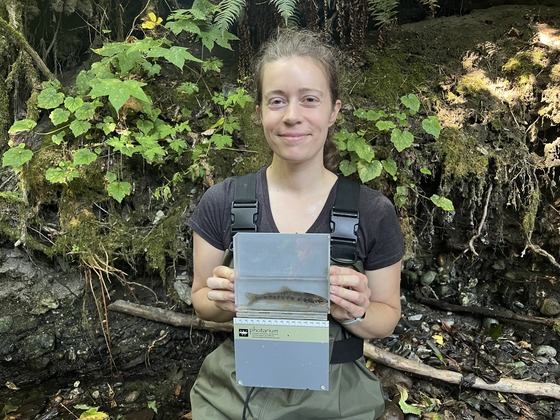 Halee Sexton, Skagit County's Natural Resources intern, holds a young cutthroat trout found while relocating fish for a fish passage project at Dry Creek.
This August, Skagit County hired our friends at Skagit Fisheries Enhancement Group to spend a day removing fish from a stretch of Dry Creek. Our intern, Halee, got to help out!
You might be wondering why we're removing fish from streams when we're trying to protect them. The answer? To prepare for a very exciting fish passage project!
Skagit County is working to restore Dry Creek and Barrel Springs by removing human-made structures. These structures have been stopping fish from swimming upstream.
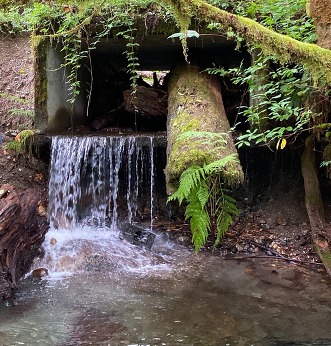
The culvert at Dry Creek (above) sits high above the stream, making it difficult for fish to enter and swim through.
This culvert is one of three that are part of this restoration project. Of the three culverts, we will replace two with bridges and one with a larger, more fish-friendly culvert. We hope to start work on the culverts in July 2026.
Before we can remove the culverts, though, we had to relocate the fish to protect them from construction. That's where Skagit Fisheries Enhancement Group came in!
|
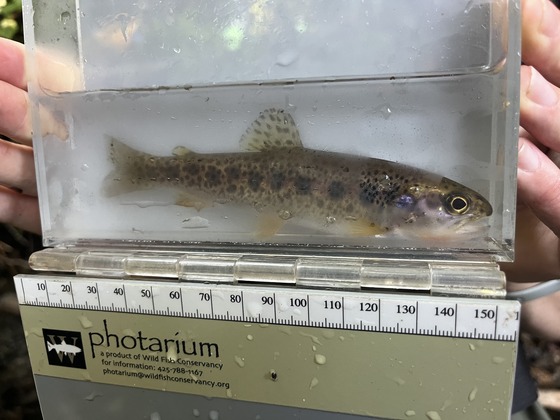 Skagit Fisheries Enhancement Group removed 232 live cutthroat trout from the stream. They quickly identified and measured the fish before releasing them into a pool in nearby Barrel Springs.
The crew also encountered a Pacific salamander and a northwest salamander, as well as many caddis fly larvae, stoneflies, midges, beetles, and mayflies. These stream bugs all provide food for fish and are indicators of great water quality. The crew relocated the salamanders and as many of the stream bugs as they could to Barrel Springs, too.
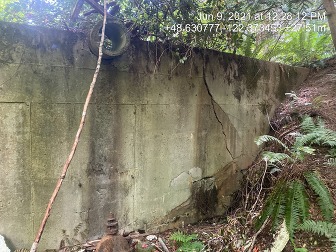
Though there are still many changes to come, we've already started the work to open up fish passage here.
Back in 2023, the County removed a 13-foot-tall, 36-foot-wide dam (left) from Barrel Springs. Getting rid of the dam immediately opened up fish passage and let more water into the stream in the dry summer months.
You can learn more about this project on the Barrel Springs Fish Passage project page.
A big 'Thank you!' to Skagit Fisheries Enhancement Group for the help and hard work!
|
|
|
|
“August slipped away…” into another month of water quality updates! We hope you had a wonderful summer and made some great memories as the season turned into just another a moment in time.
At the Mount Vernon WSU AgWeatherNet station, the average maximum temperature in August was 75.3°F, which is about 2°F warmer than usual. A storm in the middle of the month brought a brief relief from our dry spell. August rainfall was about 1.6 inches of rain, which is roughly 0.4 inches above normal.
In August, we found elevated bacteria levels at upper Thomas Creek, the south Edison Drainage, upper Coal Creek, Wiseman Creek, Maddox Creek/Big Ditch, and Swede Creek. We also observed higher bacteria levels in the Skagit River near Mount Vernon and further downstream at our South Fork site. High bacteria levels in summer can result from a combination of factors, such as low flows concentrating bacteria, increased recreational and agricultural activities, more wildlife activity, and warmer conditions that fuel bacteria survival and growth. Skagit County and our partners are working to identify and address these issues.
As we transition to the rainy season and more run off enters our streams, don’t forget to check out our Water Quality Map for the latest bacteria results!
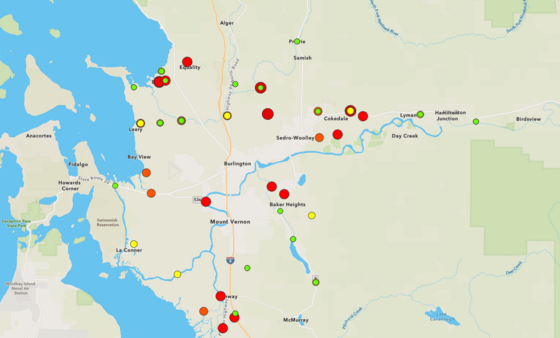 August water quality results. Red dots represent sites with high levels of fecal bacteria, yellow represents sites with moderate levels of fecal bacteria, and green dots represent sites with low fecal bacteria levels. Click on the map to go to the online water quality map, where you can explore sites in Skagit, Whatcom, and Snohomish Counties.
|
|
Home Tip of the Month
'Tis the season, the leaves are leavin'!
Autumn colors are starting to appear on our trees, and it won't be long before the branches are bare. But, while the fallen leaves make for lovely scenery, they can also cause some big problems for our neighborhoods and our water.
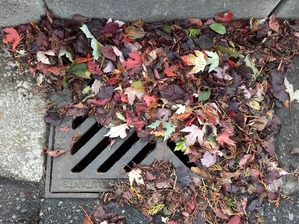
How fall leaves cause flooding
Each fallen leaf may not seem like a big deal on its own, but together they can create dense mats.
If we don't pick up fallen leaves, especially on sidewalks and in streets, these mats can clog storm drains.
Storm drains help keep water off of roads and parking lots when it rains. If storm drains are clogged with leaves, the water has nowhere to go. Clogged drains can lead to big puddles and even flooded streets. Standing water on roads makes driving very dangerous. Flooding can damage nearby yards and properties, too.
Fallen leaves can also clog or fill in ditches and culverts. Ditches and culverts help rain water flow away from neighborhoods. Clogged ditches and culverts can also create flooding problems.
Fall leaves fuel algae and weeds
Fallen leaves can actually fuel the growth of algae and invasive weeds in the summer. Weeds and algae blooms, especially toxic algae blooms, can stop us from being able to swim, boat, and fish in local lakes.
Like all organic matter, fallen leaves are full of nutrients. When they get into our water, leaves break down and release these nutrients, including phosphorus. Phosphorus is a big source of fuel for the algae blooms we see in our lakes in the summer.
This is especially a problem when we leave leaves in ditches and streets. From here, leaves can easily enter the stormwater system, which feeds directly into rivers, streams, and lakes.
|
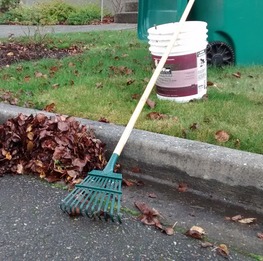
How to manage fall leaves
The most important thing is to make sure that your nearby storm drains are free of leaves and other debris.
You can use a rake to get leaves out of the street and to collect leaves in your yard. Once you've gathered the leaves, you have a few options!
1. Get yard waste picked up
If you receive Waste Management Northwest services and live west of Highway 9, you can pay for a yard waste bin and have leaves picked up from your house. This is a great option, especially if you produce a lot of yard waste. Plus, you can put food waste in the bin, too.
2. Take yard waste to a composting site
If you live east of the highway and Waste Management Northwest can't come pick up your yard waste, don't worry! You can bring your leaves (and other organic waste) to Skagit Soils to be recycled for 4 cents per pound.
3. Compost your yard waste at home
Want to make use of the nutrients in your fallen leaves? There are ways to do that, too!
If you have a garden that needs an extra boost, you can use your leaves, along with other materials, to make compost. Check out the Skagit County Composting webpage to learn how to make your own compost at home!
4. Use leaves as fertilizer
If you have a mulching lawn mower, you can also mow the leaves directly into your yard. A mulching mower cuts the leaves up into tiny pieces that break down more quickly and easily. This way, the nutrients go towards feeding your lawn, not algae blooms!
|
|
|

Farm Tip of the Month
September is Eat Local Month, and we want to take a moment to thank our farmers for all that they do!
We all know that our local growers and producers work hard to put good food on our tables. What people don't always realize is how much our farmers do to protect our water and ecosystems, too.
Farmers around Skagit County strive to reduce polluted runoff from their properties and protect the waterways around them. Here are some things you might see on a local farmer's property, and how they help keep our water clean:
|
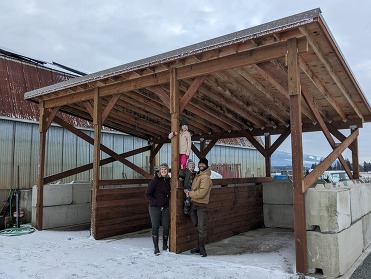
Manure storage: Covered manure storage bins help keep rain off of manure piles. This stops water from washing manure, and the bacteria it carries, into waterways.
Keeping rain off of manure piles also lets the manure turn into great, nutrient-rich fertilizer! Some farmers use tarps or other covers for their manure piles instead of a large structure.
Fencing: Fencing animals away from waterways and wet areas is another way our local farmers protect water. Keeping animals out of the water stops them from polluting it with poop and from stirring up sediment. Hooves can also crush fish eggs and trample riverbanks and stream-side vegetation, causing erosion.
Livestock crossings: Livestock crossings are bridges that allow cows or other farm animals to cross over streams or ditches on a farmer's property. Like fencing, these crossings help to keep animals out of the water.
Heavy use areas: Farmers typically take their animals off of their pastures in the cold and wet seasons to protect the grass and reduce mud. Heavy use areas, also called sacrifice pastures, are a place for farmers to put their animals during these times.
|
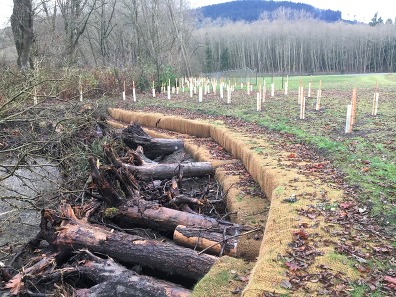
Restoration: Whether raising animals or growing crops, many farmers across the county have set aside parts of their properties for restoration planting. Especially around waterways, native plants help reduce erosion, filter pollution, and keep the water cool, just how salmon and other fish like it!
All of these different kinds of projects protect our water AND benefit farmers. They can be expensive, though.
Programs like Skagit Conservation District or the County's Natural Resource Stewardship Program can help fund these projects. Farmers themselves often put a lot of money and effort into protecting our water.
A huge 'Thank you' to our Skagit County farmers for the work you do to feed our communities and protect our resources!
Want to support our producers this Eat Local Month? Check out Eat Local First to get connected with all kinds of local products and services from our hardworking farmers!
|
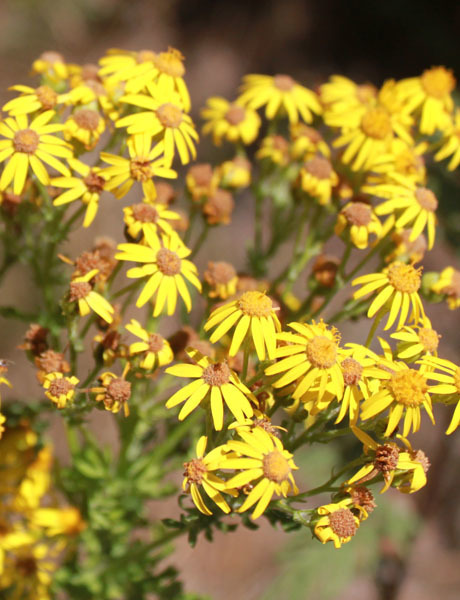
Move over, common tansy! This time tansy ragwort is in the hot seat for our Noxious Weed of the Month!
Tansy ragwort is a highly toxic weed that causes huge problems in pastures. It can kill humans and livestock, and even contaminate honey made from its flowers and milk from animals that eat it.
Tansy ragwort is a Class B noxious weed on Washington's quarantine list, meaning it is illegal to buy, sell, or transport. Here's what you need to know to make sure you're not an accomplice to this wicked weed!
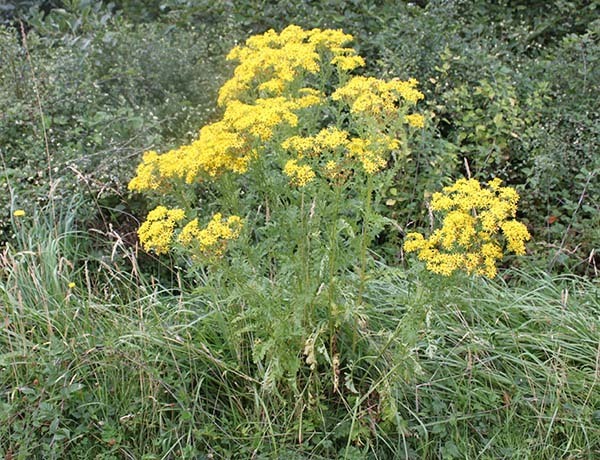
Description: Tansy ragwort is typically a biennial plant, meaning it has a two-year lifecycle. In its first year, tansy ragwort only grows as a rosette— a cluster of very ruffled, dark green leaves growing close to the ground. During the second year, the stem will grow and flower.
Tansy ragwort stems get up to 4 feet tall and can grow on their own or in clusters. Stems branch out near the top of the plant.
Ruffled green leaves grow alternately up the stems. Leaves near the top of the plant look sparser and more divided, with more space between leaf sections.
|

Yellow flowers grow in clusters at the top of the stems. Each small flower consists of a round, bumpy center, which may be slightly brownish or orange, surrounded by 13 narrow yellow petals. When they go to seed, the flowers become round, brown to white puffballs.
The fluffy seeds make tansy ragwort an especially big problem around roads. Seeds can get picked up and distributed by the wind from passing cars and trucks.
Toxicity: Tansy ragwort is highly toxic to livestock, humans, and pets. It can cause liver and neurological issues that can lead to sickness, coma, or even death. Animal products like milk and honey can become contaminated with toxins from the plant.
While livestock typically avoids tansy ragwort, it can become a big problem when unintentionally mixed into feed. It also becomes easier for animals to eat when wilted, so plants that have been pulled up and left in the field are dangerous, too.
All parts of the plant are poisonous, but the flowers hold the most toxins.
Control: Good pasture management is an important first step to prevent and reduce tansy ragwort infestations. Keep pastures, fields, and disturbed areas seeded with non-invasive (or even native!) plants to out-compete the weed.
Always wear gloves while working with tansy ragwort, as all parts of the plant are toxic. You can control small infestations by hand pulling the plants, making sure to pull the root as well. Larger infestations may need to be treated with herbicide, as well.
Mowing can help knock down flowerheads before they go to seed, but can also prolong infestations, as mowing tansy ragwort can make it return each year.
Make sure you remove all of the plants you treat or pull up from your field. Put plants, especially flowering heads, in a plastic bag and in the trash.
For more information or for help identifying and controlling tansy ragwort, including by using herbicide, please reach out to our Noxious Weed Coordinator, Evan Emrick, at (360) 707-1502 evane@co.skagit.wa.us.
Learn more about how to identify tansy ragwort from the Washington State Noxious Weed Control Board.
Photos courtesy of the Washington State Noxious Weed Control Board.
|
|
|
Classes and Events
Skagit Watershed Masters, September - November: The Watershed Masters program is a series of workshops and fieldtrips led by Skagit Conservation District. Skagit County residents can attend at no cost to learn about Skagit County water resources from the snowcaps to the whitecaps. Evening workshops and Saturday fieldtrips cover forest and stream health, riparian and habitat planting and maintenance, climate impacts and solutions, salmon, estuaries, and shellfish resources, and more.
Salmon Sightings: Cumberland Creek Humpies, September 27, 12 PM to 3 PM: Join Skagit Fisheries and Skagit Land Trust at Cumberland Creek to spot some pink salmon!
Discover Pass Free Days, September 27 and October 10, State Parks: To celebrate National Public Lands Day (9/27) and World Mental Health Day (10/10), visitors will not need a Discover Pass to park a vehicle at a Washington state park or on lands managed by the Washington State Department of Natural Resources (DNR) and the Washington Department of Fish and Wildlife (WDFW) on September 27 and October 10.
Wild and Scenic Film Festival, October 9, 6 PM to 9 PM: Skagit Fisheries Enhancement Group is excited to bring the Wild & Scenic Film Festival back to the Historic Lincoln Theater. The films to be shown capture the spirit of varying environmental movements across the globe and the relationship that they have to humanity and that humanity has to them.
Salmon Sightings: Clark Creek Coho, October 18, 12 PM to 3 PM: Join Skagit Fisheries Enhancement Group at Clark Creek in hopes of seeing spawning coho and Chinook salmon!
Volunteer Opportunities
Restoration work with Skagit Land Trust, September 20 and October 17: Help our friends at Skagit Land Trust restore our environment through plantings and invasive species removal!
Spawner Survey Workshop, October 4, 9 AM to 4 PM: Interested in learning about becoming a Spawner Survey Volunteer this fall/winter for Skagit Fisheries Enhancement Group? Join their Spawner Survey Workshop to learn protocol for identifying and documenting spawning salmon at SFEG restoration sites. (Note: Volunteers will need to be able to commit to walking their assigned stream reaches every week (7-10 days) from October – January.)
Upper Day Slough Planting Party, October 25, 9 AM to 12 PM: Celebrate Make a Difference Day with Skagit Fisheries Enhancement Group at their first planting at Upper Day Slough! They'll be planting native trees and shrubs to continue to enhance riparian habitat at this site.
|
|
Contact Us
For questions or more details, please contact Karen DuBose at kdubose@co.skagit.wa.us or 360-416-1460.
This project has been funded wholly or in part by the United States Environmental Protection Agency under assistance agreement PC01J18001-0 to the Washington Department of Health. The contents of this document do not necessarily reflect the views and policies of the Environmental Protection Agency, nor does mention of trade names or commercial products constitute endorsement or recommendation for use.
|
|
|
|
|