|
Photo of the Month
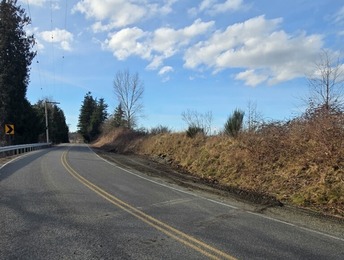
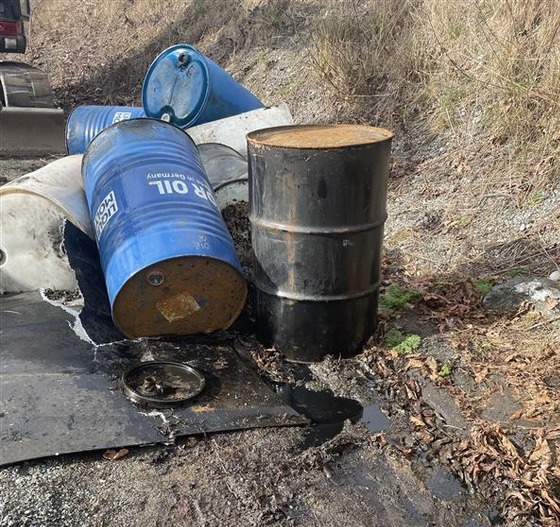 Thirteen 55-gallon barrels full of unknown material were dumped on Kelleher road this February.
Illegal dumping is more than just a roadside nuisance. It threatens public safety, uses up hours of County staff time, and can have a large price tag attached.
500-Gallon Ticking Time Bomb
Jason Quigley, Skagit County’s Stormwater Management Program Coordinator, already had a busy day ahead of him when he got an urgent call. That February morning, County Road Operations workers had found 13 large barrels full of potentially toxic material dumped illegally on the side of Kelleher Road—and some of the barrels were already leaking.
The 55-gallon barrels were all mostly full, some labeled “used oil,” and others filled with what seemed to be antifreeze and fuel. In total, Quigley estimates there were about 500 gallons of material in the barrels.
One of the steel barrels was punctured and had already spilled most of its material, which appeared to be used motor oil, onto the shoulder of the road. Two other barrels had their plugs knocked out and were leaking material, too. Roughly 20-30 gallons of material had already seeped into the soil.
Response
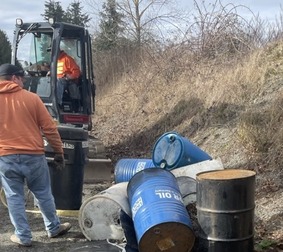
County employees across departments worked together to transport the heavy barrels to the Skagit County Transfer Station to protect public health and safety. At the Transfer Station, the unknown materials still needed to be sampled so they could be routed for proper disposal.
After removing the barrels, the team used a small excavator to scoop contaminated soil and gravel into a dump truck. They used shovels and brooms once most of the material was removed to make sure no hazardous residue was left behind. Quigley also took soil samples to be analyzed for a broad range of petroleum products to make certain the material had been fully removed from the County Right-Of-Way.
|
Time is Money
The monetary costs of illegal dumping come in the form of human resource time, heavy equipment use, sampling, and proper disposal of materials. The cleanup team included eight staff members. In addition to staff vehicles, the County also had to use two flatbed trailers, a small excavator, and a dump truck to clean up the site.
After this, the Hazardous Waste team at the Transfer Station had to spend several hours receiving, storing, and contracting to get the barrels pumped and cleaned.
All in all, the cleanup cost the County and its taxpayers several thousand dollars and many hours of hard work.
“We had to pay a pretty penny to get this all cleaned up,” said Quigley. “I’d rather spend that money helping a resident with a drainage issue or repairing a stormwater structure in need of maintenance. Plus, it took all those staff away from their regularly scheduled duties, delaying planned work.”
What You Can Do
The best way to reduce illegal dumping and its costs is to make sure you’re not doing it yourself. Spills, dumping, and pollution aren’t always intentional. You can stop accidental pollution by:
- Securing your load when transporting materials.
- Making sure chemicals and other hazardous waste are disposed of property at the Household Hazardous Waste Facility.
- Getting your vehicles checked for leaks.
- Making sure only clean, soap-free water goes down storm drains or into roadside ditches.
-Calling the Spill Hotline at 360-416-1400 to report spills or dumping.
|
|
|
|
The sun is out, the days are longer, and it’s a great time to check in on what’s happening in our local streams! April brought warmer and drier weather than normal. The Mount Vernon AgWeatherNet station recorded a maximum average temperature of 59.5°F, about 2 degrees warmer than the historical average of 57.3°F. Rainfall totaled just 1.9 inches, nearly an inch below the monthly norm. With most of the lowland streams being rain-fed systems, we’re seeing flows beginning to drop.
Routine water quality sampling this month revealed several bacteria hotspots in western Skagit County. In the Padilla Bay watershed, all the main waterbodies—Big Indian Slough, Little Indian Slough, middle and lower Joe Leary Slough, and No Name Slough—showed high bacteria levels. Other sites of concern included Edison Slough in the Samish Bay watershed and Big Ditch/Maddox Creek in the lower Skagit watershed.
Curious about the bacteria hotspots near you? Visit our Water Quality Map to explore the latest results!
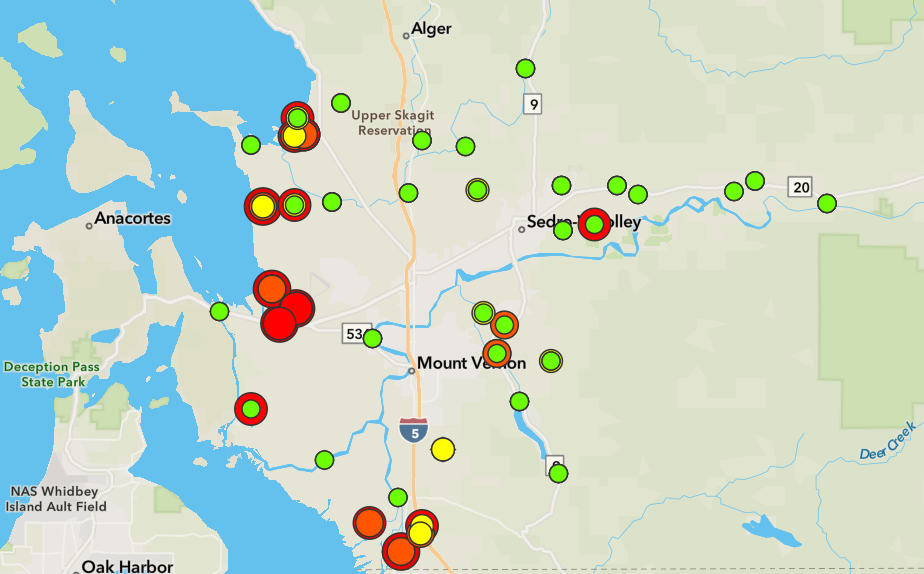 April water quality results. Red dots represent sites with high levels of fecal bacteria, yellow represents sites with moderate levels of fecal bacteria and green dots represent sites with low fecal bacteria levels. Click on the map to go to the online water quality map, where you can explore sites in Skagit, Whatcom and Snohomish Counties.
|
|
Home Tip of the Month
Taking the RV out this summer? Here’s what you need to know about emptying your gray water and black water tanks!
What are gray water and black water?
Other than the fresh water you’ll use for drinking and showering, most RVs have two water tanks: One for gray water and one black water.
The gray water tank holds wastewater from sinks and showers—dirty dishwater and bathwater.
The black water tank holds water and waste flushed down the toilet. Some RVs only have a black water tank. In these cases, shower and sink water go to the same tank as toilet water.
What do I do with gray water and black water?
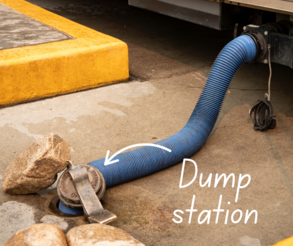
Although they are usually held in different tanks, gray water and black water should always be emptied in the same place: A designated dump station. Though some areas around the U.S. allow gray water to be dumped on the ground, it is illegal in Skagit County.
Most campsites have designated, well-marked dump stations, and there are others around the county as well.
The dumping process is easy, but there are some important steps to remember:
- Wear gloves.
- Make sure you have a sewer hose that can securely attach to your tank opening and that is long enough to reach the dump station.
- Use a hill or sewer hose support to make sure gravity is helping your waste flow out of your RV and into the dump station.
- Use a rock or something heavy to keep the hose in place.
- Dump black water first, then let the gray water rinse out the sewer hose.
- Close up your tanks completely when you’re done dumping.
- Clean out your sewer hose with a garden hose after dumping. Keep the end of the sewer hose in the dump station while cleaning it.
You should dump your black water tank when it’s about two-thirds full, which will be every 3 to 5 days depending on how many people are using the RV and how big the tank is.
Where can I dump in Skagit County?
There are several dump sites throughout Skagit County that are free or low cost for dumping. Free and by donation sites include:
A quick internet search of campgrounds in the area you plan to travel to can help you locate more dump sites.
It is important to note that free dump stations at campgrounds are typically intended for use by those camping there.
|
Can I dump at home?
The short answer is: Maybe.
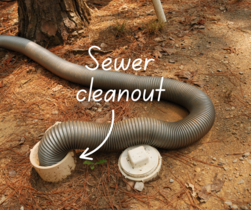
Some sewer districts allow you to dump your RV wastewater into your sewer cleanout if you have access to it. Make sure to call your jurisdiction’s sewage department to confirm whether or not this is legal in your area.
If you're on septic, connecting your RV to your system risks overloading it. Septic systems have a limited capacity and aren't built to handle a lot of material at once. Plus, common RV black water tank additives can harm your septic system and stop it from working properly. Unless you have a system specifically set up for connecting your RV, we'd highly recommend another method.
I can’t move my RV at home. What should I do?
If you can’t move your RV and can’t connect it at home, there are a variety of mobile services that can come to you to pump your RV.
|
|
|

Farm Tip of the Month
Manure on the mind? Here's how to spread the right way!
1) Determine your risk
It's not always the right time to spread manure. Depending on weather and soil conditions, the risk of losing your manure and polluting water sources might outweigh the benefits of spreading.
Luckily, there's a tool that can help you determine your risk! Check out Whatcom Conservation District's Application Risk Management worksheet!
The worksheet uses a variety of factors to help you figure out if now is the time to apply, or if you're at risk of wasting manure and polluting nearby water sources.
2) Test your soil and manure
Spreading manure in an area that is already oversaturated with nutrients is like hosing down a plant that's sitting in a foot of water. It creates waste and it sends all those excess nutrients spilling out into the environment. This leads to algal blooms in our local waters, harming wildlife AND our ability to swim, boat, and fish in the summer.
|
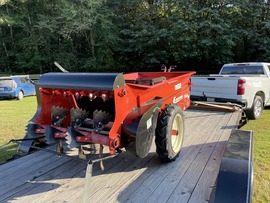
Manure spreader: This tool will help you distribute manure evenly across your field or pasture. When used properly and at the right time of year, it will provide nutrients to your soil without polluting nearby waterways.
Liquid Manure Injector: This 10-foot wide Aerway sub-surface liquid manure injector is designed to be used in tandem with a tanker truck for liquid manure. The tines in front of the splash plates allow for manure to be more quickly incorporated into the soil, which reduces the amount of nitrogen volatilization and increases efficiency when spreading.
Skagit Conservation District also has one time funding to pay a contractor to haul FREE aged dairy manure from farms to people in need of fertilizer. Delivery will be available on select dates through June 15th, 2025. Visit Skagit Conservation District's Manure Share page to apply to receive manure or to get on their list of manure providers.
4) Spread slow
A good way to make sure you soil is absorbing all the nutrients in your manure is to spread only 1/3 of your stockpile at a time.
Spreading more than that creates a high risk of manure (and the nutrients in it) getting washed away by rain or watering. You'll lose valuable manure and pollute nearby water sources. It's like taking vitamins— You wouldn't take the whole bottle at once!
|
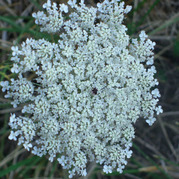
As far as we're concerned, lace is OUT! Queen Anne's lace, that is!
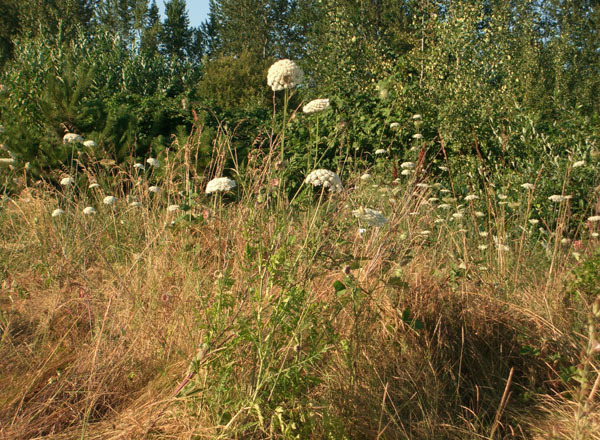
That's right, folks, Queen Anne's lace, also known as wild carrot, is a noxious weed on Washington's quarantine list. It's illegal to buy, sell, plant, and transport it in the state. This vicious vegetable outcompetes native plants, can be toxic to livestock, and can even taint milk if cows eat large amounts of it.
Queen Anne's lace also has some pretty nasty lookalikes you'll want to watch out for. Read on to learn more!
Toxicity: Queen Anne's lace can be toxic to livestock and pets. It can also cause irritation to people with sensitive skin.
Description: Queen Anne's lace is a flowering, upright plant that can grow from 1 to 4 feet tall after its first season, in which it stays as a low growing rosette.
Queen Anne's lace has hairy green stems with small grooves along them. Its leaves have a ferny, parsley-like look.
At the top of the stem, the plant has clusters of small white flowers that grow together in a dome or disk shape. At the center of the cluster is a small black or red dot. Before blooming, the buds are green, fuzzy, and curl inwards to create a cup shape.
Important note: Queen Anne's lace looks a lot like several other plants, including the extremely toxic poison hemlock. Both have similar leaves, flowers, and rosettes.
However, while Queen Anne's lace has a fuzzy green stem, poison hemlock's stem is hairless and has purple splotches. Poison hemlock is also missing the darker spot in the middle of the flower cluster.
For more details on a variety of lookalikes, check out this article from U.S. Fish & Wildlife Service.
Control: Before doing ANY control of Queen Anne's lace, make sure that you know for certain that it's not poison hemlock or another lookalike. As a precaution, and because it may irritate skin, you should wear gloves while working with this plant.
Queen Anne's lace can be pulled or mowed, especially in its first year when it's in its rosette stage.
For more information or for help identifying Queen Anne's lace or one of its lookalikes, please reach out to our Noxious Weed Coordinator, Evan Emrick, at (360) 707-1502 evane@co.skagit.wa.us.
Learn more about how to identify Queen Anne's lace from the Washington State Noxious Weed Control Board.
Photos courtesy of the Washington State Noxious Weed Control Board.
|
|
|
Program News
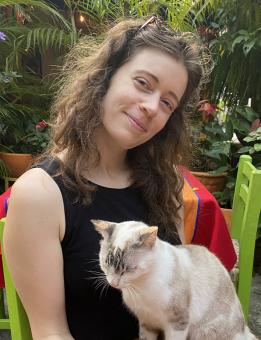
Meet Halee Sexton, our new intern!
We're excited to welcome Halee Sexton as our new intern here at Skagit County Natural Resources!
Halee grew up in the Edmonds area. While she has bounced around, she has always ended up coming home to the Pacific Northwest.
Her internship will take her out in the field doing restoration work, water quality testing, community outreach, and more!
Halee says she's "excited to become familiar with this area and the locals and to learn more about stormwater and water quality management!"
Halee worked in local government and ecotourism before taking off to Bocas del Toro, Panamá, to be a Sustainable Agriculture Systems Peace Corps volunteer. After that, she spent a few years working for the Department of Labor.
Halee is now reorienting her career back towards environmental work by pursuing a second degree in Environmental Science. Between classes she's been farming, landscaping, and now working with the Natural Resources Division!
Halee’s hobbies include looking at plants, cooking, sewing, and getting outside by hiking or biking! She lives with her cat, Astra.
|
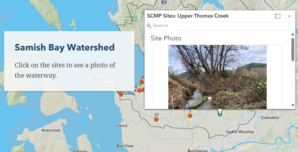
Check out the 2024 Water Quality StoryMap!
Skagit County’s 2024 Water Quality Monitoring Program Report is out—with a twist! This year it comes in another form, too—A StoryMap.
Skagit County Monitoring Program (SCMP) releases annual reports on the water quality data that the County has collected over the year, and what this data means for Skagit’s rivers, streams, and sloughs. Usually, these reports come as large written documents full of graphs, raw data, and science-heavy language. The StoryMap is a friendlier, more interactive way of learning about the health of our waterways.
Check out the StoryMap for a snapshot of water quality at each of our sample sites, or take a look at the report for a more in depth explanation of our work and results!
|
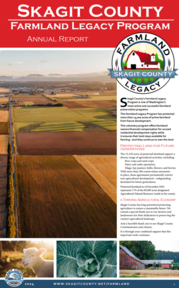
The 2024 Farmland Legacy Program Report is out now!
Skagit County’s Farmland Legacy Program 2024 Annual Report is IN!
The Farmland Legacy Program protected 460 acres of farmland in 2024, bringing the total acreage of protected farmland in Skagit County to 15,130 acres. Our Farmland Legacy Program is one of the most active and successful farmland preservation programs across Washington.
As Washington continues to lose farmland to development, the preservation of these precious acres is an important priority in Skagit County, which is why the Skagit County Commissioners established a goal of preserving 400 acres of farmland per year in the 2022 – 2032 Strategic Plan. Local farms are vital to our community and its economy. They provide access to fresh produce, support to local businesses, protection of open space and natural habitat for wildlife, and increased resilience to natural disasters!
Read more about the work the Farmland Legacy Program accomplished last year and the families that protected their farmland in 2024 in the Annual Report.
|
Classes and Events
Tangled Thicket Farm Tour, May 29, 5:20 PM to 7:30 PM: Come join Tangled Thicket Farm and Skagit Conservation District to explore this wonderful farm. The farm recently completed a working buffer along the waterway on the property through partnership with Skagit Conservation District and the Western SARE grant.
Managing Stormwater, May 31, 10 AM to 1 PM: Come to this free workshop put on by Skagit Conservation District for local contractors, business owners, and homeowners on ways to manage stormwater.
Discover Pass Free Days and Free Fishing Weekend, June 7 and 8, State Parks: For Free Fishing Weekend, visitors will not need a Discover Pass to park a vehicle at a Washington state park or on lands managed by the Washington State Department of Natural Resources (DNR) and the Washington Department of Fish and Wildlife (WDFW) on June 7th and 8th. Fishing licenses are also not required to fish for certain species in Washington on this weekend.
Fidalgo Bay Day, September 13, 2025, 11 AM to 3 PM: Join the Skagit Marine Resources Committee and friends for a FREE, fun, family outing at Fidalgo Bay Day! Similar to previous years, event activities will likely include: a beach seining demonstration, a touch tank aquarium, kid friendly craft activities, face painting, interactive discovery passport stations with prizes, complimentary samples of seafood, and a traditional Coast Salish no-host Salmon BBQ lunch.
Volunteer Opportunities
Restoration work with Skagit Land Trust, May 17th and June 2nd & 27th: Help our friends at Skagit Land Trust restore our environment through plantings and invasive species removal!
Volunteer Work Party at Bonnie Rae Park, May 17th, 9 AM to 12 PM: Help City of Mount Vernon transform the garden beds at Bonnie Rae Park into beautiful, thriving spaces for environmental learning! Volunteers will be removing invasive plants and planting native species to support local ecosystems around the buildings being developed into classrooms.
Conservation field trips with Skagit Land Trust, May 22nd and June 2nd & 3rd: Skagit Land Trust is seeking a few enthusiastic environmental educators and volunteers to support kids in some fun outdoor learning experiences at our Utopia Conservation Area this May and June! Their education team will be hosting nine student field trips for second graders from Sedro-Woolley schools and one Mount Vernon School.
|
|
Contact Us
For questions or more details, please contact Karen DuBose at kdubose@co.skagit.wa.us or 360-416-1460.
This project has been funded wholly or in part by the United States Environmental Protection Agency under assistance agreement PC01J18001-0 to the Washington Department of Health. The contents of this document do not necessarily reflect the views and policies of the Environmental Protection Agency, nor does mention of trade names or commercial products constitute endorsement or recommendation for use.
|
|
|
|
|