|
Photo of the Month


It's tulip season! For some people this means pretty flowers and a great photo op, for others it means traffic, tourists, and maybe even TURDS!
Here in the Natural Resources Division, we love the tulips. We also love the number of people who come to see them... when they plan their visit well.
Year after year, many visitors leave something crucial out of their trip planning: bathroom breaks! The result? Travelers stuck in traffic with nowhere else to "go" but farmers' fields. Some farmers have even complained of finding dirty diapers thrown onto their property. This is no fun for farmers, many of whom grow food crops that should NOT come into contact with human waste. Unplanned poop also gets into nearby waterways, turning our seasonal festival into a pollution palooza.
Here are a few tips to enjoy the tulip fields responsibly if you go out to the valley this year.
-
Don't underestimate the traffic. With so many people coming from all over to see Skagit's beautiful flowers, it's not unlikely that you'll get stuck in several hours' traffic with no public restrooms nearby.
-
Plan stops. There are several public restrooms in the towns along the Skagit Valley, plus many businesses that would be happy to offer restrooms to customers. There are a few porta-potties in the valley, but you won't necessarily be close to any when you're stuck in traffic, so plan to find a bathroom before you drive out of the cities.
- Plan for the worst. Even if you do everything right, you might still end up needing to "go" in the middle of nowhere— especially if you have younger travelers with you. Bring a few sturdy plastic bags with you to scoop up poop (and toilet paper) like you would do for dog poop. Tie the bag off and bring it with you until you can throw it away in the trash. If you have babies or young children, bring a bag big enough to put dirty diapers in.
We love our tulip fields and want everyone to enjoy them, but we also love our clean, farm-grown produce and our clean water. With just a little bit of planning, we can have it all!
|
|
|
|
April Fools’ Day may be all about pranks, but water quality is no joke! Clean water is essential for healthy communities, thriving ecosystems, and safe recreation, so keeping an eye on bacteria levels is serious business. Our routine sampling in March showed bacteria hotspots at Big Ditch/Maddox Creek, Sullivan Slough, Wiley Slough, and Joe Leary Slough. Late March brought multiple storms. During one of them we conducted a special storm sampling event in the Samish watershed. Heavy rains wash accumulated bacteria and other pollutants from the landscape into our waterways, so these targeted sampling events help us understand where pollution is coming from.
The storm sampling revealed additional hotspots at Butler Camp Creek, lower Thomas Creek, and the South Edison Drainage. A huge shoutout to our partners at the Samish Indian Nation and the volunteer Storm Team! With their help, we were able to collect even more data during this event. This information is crucial for tracking bacteria sources and improving water quality.
In March, the Mount Vernon AgWeatherNet station recorded 4.1 inches of rain—about 1.0 inch above the historical average. Temperatures were near normal, with an average high of 53.0°F, compared to the historical average of 52.4°F.
Curious about bacteria conditions near you? Check out our Water Quality Map for the latest updates!
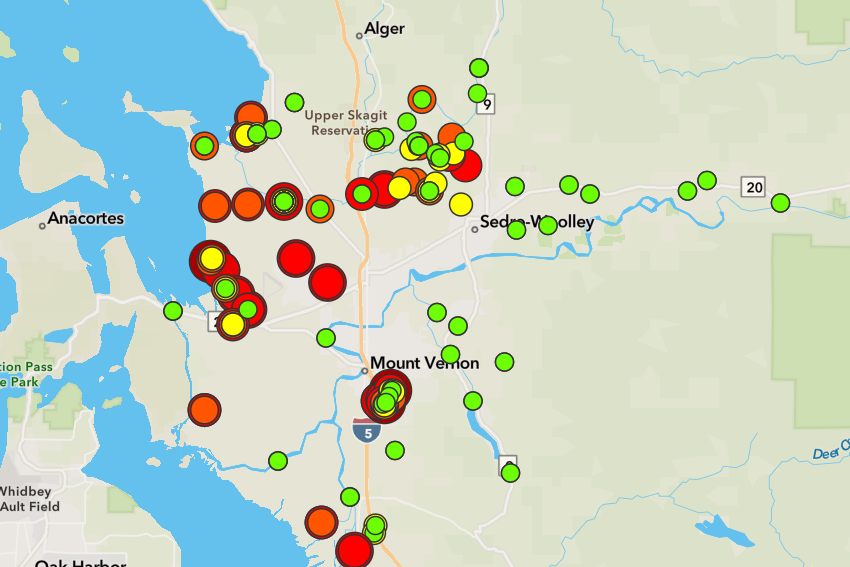 March water quality results. Red dots represent sites with high levels of fecal bacteria, yellow represents sites with moderate levels of fecal bacteria and green dots represent sites with low fecal bacteria levels. Click on the map to go to the online water quality map, where you can explore sites in Skagit, Whatcom and Snohomish Counties.
|
|
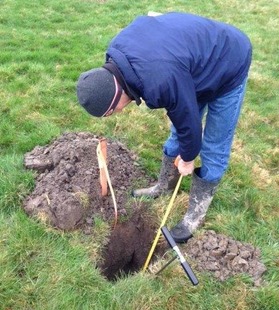
Spring cleaning? Cross your septic inspection off your checklist to stop one mess before it starts!
Why is getting your septic system inspected so important?
Septic inspections help you find out if there's something going wrong with your septic system before your system fails. A failed septic system means cleanup, inconvenience, and expensive repairs, or even full system replacement. Smaller, less expensive repairs will keep your system going longer and will save you money and time.
When should I get my system inspected?
If your system has any pumps or moving parts, you should get it inspected every year. If it's a gravity system, meaning it has no automated parts and is powered by gravity alone, once every three years is fine.
If you’re having any issues with your system, it’s a good time to get an inspection. Here are some things to look out for that might indicate problems with your system:
- Slow draining toilets and drains.
- Toilets and drains backing up.
- Smell of sewage, especially around your septic tank or drain field.
- Foul smelling puddles or saturated ground on or around your drain field.
How do I get my system inspected?
There are two ways to get a septic inspection. You can hire a certified inspector to do it, or, if you have a gravity system, you can do it yourself after taking a couple of online courses. You can find a list of certified inspectors in Skagit County and information on our classes for do-it-yourself inspections on the Skagit County septic page. Even if your system has moving parts and you can't self-inspect, the online courses are still a great way to learn more about your system.
While funds last, you can also apply for Skagit County's septic rebate program, where you could get up to $200 towards an inspection, risers, or pumping. Learn more on the Skagit County septic page.
How can I take care of my system between inspections?
Here are a few things you can do to protect your system and prolong its life:
- Flush only pee, poop, and toilet paper — Never flush wipes, even if they are labeled as being flushable.
- Stagger showers, dishwashing, and laundry machine cycles — Too much water all at once can overload your system.
- Don’t send any harsh chemicals down your drain — They will kill the bacteria that make your system work. Despite the marketing, septic additives don't help your system and may actually harm it.
- Keep fats, oils, and greases out of your drains — Even if they’re liquid when they go down, they can harden in your pipes and clog your system.
- Protect your drain field and tank — Never drive over your system, keep large animals and digging dogs away, and only plant grasses and shallow rooting flowers over and around your system.
|
|
|
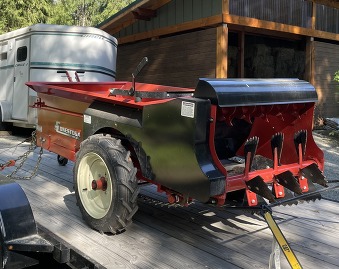
Farm Tip of the Month
Did you know? Skagit Conservation District has the tools to help you with all kinds of projects around the farm this spring!
The Conservation District's Equipment Share offers a manure spreader, manure injector, cone spreader, no till drill, weed wrench and MORE for rent to local producers.
These tools will help your operation and the land surrounding you. Here's a little more about each of their tools:
Manure spreader: This tool will help you distribute manure evenly across your field or pasture. When used properly and at the right time of year, it will provide nutrients to your soil without polluting nearby waterways.
Liquid Manure Injector: This 10-foot wide Aerway sub-surface liquid manure injector is designed to be used in tandem with a tanker truck for liquid manure. The tines in front of the splash plates allow for manure to be more quickly incorporated into the soil, which reduces the amount of nitrogen volatilization and increases efficiency when spreading.
Cone spreader: You can attach the cone spreader to almost any vehicle to spread seeds, fertilizer, sand, and salt. This is an easy way to seed an empty field with cover crops in between growing seasons.
No till drill: The no till drill spreads seeds without — you guessed it — tilling your soil. This has lots of benefits for the health of your fields and our local waterways. Leaving the soil untilled means more beneficial organic matter. It also reduces erosion, which means you'll lose less of your soil and nutrients to your nearby stream or ditch!
Weed wrench: The weed wrench does exactly what it sounds like! It helps you pull stubborn weeds out of the ground. This keeps harmful weeds out of your field and stops them from spreading to the rest of the County.
Planting Tools: Skagit Conservation District has a variety of planting tools available at no cost to Skagit residents!
Soil Probe: Skagit Conservation District has a soil probe with foot hold available at no cost to Skagit residents!
But wait, there's more! Skagit Conservation District has one time funding through the Washington State Conservation Commission's Sustainable Farms and Fields to pay a contractor to haul FREE aged dairy manure from farms to people in need of fertilizer. Delivery will be available on select dates between April 1st to June 15th, 2025. Visit Skagit Conservation District's Manure Share Page to apply!
|

Hunting for eggs this spring? Keep your eyes out for this "egg"... and get rid of it!
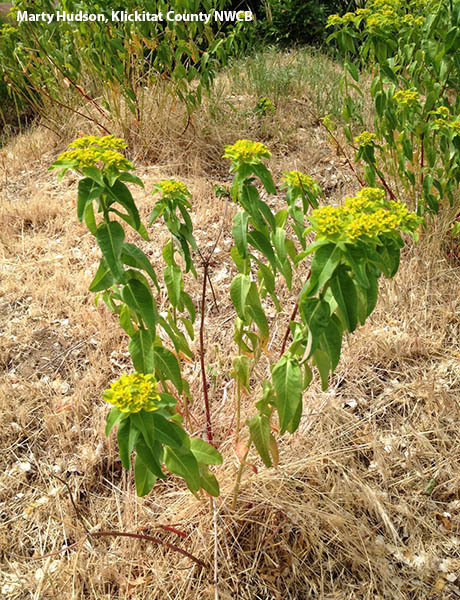
Eggleaf spurge, our noxious weed of the month, may be hiding out among your ornamental plants. Toxic to humans, pets, and farm animals, and harmful to the environment, this invasive plant has cracked up to be a BIG problem in Washington. In fact, it's on Washington State's quarantine list, meaning it's illegal to buy, sell, and plant.
Here's how to spot eggleaf spurge and protect your garden beds from it.:
Description: Eggleaf spurge grows on stalks that grow about three feet tall and branch at the top. Its stem is covered in small white hairs.
Leaves are green, hairless, about 2.6 inches long, and grow directly out of the stem in alternating directions. Leaves are narrow and ovular with slightly pointed tips, very finely serrated edges, and a bold, lighter colored vein running down the middle.
Flowers grow at the branched top of the stalk. The flowers are small and yellow. They are surrounded by small, yellow-green leaves. These flowers grow round green seed capsules from their centers.
Toxicity: Eggleaf spurge is toxic to humans, dogs and cats, and farm animals. Its sap can also irritate the skin, so be sure to wear gloves when handling it.
Control: Eggleaf spurge has a very long taproot, so it has to be dug up to be effectively removed. Unfortunately, mowing and cutting may only lead to more shoots.
If you'd like more tips on controlling eggleaf spurge, please reach out to our Noxious Weed Coordinator, Evan Emrick, at (360) 707-1502 evane@co.skagit.wa.us to discuss control options and support.
Learn more about how to identify eggleaf spurge from the Washington State Noxious Weed Control Board.
Photos by San Juan County Noxious Weed Board and Marty Hudson of Klickitat County Noxious Weed Control Board, courtesy of the Washington State Noxious Weed Control Board.
|
 |
|
|

We're thrilled to welcome the wonderful Taylor Scott to our team as our new Voluntary Stewardship Program Coordinator!
Taylor started as our Voluntary Stewardship Program (VSP) Coordinator in February. Although she’s new on our team, we’ve had the privilege of working with her many times when she was at Skagit Conservation District.
As VSP Coordinator, Taylor will work with agricultural landowners and other partners on projects to benefit farmers and our natural resources.
"I’m excited to work with our local farmers, Watershed Advisory Group volunteers, and various organizations to implement great projects," says Taylor.
After completing her biology degree at Washington State University, Taylor joined an Americorps trail crew. She continued working outside and planting trees with the Skagit River System Cooperative.
Taylor moved on to Skagit Conservation District where she helped with landowner outreach, restoration projects, and monitoring for the past 3 years before joining our team.
In her free time, Taylor is either jam packing her weekends with hikes, hangouts, and house projects, or watching Netflix and crocheting with her cats, Mr. Boy and Kitty Girl.
|
Classes and Events
"Dam It — Beavers in Washington State" with Shawn Behling, April 22nd, 6 PM to 7:30 PM, online: For Earth Day, join Skagit Land Trust and guest Shawn Behling to learn about the history, biology, and management of beavers in our state.
Discover Pass Free Day, April 22nd, State Parks: To celebrate Earth Day, visitors will not need a Discover Pass to park a vehicle at a Washington state park or on lands managed by the Washington State Department of Natural Resources (DNR) and the Washington Department of Fish and Wildlife (WDFW) on April 22nd.
Backyard Conservation Program classes and field trips, Wednesdays 5:30 PM to 8 PM through April 23rd and Saturday field trips through April 26th: Skagit Conservation District's Backyard Conservation series is a FREE 6-week evening class series (plus weekend field trips) offered every spring that teaches participants the principles of how to create beautiful landscapes that benefit humans, animals, and the environment in your own backyard.
Shore Friendly Beach Walk on Samish Island, April 30th, 3 PM to 5 PM: The Shore Friendly program of the Northwest Straits Foundation and coastal professionals from Natural Systems Design and Coastal Geologic Services are hosting a FREE guided beach walk for community residents located on the north shore of Samish Island. Hear from guest speaker Jim Johannessen, MS and Licensed Engineering Geologist.
Hiking Close to Home with Jack Hartt, May 14th, 6 PM to 7:30 PM: Skagit Land Trust member, volunteer, and local hiking expert Jack Hartt will introduce some fun hikes on Skagit Land Trust properties and beyond.
Planting for Pollinators with Padilla Bay Foundation, May 17th, 10 AM to 12 PM: Learn to easily maximize your gardening lifestyle and harvests by developing a gorgeous garden full of PNW indigenous plants that pollinators adore. Includes a 50-minute seminar, a Q&A session, and a guided native plant tour on the upland trail.
Volunteer Opportunities
Padilla Bay Reserve Work Parties, April 12th, 10 AM to 1 PM: These volunteer events are a great way to meet new people, learn a new skill, and get outside. Work parties will generally focus on planting native plants and removing invasive species.
Earth Day 2025 Work PARTY! April 26th, 10 AM to 1 PM, Edgewater Park, Mount Vernon: Join Skagit Fisheries and Mount Vernon Parks and Enrichment Services for a fun and meaningful Earth Day Celebration at Edgewater Park! Hosted in partnership with Mount Vernon Parks and Recreation and the Skagit Fisheries Enhancement Group, this event is all about giving back to nature and connecting with our local environment. RSVP required.
Restoration work with Skagit Land Trust, May 2nd and May 17th: Help our friends at Skagit Land Trust restore our environment through plantings and invasive species removal!
Conservation field trips with Skagit Land Trust, May 1st, 2nd, 5th, 8th, 9th, and 22nd, and June 2nd and 3rd: Skagit Land Trust is seeking a few enthusiastic environmental educators and volunteers to support kids in some fun outdoor learning experiences at our Utopia Conservation Area this May and June! Their education team will be hosting nine student field trips for second graders from Sedro-Woolley schools and one Mount Vernon School.
|
|
Contact Us
For questions or more details, please contact Karen DuBose at kdubose@co.skagit.wa.us or 360-416-1460.
This project has been funded wholly or in part by the United States Environmental Protection Agency under assistance agreement PC01J18001-0 to the Washington Department of Health. The contents of this document do not necessarily reflect the views and policies of the Environmental Protection Agency, nor does mention of trade names or commercial products constitute endorsement or recommendation for use.
|
|
|
|
|