|
Photo of the Month
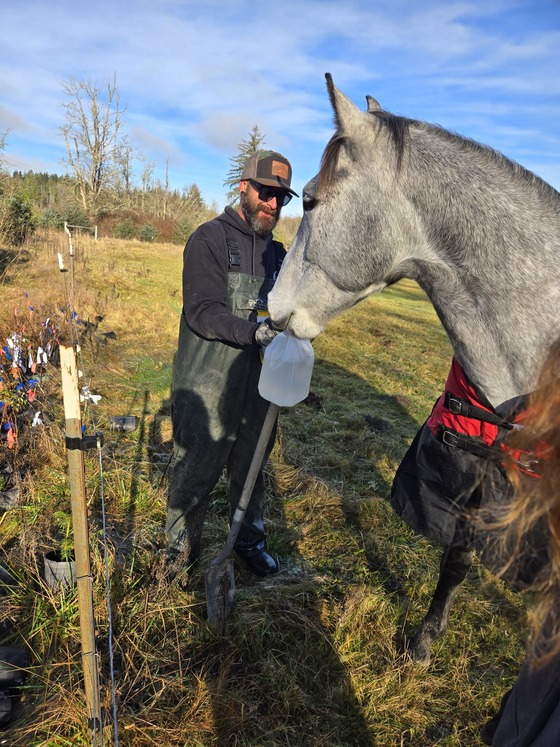 Our new friend giving Ken Wheeler's water jug a nibble. // Photo by CJ Jones

Howdy, partners! This week, a very curious horse (affectionately nicknamed Chewey by our team), came to "help" us with a planting project by Walker Creek. Our new pal was particularly interested in maintenance technician Ken Wheeler and tried to take a bite out of his water jug.
The planting that this friendly horse joined us for was part of a project that the Department of Ecology originally funded in 2014. The project included installation of large woody debris in Walker Creek and plantings along the bank to reduce erosion and improve habitat. Our team also put up fencing to keep the horses away from the water, keeping the banks intact and the stream cleaner.
Last year, the County reached out to the new property owners who let us know that some of the original trees hadn't survived, and that parts of the bank were still eroding. So, we got back to work!
With funding from our Voluntary Stewardship Program, we added more logs for large woody debris and moved part of the fence back to protect the bank from more damage. Now, we're replanting in the areas where our first plants didn't make it.
Projects like this don't only protect fish and wildlife, but also protect people's land. This work will help preserve pasture area from the creek as its banks erode, maintaining property value and usability. You can see where we've done similar restoration projects across the County on our online Restoration Projects Map!
Do you have a property that could benefit from restoration work or a structural implement like fencing along waterways, a manure bin, or a heavy use area? We may be able to connect you with funding! Contact Karen DuBose at kdubose@co.skagit.wa.us or 360-416-1460 to learn more.
|
|
|
|
The holiday season is upon us, bringing chilly days, festive lights, and plenty of rain! In November, the Mount Vernon AgWeatherNet station recorded 4.85 inches of rain, slightly above the average of 4.61 inches. Temperatures were close to normal, with an average high of 50.8°F— just 0.2°F warmer than usual.
With these wet conditions, we’ve also seen their impact on our waterways. The waterways with the highest bacteria levels in November were the North Edison Drainage, No Name Slough, Little Indian Slough, upper Carpenter Creek, and Wiley Slough. Wet conditions often lead to pollutants like bacteria and nutrients running off into our waterways. This is why in addition to our normal, bi-weekly sampling of sites, we also collect storm samples in problem areas to try and understand and locate the peak pollutant levels.
You can help protect our waterways by picking up pet waste, maintaining septic systems, and avoiding fertilizer use during rainy periods. Every small action makes a big difference!
Check out our Water Quality Map for more frequent updates on our water quality. Festive color coding with red and green circles included!
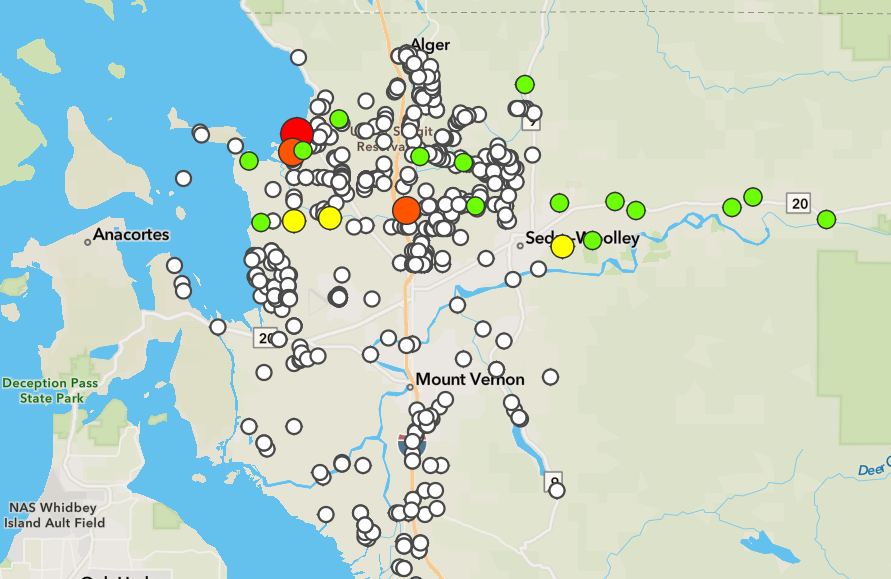 November's water quality results. Red dots represent sites with high levels of fecal bacteria, yellow represents sites with moderate levels of fecal bacteria and green dots represent sites with low fecal bacteria levels. Click on the map to go to the online water quality map, where you can explore sites in Skagit, Whatcom and Snohomish Counties.
|
|
Home Tip of the Month
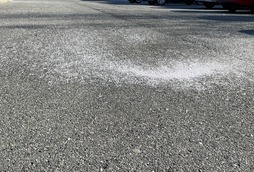
Winter is kicking in, and it's time to start getting ready for cold weather! However, that doesn't just mean dumping salt on roads, driveways and sidewalks (we do NOT want to see something like the photo on the left in front of your house or business!).
Deicing products like road salt get washed into our waterways, where they can harm salmon and other wildlife. These products can also damage plants and lawns and irritate dogs' paws. Here are some tips for using deicing products this winter:
 Keep in mind that frosty mornings don't necessarily mean icy roads and walkways. Make sure you NEED deicer before you use it. Keep in mind that frosty mornings don't necessarily mean icy roads and walkways. Make sure you NEED deicer before you use it.
Take a look at the instructions on the bag when using deicer. Don't use any more than is suggested. Typically, you can cover about 10 sidewalk squares with a coffee mug worth of salt (12 oz).
Spread your salt evenly. Avoid leaving big patches, like in the picture here!
If the cold snap is over and your salt is still on the ground, or if you used a bit too much, sweep it up. Make sure that extra deicer ends up in the trash, not our water!
The best advice for those who use salt is read the instructions and use the smallest amount necessary to melt the snow. There's a difference between salts, though. Here are the options, from best to worst:
- Calcium chloride (CaCl): Only a small amount is necessary to effectively melt snow.
- Potassium chloride (KCl): You might need a little more than if you used calcium chloride, but this one is still a good option.
- Sodium chloride (NaCl, or rock salt): Please use as little as possible - the sodium in the runoff turns freshwater into salt water and can kill fish.
- Always avoid deicers containing magnesium or ammonia, as they will deteriorate your concrete. Ammonia is toxic to aquatic life.
|
|
|
Farm Tip of the Month
The cold season is here, which means it's pasture protection time!
If your animals are still in the field, now is the time to take them off and move them to a heavy use area. This will keep their hooves dry and safe from rot. It will also protect your grass from hooves and overgrazing!
Churned up grass and mud in the winter will mean bare patches in the spring. This means less forage and opens doors for all kinds of weeds— some of which may be toxic to your livestock.
Even if your fields seem dry enough to have animals on them, your grass is at a particularly vulnerable point. Grazing right now could cause seriously stunted growth in the spring.
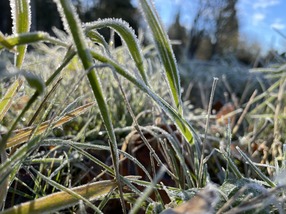
Grass goes dormant in the winter. It stops growing and stores its energy in the bottom 4 inches of the stalk. If this part of the plant gets eaten, the grass won't have the energy to grow as well when spring comes.
Move into pasture protection mode now to make sure your fields bounce back in the growing season!
|
|
|
Here are some facts of varying degrees of fun about myrtle spurge (AKA donkey tail spurge or creeping spurge), our noxious weed of the month:
Fun fact! Myrtle spurge is in the family Euphorbiaceae, the same family as poinsettias!
Less fun fact! Myrtle spurge escapes pots and gardens and can quickly crowd out native plants.
Least fun fact! Myrtle spurge has toxic sap that can cause vomiting when ingested, blindness when it gets in your eyes, and blisters when it touches your skin.
Now that you know the basics, here's how to identify and control this poisonous invader.
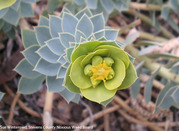
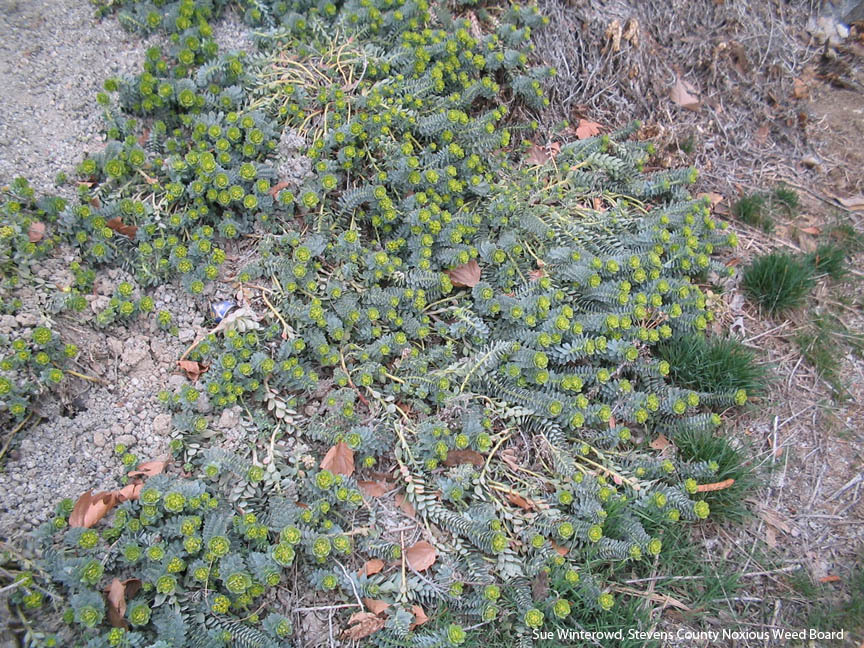
Description: Myrtle spurge has fleshy leaves that grow in tight spirals. It grows on fleshy, low growing stems, which the leaves grow directly out of. Lower leaves are a very pale blue-green, while the leaves at the very end of the trailing stems are yellow and much brighter. These end leaves are a 'bract' that surround a flat yellow flower. The flower can fling seeds up to 15 feet away from the plant.
Toxicity: As we learned in our "fun" facts, myrtle spurge is toxic to humans. According to the Washington State Noxious Weed Control Board, "its caustic, latex sap... causes nausea, vomiting and diarrhea when ingested. The sap can cause blindness if it gets in people's eyes. Skin contact with sap causes redness, swelling and blisters." It is also toxic to dogs, cats, and cattle.
Control: Myrtle spurge can be pulled by hand. Make sure to pull all roots, and to take care that the sap doesn't touch your skin or eyes. Because it can fling its seeds to reproduce, it's important to control myrtle spurge before it goes to seed.
If you are experiencing a larger infestation or struggling to remove myrtle spurge from your property, please reach out to our Noxious Weed Coordinator, Madelyn Loy, at (360) 416-1467 or mloy@co.skagit.wa.us to discuss control options and support. However, please note that Madelyn will be leaving her position with the County at the end of December to work with the Washinton State Department of Fish and Wildlife. Congratulations, Madelyn!
Learn more about how to identify myrtle spurge from the Washington State Noxious Weed Control Board.
Photos by Sue Winterowd, Stevens County Noxious Weed Board, courtesy of the Washington State Noxious Weed Control Board.
|
Program News
We have two jobs and one paid internship open at Skagit County Natural Resources Division! Think you or someone you know would be a good fit for our team? Apply today!
Voluntary Stewardship Coordinator: Work with local organizations such as Skagit Conservation District, Western Washington Agricultural Association, Skagit Watershed Council to help connect agricultural landowners to funding for projects that will improve habitat.
Noxious Weed Coordinator: Support landowners in Skagit County in identifying weeds and creating weed management plans for their lands. Work with noxious weed technicians on weed surveying and control around the County.
Natural Resources Intern: Help support various programs within the Natural Resources Division! This position includes field and restoration work, office work, outreach, and more!
Classes and Events
Children's Library Salmon Release, December 9, 12pm to 1pm: Join Skagit Fisheries in releasing coho fry into their natal watershed at Northern State Recreation Area, at 25625 Helmick Rd in Sedro-Woolley.
Skagit Conservation District Native Plant Sale: Skagit Conservation District's Annual Native Plant Sale is about to start. Pre-orders on a huge array of native plants begin January 2nd.
Country Living Expo, January 25, 9am, Stanwood High School: Get your tickets for WSU's annual Country Living Expo today and choose from a HUGE variety of farming and homesteading classes taught by experienced instructors. From classes on cheesemaking to wool processing, raising animals to foraging, farm maintenance to building, there is truly something for everyone at the Country Living Expo. Get your tickets today!
North Sound Riparian Conference, January 29, 9am: Online conference bringing together riparian restoration practitioners to share strategies and results.
Friends of the Salish Sea winter lecture series: Want to learn about underwater adventures, volcanoes, octopuses, and whales? Check out Friends of the Salish Sea's winter lecture series, which runs through March!
Volunteer Opportunities
Volunteer with Skagit Land Trust: Help our friends at Skagit Land Trust restore our environment through plantings and invasive species removal! See their volunteer event calendar for more details.
|
|
Contact Us
For questions or more details, please contact Karen DuBose at kdubose@co.skagit.wa.us or 360-416-1460.
This project has been funded wholly or in part by the United States Environmental Protection Agency under assistance agreement PC01J18001-0 to the Washington Department of Health. The contents of this document do not necessarily reflect the views and policies of the Environmental Protection Agency, nor does mention of trade names or commercial products constitute endorsement or recommendation for use.
|
|
|
|
|