|
Photo of the Month

Daikon, resident cat at the Mount Vernon Country Store, got a little tired of listening to us talk about dog poop, but it's an important topic!
Daikon visited our table there during the store's Petapalooza event. We were there handing out free supplies for dog owners— cute stickers, rolls of doggie bags, clip on bag holders, and our favorite, leash attachments that let you carry used poop bags hands-free!
Scooping dog poop is important, no matter where you are. In your yard, on trails, and even off the beaten path, scooping poop keeps people, dogs, and wildlife from getting sick. It also keeps poop, bacteria, and parasites out of our water.
Dog poop is full of bacteria that can survive for a long time in the environment. Even when it looks like the poop has broken down and "disappeared," the bacteria is there and still harmful. The bacteria that isn't left behind in your yard or along trails ends up in our water. Yuck!
After listening to us tell this to everyone we talked to, Daikon only had one thing to say...
"Scoop it, bag it, and trash it every time!"
|
|
|
Fall has arrived, bringing pumpkins, colorful leaves, and, of course, rain! We’ve certainly felt the seasonal shift this month with cooler, wetter weather. The Mount Vernon AgWeatherNet station recorded 2.25 inches of rain - about 0.54 inches more than normal. Most of that rain fell during one heavy storm on September 25th. Temperatures have also been cooler than normal, with a maximum average of 66.8°F, which is 1.6°F below the average.
While most of our monitoring sites showed low to moderate bacteria levels, a few areas had higher concentrations. These hotspots included Upper and Lower Hansen Creek, Upper Thomas Creek, and the North Edison Drainage.
This fall, you can help protect our waterways by picking up pet waste, disposing of trash properly, and avoiding the use of fertilizers before rainfall. These simple steps go a long way in reducing bacteria pollution, lowering nutrients input, and keeping our water clean!
For more updates, visit our Water Quality Map to stay informed about bacteria levels across Skagit County!
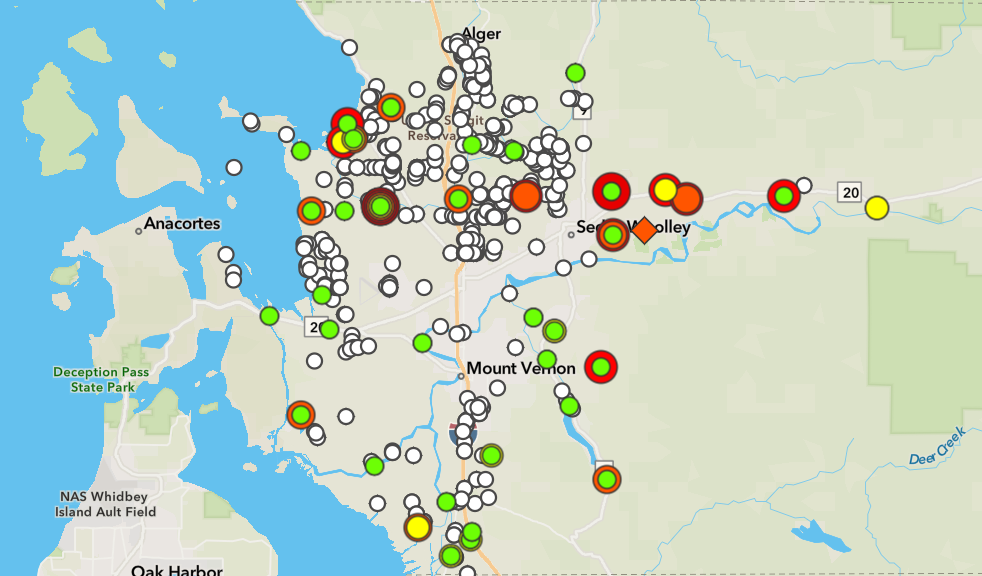 September's water quality results. Red dots represent sites with high levels of fecal bacteria, yellow represents sites with moderate levels of fecal bacteria and green dots represent sites with low fecal bacteria levels. Click on the map to go to the online water quality map, where you can explore sites in Skagit, Whatcom and Snohomish Counties.
|
|
Home Tip of the Month
Did you know that HOA's, neighborhoods, homeowners, and businesses are responsible, in most cases, for maintaining their own stormwater facilities? In fact, if a facility you're responsible for fails, you might have to pay for any damage caused by overflowing or misdirected water.
Luckily, there are many online resources to help you determine what you might be responsible for and how to maintain it.
How do I know if I'm responsible for any stormwater infrastructure?
The short answer is: If the facility is on your property and not in the right-of-way, you are probably responsible for it. If it captures runoff from a group of properties but not the right-of-way, your group of property owners is probably responsible for it. You can check your property plat, which you likely received when you purchased your property, or the "Covenants, Conditions, and Restrictions” of your subdivision for any facilities on your property. If you are in an HOA, your HOA leadership should have access to information on any stormwater facilities your association is responsible for.
Learn more about identifying your facilities here: Managing Stormwater for Private Property Owners and HOAs
What might I be responsible for?
On residential properties and in neighborhoods, stormwater or retention ponds are common facilities. Businesses are often also responsible for storm drains and catch basins.
Check out this webpage for a list and pictures of different stormwater facilities: Facilities | Stormwater Partners
How do I maintain my facilities?
Maintenance needs depend on the facility. You can usually do a lot of the maintenance yourself. For example, stormwater pond banks need to be mowed and vegetation kept to 3-4 inches in height. Inlet and outlet pipes need to be clear of blockages. Storm drain grates need to be kept clear of trash and debris, and catch basins need sediment removed, which can sometimes be done with a shovel. For some maintenance work, you may need to hire a professional. You should always hire a qualified professional if entering an enclosed space is required.
Check out City of Bellingham's video series of stormwater infrastructure maintenance to learn more on caring for your facilities: Maintaining Stormwater Drains and Facilities
If you're having trouble identifying or maintaining stormwater infrastructure on your property, reach out to your city or county stormwater program.
|
|
|
Farm Tip of the Month
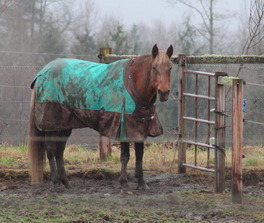
Did you know that 748 gallons of water runs off of an average-sized, 30x40 foot barn during a one-inch rainstorm? That makes for a LOT of mud around your barn!
Gutters and downspouts allow you to catch that runoff and channel it somewhere away from your animals and your manure storage area. That keeps clean water clean, but it's also good for animal health. Animals that stand in mud and water can pick up hoof problems, resulting in more visits with the vet.
Can you harvest that rainwater to use on your farm? Yes! More and more farm owners are looking for ways to capture rainfall for irrigation, watering of animals, and lightening the load on private wells. If you're interested in rainwater harvesting on your farm, there are a wealth of resources available online. If you prefer the personal touch, the friendly farm planners at the Skagit Conservation District can help you map out a plan and offer great tips from other projects they've seen.
|
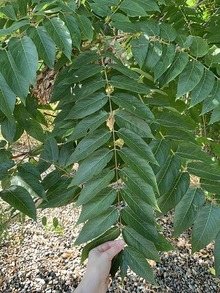
If tree-of-heaven wore a Halloween costume, it would be a halo and a pair of angel wings to disguise its true nature. This invasive tree comes with a host of not-so-heavenly features, including chemicals that kill native plants, bark that causes rashes and irritation, and another invasive species— the spotted lanternfly.
Tree-of-heaven affect plants around it in several ways. It grows in thickets that shade out and outcompete native plants. It also releases allelochemicals, toxins that can harm other plants, into the soil. Finally, it is a preferred home for the spotted lanternfly. This invasive pest, which is becoming a big problem on the East Coast, can affect crops and habitat.
Description:
Tree-of-heaven is a tree that can grow up to 60 feet tall. Its leaves are green and compound, meaning they are made up of many smaller leaves that grow across from each other on the stem. Young stems are smooth and greenish to brown, while older stems are gray and rougher. Its small flowers are yellow or green and grow in clusters at the end of stems. Male flowers are larger than female flowers. Seed pods are very flat, with one seed enclosed in the middle. They can be green, yellow, or reddish. Besides its seeds, the plant reproduces via its roots or cut branches.
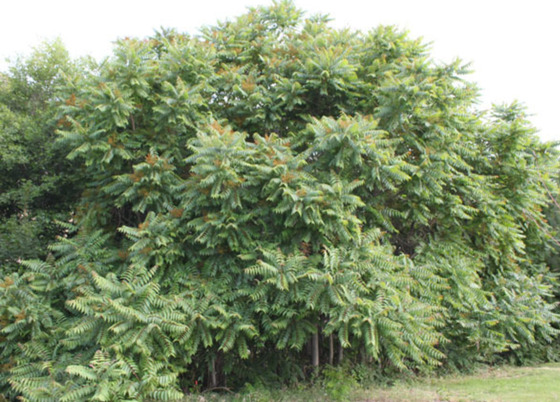
Tree-of-heaven has several native lookalikes, including sumac and black walnut. Unlike all these plants, tree-of-heaven has smooth leaf edges. It also has a distinct popcorn or peanut butter smell.
Toxicity:
Tree-of-heaven can irritate the skin and cause rashes.
Control:
Tree-of-heaven is best controlled when it is younger, as seedlings can be pulled out, roots and all. Stumps, branches, and roots left behind can resprout. Plant parts should be bagged and disposed of in the garbage.
If you'd like more tips on controlling tree-of-heaven please reach out to our Noxious Weed Coordinator, Madelyn Loy, at (360) 416-1467 or mloy@co.skagit.wa.us to discuss control options and support.
Learn more about how to identify tree of heaven from the Washington State Noxious Weed Control Board.
Photos courtesy of the Washington State Noxious Weed Control Board.
|
|
|

Program News
As you may have guessed from our photo of the month, we've been doing lots of tabling! Most recently, we set up at Taylor Shellfish Farms for Festival of Family Farms. We talked to lots of people about the importance of scooping poop, and nearly 40 people took a pledge to scoop every time!
We also had a table at Double O Ranch, where we had examples of water samples taken from different locations to show the difference in the water quality!
|
Classes and Events
Salmon Sightings with Skagit Fisheries Enhancement Group: Visit local streams and rivers with Skagit Fisheries Enhancement Group's salmon experts to see these iconic fish on their great journey. Check out their event calendar for dates and details!
Learning from tree to sea!: Check out Padilla Bay National Estuarine Research Reserve's list of events for this season!
Volunteer Opportunities
Planting parties with Skagit Fisheries Enhancement Group: Help our friends at Skagit Fisheries Enhancement Group create and restore habitat around Skagit County! See their volunteer event calendar for more details.
Volunteer with Skagit Land Trust: Help our friends at Skagit Land Trust restore our environment through plantings and invasive species removal! See their volunteer event calendar for more details.
|
|
Contact Us
For questions or more details, please contact Karen DuBose at kdubose@co.skagit.wa.us or 360-416-1460.
This project has been funded wholly or in part by the United States Environmental Protection Agency under assistance agreement PC01J18001-0 to the Washington Department of Health. The contents of this document do not necessarily reflect the views and policies of the Environmental Protection Agency, nor does mention of trade names or commercial products constitute endorsement or recommendation for use.
|
|
|
|
|