|
Photo of the Month
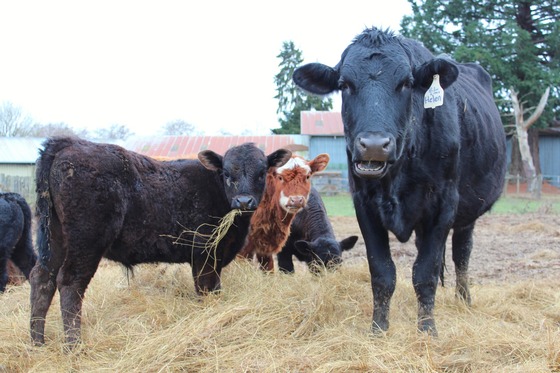 Mama Helen watches over three calves in the heavy use area. The herd will stay in the high and dry heavy use area until the other pastures are drier and the grass is longer.
It's one of our favorite times of year: winter calving season! Here's Mama Helen with some of the newest members of our Natural Resource Technician Leanne's family’s herd. These calves were born over the last few weeks and are enjoying life in the heavy use area.
The heavy use area, or sacrifice area, is a piece of land where the herd is kept during the wet season. They'll be here, on the highest, driest part of the property, until the other pastures are dry and the grass is 6 to 8 inches tall. If these babies and their mothers were turned out to pasture sooner, they could damage the grass roots, stunt growth and make more room for weeds to grow, meaning less forage come spring and summer. Once the herd is turned out to pasture, the heavy use area will be reseeded.
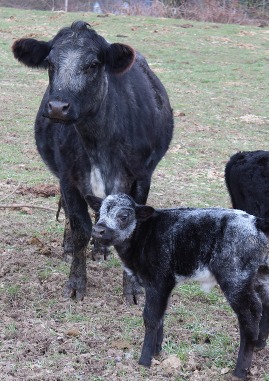
During the dry season, Leanne’s family uses a technique called rotational grazing, where the herd can graze just one section of pasture at a time. Once the grass in that section is eaten down to about 3 inches, they move the cows on to the next section. This protects the grasses energy source, so it continues to grow back faster and healthier.
Not sure when to let the cows out? Take a look at our Farm Tip section below for more information on when your grass will be ready for animals! You can also check out Skagit Conservation District's Farming Resources page to learn more about rotational grazing and other pasture care practices.
|
|
|
|
Though early spring bloomers like oso berries, cherry blossoms and daffodils have started to unfold, we haven't left winter yet! A couple of large storms rolled in at the end of the month, bringing rain and even some snow. Total precipitation in February was slightly higher than usual with 3.18” of rainfall compared to a historical average of 2.82.” The max average temperature at the Mount Vernon AgWeatherNet station was 49.3°F, which is about the usual for this time of year.
We generally found low bacteria concentrations throughout February. Our repeat hotspots at the Edison Drainages and Slough even had fairly low counts! Cool temperatures and a lack of the large storms, like the conditions we saw at the beginning of the month, are often good for water quality. The highest bacteria levels this month were found at Mid-Thomas Creek. Moderately high bacteria concentrations were found at Sullivan Slough, Lower Hansen Creek and Big Ditch.
The two storms at the end of February were large enough to cause shellfish harvest closures in Samish Bay. The Samish River flow increasing over 400 cubic feet per second (CFS) in under 24 hours triggers harvest closures in November and February. We confirmed one closure with high bacteria levels in the river and once the river water cleaned up, harvest reopened.
If you’re interested in how water quality is doing in your neighborhood, head on over to our Water Quality Map! We upload our sample results regularly throughout the month!
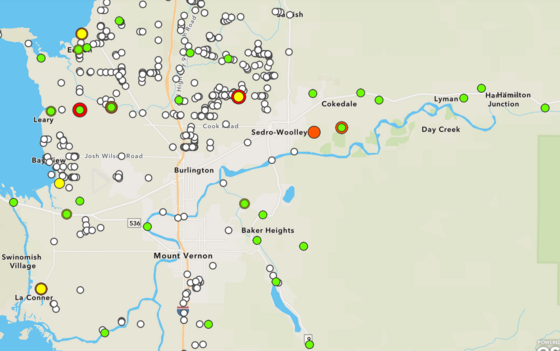 February's water quality results. Red dots represent sites with high levels of fecal bacteria, yellow represents sites with moderate levels of fecal bacteira and green dots represent sites with low fecal bacteria levels. Click on the map to go to the online water quality map, where you can explore sites in Skagit, Whatcom and Snohomish Counties.
|
|
Home Tip of the Month
Doing some spring cleaning in your shed, garage or supply closet? If you see any materials with labels that say "Danger," "Warning" or "Caution," bring them to our Household Hazardous Waste Facility for FREE disposal!
Materials with these warning labels are hazardous waste. Pest and plant killers, paint thinners, car and battery fluids and some cleaning products are hazardous waste. They contain chemicals that could be dangerous. When these materials are put in the regular trash, they are at risk of leaking out into the environment, where they can poison and even kill people, pets and wildlife.
To help you deal with these dangerous chemicals properly, Skagit County has the Household Hazardous Waste Facility where we dispose of your hazardous waste for free!
The Household Hazardous Waste Facility can take up to 25 gallons of your home's hazardous waste each month. Click here for more information on the facility and to see a full list of materials we accept. Make sure to keep all of your materials separate and clearly labeled when you bring them.
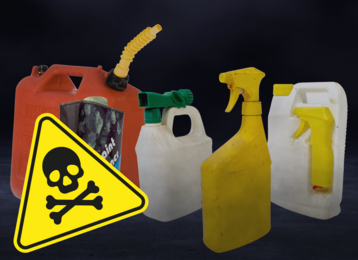
If you have hazardous materials you're still using, make sure they are properly contained. All containers should be labeled and leak-free with a tightly closing lid. Keep all chemicals out of reach of children and animals. Even everyday household cleaning products can contain chemicals that will kill people and pets if ingested.
Don't want to worry about hazardous waste? Here are some tips for reducing the chemicals in your home:
-
Research alternatives: See if you can use a non-toxic or less toxic product to solve your problem. There are often low- or no-chemical alternatives to common hazardous products. For example, natural cleaners using things like vinegar or baking soda can often replace chemical-heavy cleaning products.
-
Buy less: If a hazardous product is the only option for your project, buy only what you will use up in a reasonable amount of time. If you have leftovers you can't use, share them with neighbors and friends.
-
Avoid aerosols: Aerosol is used in many spray cans to propel the product out. The aerosol often runs out before the product, leaving leftover hazardous waste in the can. Cans with any hazardous waste in them need to be brought to the hazardous waste facility.
|
|
|
Farm Tip of the Month
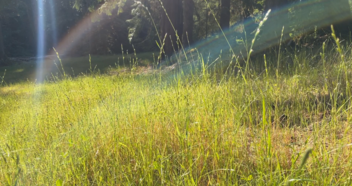
As spring creeps in, your pasture grasses might be looking a little longer, but you'll still have to hold your horses— and your cows!
Grasses should be at least 6 to 8 inches tall before animals are turned out to graze. This is because grass stores its energy in the bottom three inches of the stalk. If this lower three inches is eaten, the grass's growth will be stunted. In short, grazing too early will mean less grass for the rest of the year.
How can you tell when it's time to graze? Once the grass is tall enough (6 to 8 inches) you can do a "pull test" by tugging the grass until it breaks or pulls up from the roots. If the grass pulls up by the roots, it is NOT ready to be grazed on. If it breaks and leaves its bottom portion behind, you can turn your animals out to pasture.
Keeping your pastures healthy can discourage weeds that could be toxic to livestock. Grazing taller grasses can help keep your animals healthy, too, because it keeps them farther from the dirt where they could be exposed to parasites and bacteria. Strong root systems can also help animals in the surrounding environment by reducing erosion and improving water quality.
For more tips and information like this, check out Skagit Conservation District's Farming Resources Page to access resources like their monthly farm planner.
|
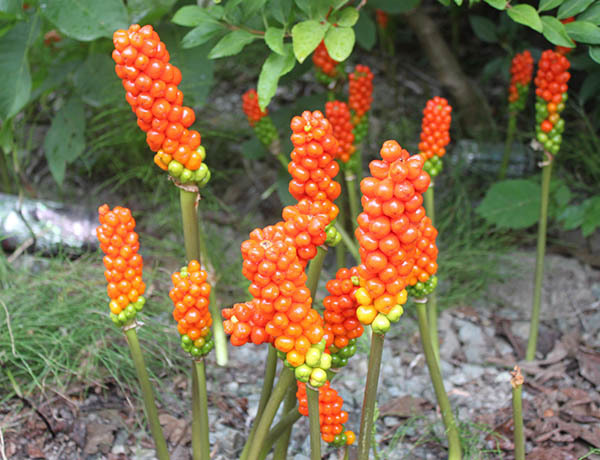
Have you ever invited someone over and they JUST. WOULDN'T. LEAVE? Yeah, that's Italian arum, also known as Italian lords and ladies, Italian lily or cuckoo’s pint. All noxious weeds are tricky to get rid of, but Italian arum takes this to a new level. Between its tendency to stick around where it's not wanted, its toxic nature (it's poisonous to humans, pets and livestock) and its gaudy appearance, this once liked ornamental has fallen out of favor.
Here's what you need to know about identifying and controlling this pesky plant:
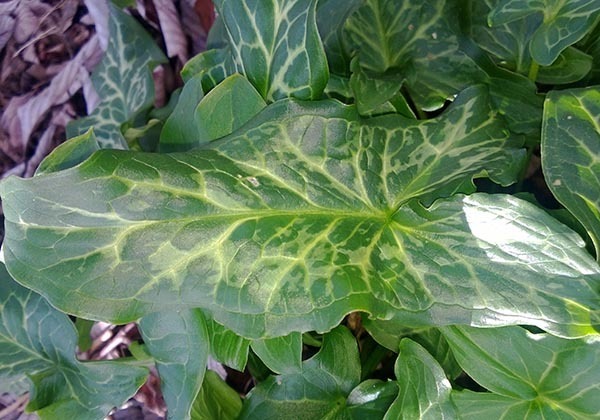
Description: Italian arum is pretty recognizable all around. Its arrow-shaped leaves grow close to the ground and are dark green with distinctly lighter veins. They grow to around the size of a hand. Leaves are visible this time of year, so if you see them in your yard, now is the time to act!
Its flower looks like a pale green calla lily flower— one large, pointed petal worn like a shawl and hood around a long yellow nub that produces pollen.
After flowering, Italian arum produces bright red, tightly clustered berries at the end of its stems. Younger berries at the bottom of the cluster will sometimes remain green.
Toxicity: Italian arum is toxic to humans, pets and livestock and, in severe cases, can kill. This is especially true for cats— all lilies are extremely poisonous to cats, and even ingesting a few grains of pollen can lead to kidney failure and death.
Control: The first step to controlling Italian arum is to not plant it in the first place! Once you do, it is very difficult to get rid of.
If you already have Italian arum on your property, the best way to control it is to dig it up. It grows and reproduces via tubers, so you'll want to remove as many of those toxic little potatoes as possible. Once you do, pouring boiling water where you dug can help kill off remaining roots. Make sure all stems, roots and berries end up in a plastic bag in the trash, not the compost. Always wear gloves when working with Italian arum, as its sap can irritate skin.
Learn more about how to identify and control Italian arum from the Washington State Noxious Weed Control Board. Need help creating a plan to control this weed? Reach out to Madelyn, our Noxious Weed Coordinator, at mloy@co.skagit.wa.us.
Photos courtesy of Washington State Noxious Weed Control Board.
|
|
|

Program News
Welcome, Kat!
We are thrilled to introduce our new intern, Kat! Kat is an Environmental Conservation student at Skagit Valley College. She is excited about site visits, water quality testing, working with the public, and all the learning opportunities here at Skagit County Natural Resources. Kat will be helping at some of our outreach events, so come say hi!
2024 Stormwater Management Plan Draft
The 2024 Stormwater Management Plan Draft will be posted for comment this month! Keep an eye on our stormwater page or follow us on Instagram and Facebook— We'll be posting about it there when it goes up!
|
Classes and Events
It's plant pick up time, March 10, 9AM to 1PM, Plant Materials Center, Bow: It's time to pick up the native plants you ordered from Skagit Conservation District's Annual Plant Sale! Head over to the Plant Materials Center in Bow on the 10th to get them. Haven't ordered yet? You're in luck! They still have stock of a few beautiful plants! Learn more here.
Raptor walk on Samish Island, March 10, 8AM to 10AM: Join Skagit Land Trust as they observe predatory birds at the Samish Island Conservation Area! Learn more and register here.
Forest Landowner Assistance Programs Webinar, March 13, 12PM to 1PM: Got forest on your land? Learn about cost-share programs at this 1-hour virtual information session. Learn more here.
SICBA Home and Garden Show, March 22-24: Get the best for your home, yard and garden at the Skagit and Island Counties Builders Association Home and Garden Show. There's lots of learning to be done at this annual event. Come by our table and say hi! Learn more here!
Rainwater harvesting, enhancing your outdoor spaces, gardening for wildlife, and more! Check out Skagit Conservation District's Backyard Conservation Workshops in April and May! Learn more and RSVP here.
Mount Vernon High School Science Night, April 18, 5PM to 8PM: Come for the science, stay for the FUN! Check out student science and how science is used around the community. Plus, stop by to see us with our erosion display! Learn more here.
Get the WSU Plant Fair on your calendar, May 11, 8AM to 2PM: Pick from a variety of beautiful plants (including native options) for your garden or yard. We'll be there, too! Come say hello! Learn more here.
Salmon, soaring birds and signs of spring: Check out Padilla Bay National Estuarine Research Reserve's list of events for this season here!
Volunteer Opportunities
Salmon in the Classroom training, February 13, 10AM to 3PM: Take Skagit Fisheries Enhancement Group's Education Volunteer Spring Training to learn how to help with Salmon in the Classroom field trips. Learn more and register here!
Plant and pot with Skagit Fisheries Enhancement Group: Help our friends at Skagit Fisheries Enhancement Group plant and pot native plants that will help create habitat. See their volunteer event calendar here.
Volunteer with Skagit Land Trust: Help our friends at Skagit Land Trust restore our environment through plantings and invasive species removal! See their volunteer event calendar here.
|
|
Contact Us
For questions or more details, please contact Karen DuBose at kdubose@co.skagit.wa.us or 360-416-1460.
This project has been funded wholly or in part by the United States Environmental Protection Agency under assistance agreement PC01J18001-0 to the Washington Department of Health. The contents of this document do not necessarily reflect the views and policies of the Environmental Protection Agency, nor does mention of trade names or commercial products constitute endorsement or recommendation for use.
|
|
|
|
|