|
Photo of the Month
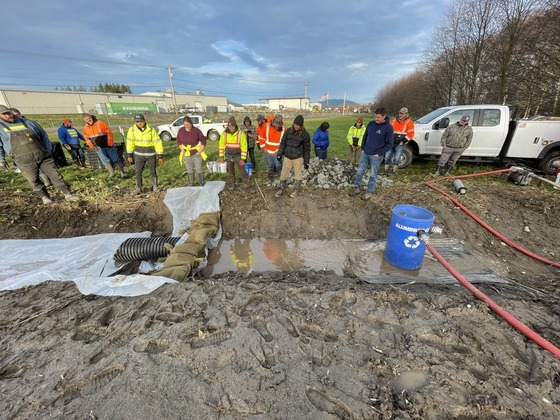 This winter, Skagit County Public Works employees took a hands on training session to learn how to keep our water clean during work projects.
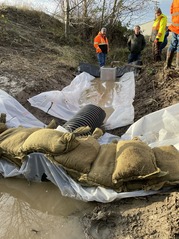
This winter, Skagit County Public Works employees got their hands dirty to learn how to keep water clean. Our group took a sediment and erosion control class that went over ways to stop pollution from leaving project sites.
Projects like road work, ditch maintenance, construction and grading often disturb and loosen soils. These loose soils get picked up by wind, rain and vehicle tires and carried off the work site. They often end up in our streams, rivers and lakes.
This soil disturbing work needs to be done— but it doesn't need to pollute our water.
At our training, the team learned some easy and effective ways to keep polluted water from leaving work sites. Some methods redirected water around the site so it didn't pick up sediment in the first place. Others slowed the water down, allowing particles to settle to the bottom and clean water to flow on, as in the photos above. These methods often used piled rocks and other damming materials to slow the water.
Another erosion prevention method you may have seen before is the use of special fabrics to cover exposed hillsides. These coverings protect the slopes from rain, stopping the loose dirt from washing away.
Sediment and erosion control are required at construction and work sites. Keeping sediment out of waterways protects our water for us and for wildlife.
If you see a construction site or other project that is creating a pollution problem (i.e. you can see dirty water leaving the site, or there is sediment spilling out onto the road), let Washington Department of Ecology know and send them a couple of photos of the issue.
|
|
|
|
January’s weather was a quite a rollercoaster! We had below-freezing temperatures and snow one week and warm, spring-like weather the next. The max average temperature in January at the Mount Vernon AgWeatherNet station was on the cooler side with an average of 45.4°F, about 2°F lower than the historical average. Total precipitation in January was 4.60”, a bit higher than the historical average of 3.91”.
We had one storm pass through that was large enough to cause a closure in the Samish Bay shellfish beds on the 28th when the Samish River flow increased over 400 cubic feet per second (CFS) in under 24 hours. High levels of bacteria in the river confirmed the closure, but harvest resumed once those bacteria levels went back down.
During freezing temperatures, we often see low bacteria levels in our waters due to things like bacteria die-off, reduced recreational and agricultural activities and farm animals taken off pastures. Low bacteria levels during cold temperatures aren’t always the case though. Maddox Creek/Big Ditch showed an increase in bacteria levels during our cold snap. Other hotspots we observed this month were in Lower Thomas Creek, Edison Slough, the North and South Edison Drainages and Joe Leary Slough. We, along with other agencies, are conducting investigations into the sources of pollution in these areas.
Interested in more details on our sample results? Check out our Water Quality Map!
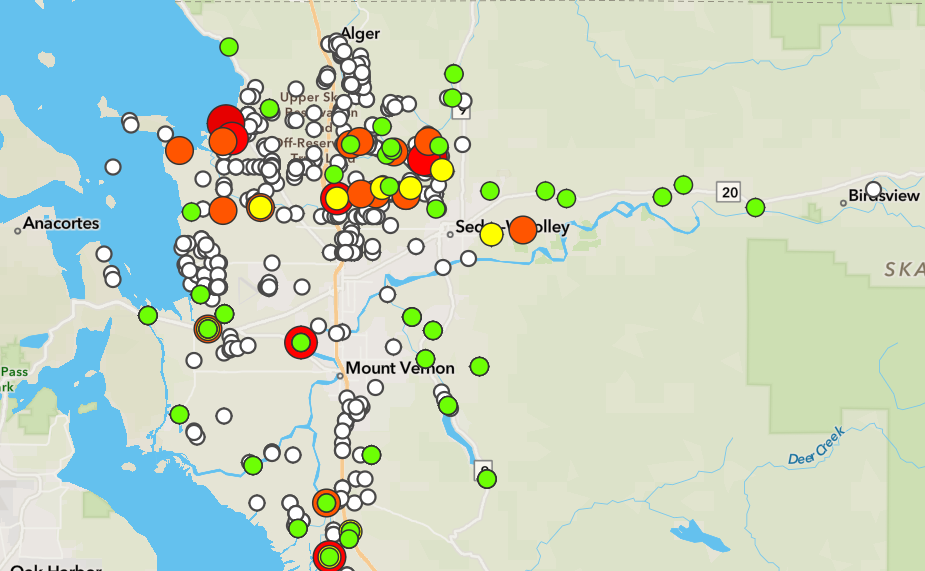 January's water quality results. Red dots represent sites with high levels of fecal bacteria, yellow represents sites with moderate levels of fecal bacteira and green dots represent sites with low fecal bacteria levels. Click on the map to go to the online water quality map, where you can explore sites in Skagit, Whatcom and Snohomish Counties.
|
|
Home Tip of the Month
This spring, take your gardening game up a notch by planning for more than just good looks. From landscaping legends to blooming beginners, gardeners across Washington are gardening using native plants. The result? Beautiful yards and gardens that are also easy to maintain, attract pollinators and wildlife and protect the surrounding environment.
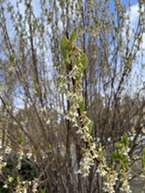
1. Find what fits.
A major benefit of native plants is that they are adapted to our local climate. However, every plant still has its preferences. Take a close look at your yard. Where is there shade or sun? Where is the ground drier or damper? Keep these things in mind as you plan your perfect garden.
Tip: Check out Skagit Conservation District's Native Plant Page to learn more about what conditions certain plants will do best in!
2. Take advantage of local plant sales.
Tis the season for plant sales! There are several ongoing plant sales in the area where you'll be able to find native plants to fill your garden. Check out the Skagit Conservation District Annual Plant Sale for good prices on lovely native plants. The SICBA Home and Garden Show (March 22nd - 24th) and the WSU Master Gardeners Plant Fair (May 11th) are also great opportunities to check out some beautiful native plants.
3. Know what NOT to grow.
Some common garden plants have a dirty secret— They are actually invasive weeds! As you're getting new plants, check the Washington State Noxious Weed Control Board website to check if they are noxious weeds before buying them.
If you love how your garden looks but learn that some of your plants are noxious weeds, you can browse for similar looking alternatives with the Noxious Weed Control Board's Garden Wise plant lists.
|
|
|
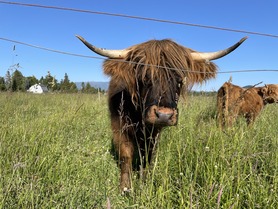
Got restless animals but still have wet spots in your pastures? Consider putting up some temporary fencing!
Temporary fencing is a good solution to the common spring problem of uneven pasture growth and saturation.
Fencing animals away from wet patches will have some major benefits for you and your pasture, including...
Less mud- It's common knowledge: Wet ground + heavy animals = MUD! But subtract your saturated areas from the equation and you could see a mud-free spring!
Less weeds- Some less common knowledge is that seeds that are stored in the ground can get brought up to the surface when animals stir up mud. These seeds often give way to harmful weeds that can make your animals sick and push good forage out.
More grass! Your pasture grass needs it's bottom 4 inches of leaves to store energy so it can grow in spring. Animals trampling grass in this delicate stage can seriously stunt growth, reducing your forage come spring and summer. Weaker, sparser grass also leaves space for more harmful weeds.
Set your pastures up for spring success by protecting them from damage now!
Extra: Are you an agricultural producer impacted by climate change? WSDA wants to hear from you! Take their survey here.
|
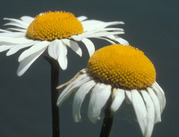
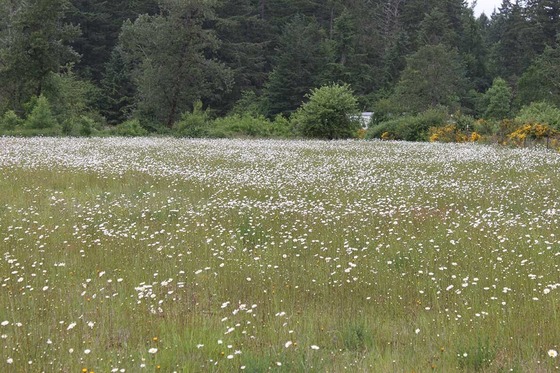
Valentine's Day is coming up, but make sure you're not giving any of these daisies to your darling! Oxeye daisies may look innocent, but they are invaders of crop fields and pastures. The plant spreads so aggressively that it is illegal to buy or sell in Washington. But don't worry, it didn't belong in that Valentine's bouquet, anyway— it's known for its not-so-flowery smell.
Description: This flower can be difficult to tell apart from other daisies, but if you see patches of large daisies growing along roadsides or encroaching on fields, they're probably oxeyes. Its green stems grow 1 to 3 feet tall and end in the distinct daisy flower— narrow white petals with a round, bright yellow center.
The leaves are narrow and green with widely spaced teeth. They get smaller closer to the top of the plant and grow opposite each other on the stem. The rosettes (young plants) are tighter clumps of leaves that grow close to the ground.
Toxicity: Oxeye daisies are not poisonous but can cause vomiting and mouth irritation in cats and dogs. The pollen from these plants is also a potential allergen. Ahhh-CHOO!
Control: Young plants can be hoed or pulled by hand, but older plants and larger infestations might require repeated pulling over several years. Replant the places where you've removed oxeye daisy with native plants or good forage. Always remove flower heads before they go to seed so the plant can't spread.
Learn more about how to identify and control oxeye daisy from the Washington State Noxious Weed Control Board. Need help identifying this weed? Reach out to Madelyn, our Noxious Weed Coordinator, at mloy@co.skagit.wa.us.
Extra: National Invasive Species Week is coming up at the end of February! The week of February 21st to March 1st aims to educate the public on invasive species that harm us and our ecosystem. Learn more at www.nisaw.org.
Photos courtesy of Washington State Noxious Weed Control Board.
|
|
|
Classes and Events
The time has come to order your native plants! Skagit Conservation District's Annual Plant Sale is OPEN. Pre-orders on a huge array of native plants have begun. Learn more here.
Raptor walk on Samish Island, March 10, 8AM to 10AM: Join Skagit Land Trust as they observe predatory birds at the Samish Island Conservation Area! Learn more and register here.
SICBA Home and Garden Show, March 22-24: Get the best for your home, yard and garden at the Skagit and Island Counties Builders Association Home and Garden Show. There's lots of learning to be done at this annual event. Come by our table and say hi! Learn more here!
Get the WSU Plant Fair on your calendar, May 11, 8AM to 2PM: Pick from a variety of beautiful plants (including native options) for your garden or yard. We'll be there, too! Come say hello! Learn more here.
Salmon, soaring birds and signs of spring: Check out Padilla Bay National Estuarine Research Reserve's list of events for this season here!
Volunteer Opportunities
Salmon in the Classroom training, February 13, 10AM to 3PM: Take Skagit Fisheries Enhancement Group's Education Volunteer Spring Training to learn how to help with Salmon in the Classroom field trips. Learn more and register here!
Plant and pot with Skagit Fisheries Enhancement Group: Help our friends at Skagit Fisheries Enhancement Group plant and pot native plants that will help create habitat. See their volunteer event calendar here.
Volunteer with Skagit Land Trust: Help our friends at Skagit Land Trust restore our environment through plantings and invasive species removal! See their volunteer event calendar here.
|
|
Contact Us
For questions or more details, please contact Karen DuBose at kdubose@co.skagit.wa.us or 360-416-1460.
This project has been funded wholly or in part by the United States Environmental Protection Agency under assistance agreement PC01J18001-0 to the Washington Department of Health. The contents of this document do not necessarily reflect the views and policies of the Environmental Protection Agency, nor does mention of trade names or commercial products constitute endorsement or recommendation for use.
|
|
|
|
|