|
Photo of the Month

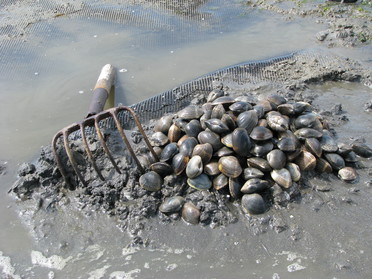
Curious about local agricultural organizations and the work that they do? You can learn all about it in the 2020 Agricultural Yearbook! From crops to drainage to supporting farmers, you can learn all about the many organizations that support farming in Skagit County. You can even learn how the pandemic affected agriculture last year.
Find it all at: https://issuu.com/skagitpublishing/docs/skagitcountyagyearbook_pf_4c82a8f934733c
|
|
|
|
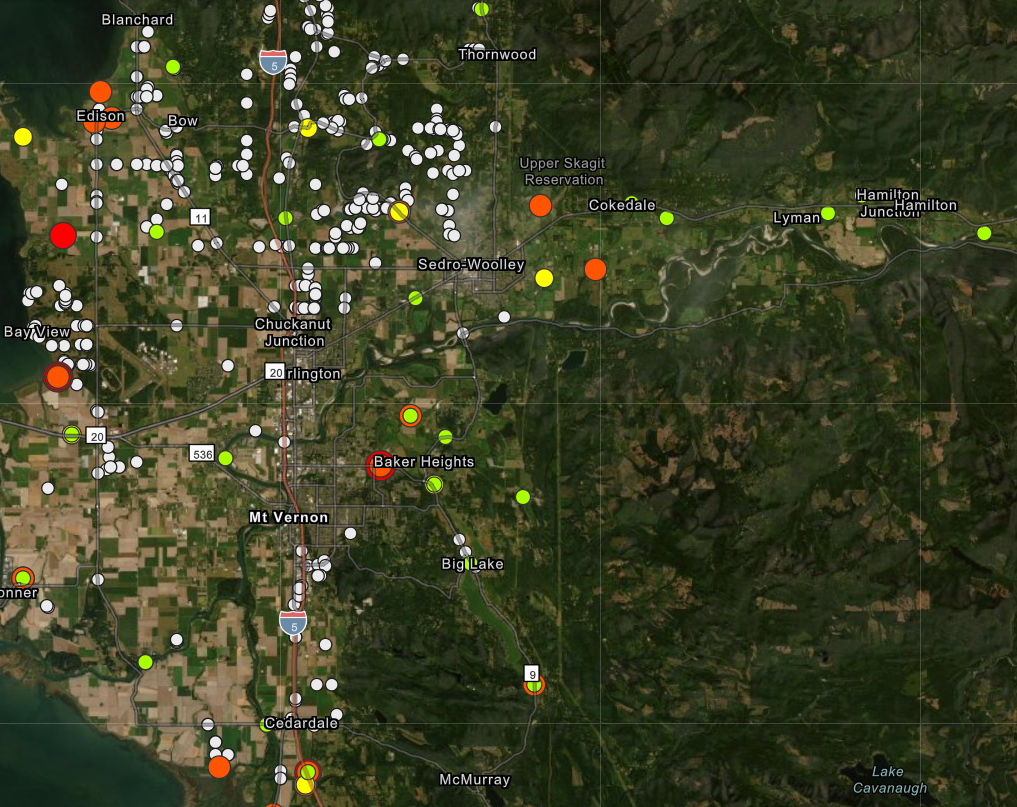
Warm temperatures have arrived, bringing higher levels of bacteria at some of our regular sampling sites. Many of our slow-moving sloughs had higher levels of fecal coliform in May, including the Edison area, No Name Slough, and Joe Leary Slough. We're not sure why. It could be that higher temperatures and nutrient levels cause bacteria to reproduce, or perhaps there are pollution sources we don't know about. We're hoping to start answering that question with the help of microbial source tracking (often called "DNA testing") that we'll be doing all summer long in the Edison area.
Areas that still have low levels of bacteria include most of the Samish watershed (except for the lower Edison area), the middle Skagit River tributaries, most of the Nookachamps watershed, and the Skagit River itself.
As you may recall, it's been a pretty dry spring. That means that some of our creeks may dry up earlier than usual. One creek in particular has stood out over the past three years - Brickyard Creek, which flows into Hart Slough. During the majority of our 17+ years of sampling, Brickyard Creek usually dries up in July or August. Since 2019, though, it has dried up in May. It will be interesting to see if this trend stays for good, or if it's just temporary. We'll keep an eye on it!
You can always access all of our fecal coliform data on the online water quality map at https://arcg.is/1iiifS. All of our partners submit data to this map, so you can see (and even download) fecal coliform results from WSDA, Ecology, Whatcom County, Snohomish County, Skagit County, and more! If you're interested in a deep dive of all of Skagit County's ambient water quality monitoring data, you can find all our annual reports at https://www.skagitcounty.net/Departments/PublicWorksSurfaceWaterManagement/WQ.htm.
|
|
Tip of the month to Protect Life and Home

Did you know you can empty your RV's sewage tank for FREE at several different sites around Skagit County? It's all part of our effort to make sure that sewage stays out of our creeks and beaches, and our community stays healthy and safe.
You can find all locations in the county here: http://bit.ly/RVDumpStations. Locations throughout the US, Canada, and Australia(!) are available at http://sanidumps.com/.
If your RV doesn't move, you have a couple of options. The easiest is to pump your RV sewage into the septic system or municipal sewage system.
If you're going the septic route, be sure to contact a septic system maintenance provider to make sure the septic system can handle the extra flow, and get tips on how to do it without damaging your system. You may have to pump the septic system more frequently if you're adding RV sewage to it. (Septic system inspections are required by state law every year, or, if you have a gravity-fed septic system, every three years. Pumping a septic system is NOT the same as an inspection.)
If you're pumping into the municipal sewer system, be sure to contact your sewage treatment provider (typically your city) to make sure you don't accidentally cause a problem with your home's sewer pipes.
It is NEVER ok to dump sewage into a storm drain, roadside ditch, creek, "the back 40," or anywhere on the ground surface. None of these are treated in any way, and sewage dumped in these places is a threat to the health of our children, pets, and community.
|
|
|
Farm Tip of the Month: Mow Your Pastures
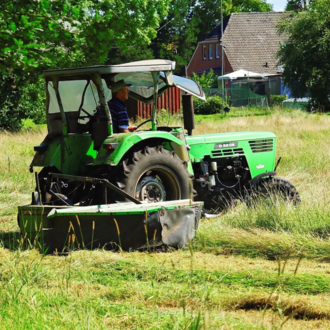
A critical step in good pasture management is mowing your pastures after rotating your animals off of them. Why? For one, it prevents the weeds that your animals didn't eat from going to seed. Nobody needs more weed seeds in their pastures!
Mowing also makes sure that all the plants in your pastures are the same height. Your animals like some species more than others, and they eat those favorites down lower than the rest. Mowing brings everything to the same height so that those delicious favorites aren't shaded out by the taller, less tasty plants as the pasture recovers.
Last but not least, mowing encourages pasture grasses to produce more leaves and fewer stalks. Your animals don't want to eat tough stalks, and the leaves hold a lot more nutrition than stalks. Plants with lots of leaves are better at taking up all the nutrients from manure, too, so there's less risk of those nutrients running off of your pasture and polluting nearby water.
After mowing, let the grass grow. You can let your animals back on when the grass is 6-7 inches high. At that height, the leaf growth is slowing, but the plants haven't begun the process of setting seeds yet. It's the perfect time to get as much nutrition out of the pasture as possible, then you can start the cycle all over again!
Want more tips? Check out the WSU Skagit Extension Pasture Management Program Workshop Archive to listen to recordings of recent Pasture Management 101 workshops: https://extension.wsu.edu/skagit/pasture-management/
You can also sign up for Pasture Management 201 workshops at the Skagit Conservation District website. Topics include off stream watering, what to do during the dry season, soil health, fertilizing and more! Get the schedule here: http://www.skagitcd.org/sites/default/files/publications/WSU_pastureworkshops2021.pdf, and watch the recording of the first workshop all about pasture weed management here: http://skagitcd.org/clinics.
|
|
|

Program & Partner News
Boat owners: download the free Pumpout Nav app! Find the locations of boat sewage pump out stations near you with the FREE Pumpout Nav app for Android or iPhone. Or, find locations on the web at https://pumpoutwashington.org/. Locations are in marine and fresh water areas, all around the state!
Learn about our fish habitat and drainage work: Our surface water and habitat teams recently updated the Board of County Commissioners on the drainage, restoration, culvert blockage, and habitat work that we do. You can check it out on Skagit 21, or on demand at: https://skagit.granicus.com/MediaPlayer.php?view_id=8&clip_id=3630.
Learn about water quality monitoring and the Marine Resources Committee: We'll be presenting an update to the Board of County Commissioners about our Ambient Water Quality Monitoring Program (which is the program that collects most of the water quality information shared in the water quality segment above), as well as the Marine Resources Committee. You can check it out live on Skagit 21 starting at 8:30am on June 8, or catch it later at https://www.skagitcounty.net/TV21.
|
Educational & Volunteer Opportunities
June is Orca Action Month in Puget Sound! Events are happening all over the region. Wherever you happen to find yourself in the Puget Sound region, there's probably an event happening nearby! Learn more at https://www.orcamonth.com/.
Beach cleanups and work parties: Skagit Land Trust has a variety of beach cleanups, work parties, and nature walks scheduled throughout June. Take a peek at their events page and email their event coordinator for more details: https://www.skagitlandtrust.org/events.aspx
The Letterbox Trail is open: It's the adventure of geocaching with a little education mixed in! The Skagit Watershed Letterbox Trail is open for the summer, and all you need is the passport (available on the website), a pencil, and a sense of adventure. You can visit Pomona Grange Park, the Padilla Upland Trail, or Cumberland Creek. Check it out and have an adventure! https://skagitcleanwater.org/events/
Pasture Management Workshops: The Skagit Conservation District is sharing a ton of great information for farm animal owners in their Pasture Management 201 Workshop Series, which runs all summer long. Check out the schedule here. You can watch the recording of the June workshop all about pasture weeds here: http://skagitcd.org/clinics.
Orca Observation and Photography Showcase: Join Skagit Fisheries Enhancement Group for the June installment of their Spring Speaker Series on June 10 from 6-7:30pm: http://www.skagitfisheries.org/event/spring-speaker-series/
Fire resistant plants for wildfire protection: Did you know that juniper and arborvitae are extremely flammable plants? Many of us have them around our homes. Learn more about what you can do to protect your home from wildfire, and what plants are better choices. https://www.firefree.org/wp-content/uploads/2016/02/Fire-Resistant-Plants.pdf?fbclid=IwAR2ROotVqEBI4UUV5wYVl3cE1euEMPV8ekL1STbHUgCF7EPe9mcEccKi7zo
|
|
Contact Us
For questions or more details, please contact Karen DuBose at kdubose@co.skagit.wa.us or 360-416-1460.
This project has been funded wholly or in part by the United States Environmental Protection Agency under assistance agreement PC01J18001-0 to the Washington Department of Health. The contents of this document do not necessarily reflect the views and policies of the Environmental Protection Agency, nor does mention of trade names or commercial products constitute endorsement or recommendation for use.
|
|
|
|
|